Home/GST Contact Search Guides/Business Phone by GST Number: How to Read and Check the Number You Get
Business Phone by GST Number: How to Read and Check the Number You Get
Business phone by GST number, decoded: tell landlines from mobiles, read STD codes, spot 1800 and 1860 lines, handle extensions and sanity-check each number.
GST Identification Number
27ABCDE1234F1Z0
- Legal nameSample Traders Pvt Ltd
- StateMaharashtra (27)
- RegistrationActive
- Phone+91 98XXX XXXXX
- Emailc****@example.com
Illustrative result. Request a sample format for live records.
Reading time 7 min
Last reviewed October 2026
Business phone by GST number searches usually end with a number on a screen, and that is where a surprising number of mistakes begin. A number copied with a missing digit, a landline stored without its city code, a service line that charges the caller, or an extension written as part of the main number can all make a correct result look wrong. Knowing how Indian business phone numbers are built lets you check any number in seconds and store it in a way that works every time.
This guide explains how to read the phone number you get for a business: how landlines and mobiles differ, what the city code tells you, how special service numbers work, how to handle extensions and board lines, and how to cross-check the number against the GST record it came with.
Quick answer
- Indian numbers have ten digits after the country code, for landlines and mobiles alike.
- Landlines start with a city code; mobiles start with 6, 7, 8 or 9.
- The city code of a landline should fit the address in the GST record.
- 1800 and 1860 numbers are service lines, not direct business lines.
- Store extensions in a separate field, never glued onto the main number.
The Ten-Digit Rule
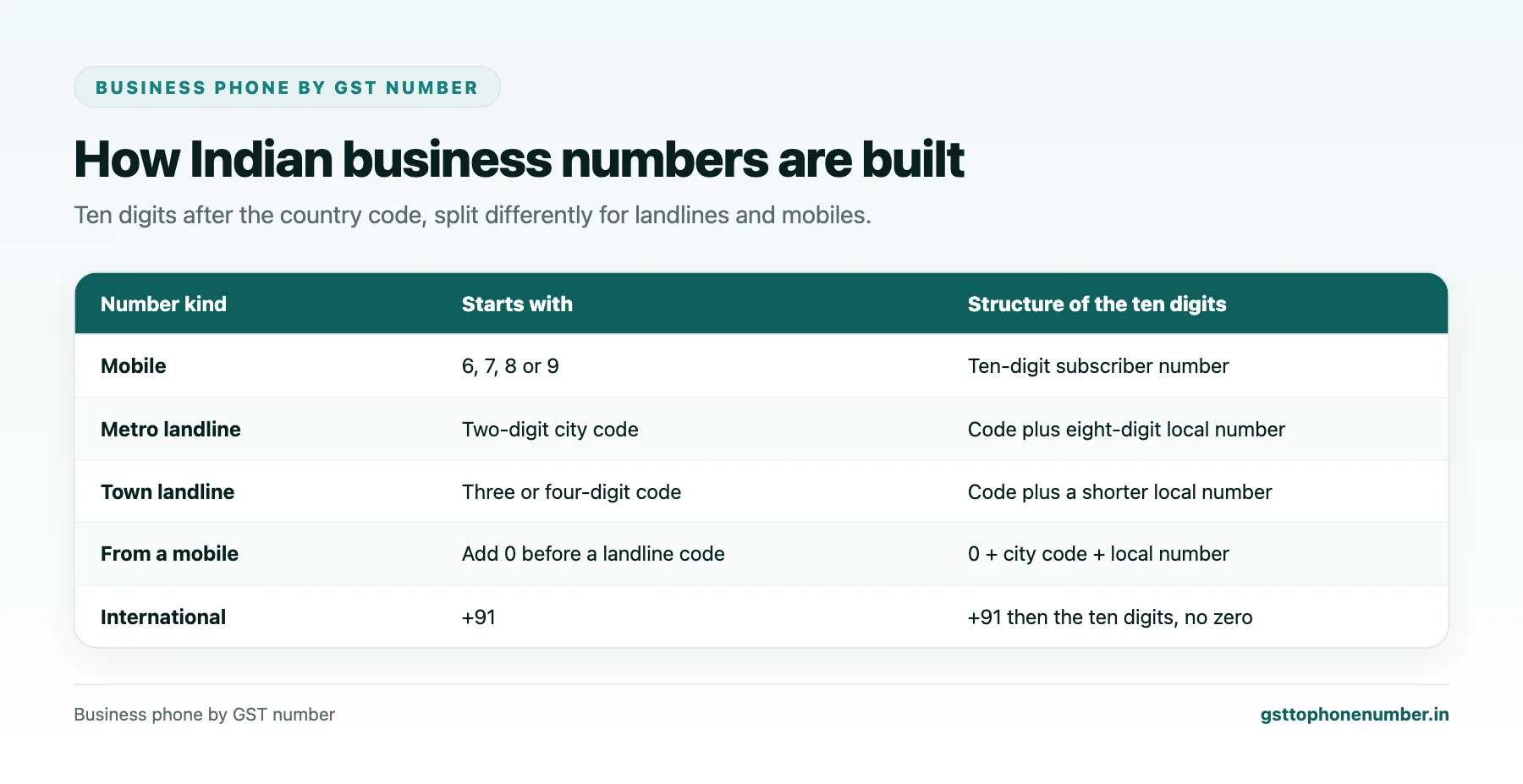
Every Indian phone number, landline or mobile, has ten digits after the country code 91. For mobiles that is obvious, because the ten digits are what people give out. For landlines it is less obvious, because the ten digits are split between a city code, also called the STD code, and a local subscriber number. A big city has a short code and a long local number; a small town has a longer code and a shorter local number. Either way the two parts add up to ten.
That gives you a simple first check. Remove the country code, any leading zero, spaces, brackets and hyphens. If what remains is not exactly ten digits, the number is incomplete or has an extra digit, and it should not be stored until it is fixed.
Landline or Mobile?
After the cleaning step, the first digit tells you the kind of number. Indian mobile numbers begin with 6, 7, 8 or 9. Landline numbers begin with the city code, and city codes begin with a digit from 1 to 8. Because city codes in parts of eastern, central and southern India also begin with 6, 7 or 8, the first digit alone cannot settle every case. For example 80 is the code for Bengaluru, yet many mobile numbers also begin with 8, so the full code has to be read in context.
When a number is hard to classify, compare it with the business’s address. A ten-digit number that starts with the code of the city in the GST address is very likely the office landline. If the city does not match, treat it as a mobile or as a number that needs checking.
What the City Code Tells You
City codes are assigned to geographic areas. The large metros have two-digit codes: 11 for Delhi, 22 for Mumbai, 33 for Kolkata, 44 for Chennai, 80 for Bengaluru and 40 for Hyderabad, among others. Other cities and towns have three- or four-digit codes. When you dial from a mobile, you add a 0 before the code; in international format you write +91 followed by the code without the zero.
For a GST-based lookup, the city code is a built-in consistency check against the principal place of business in the registration. A business registered in Pune with a landline beginning 20 fits. The same business with a landline beginning 44 suggests the number belongs to a Chennai branch, a sales agent or a different business altogether, and it is worth a question on the first call.
Need the contact behind a GSTIN?Get the sample format with verified business contact fields.
Board Lines, Hunting Lines and Extensions
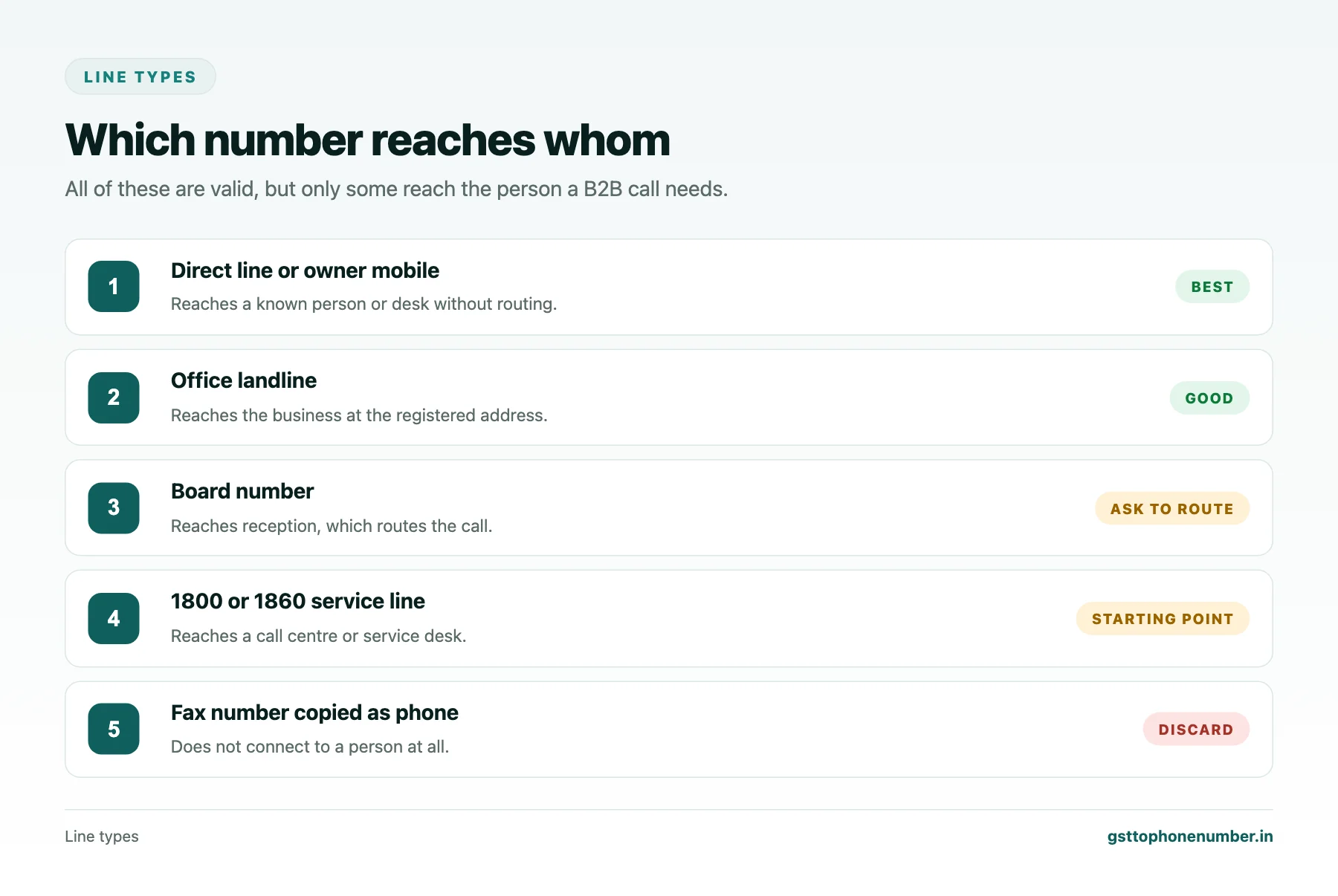
Larger businesses often publish a single board number that rings at reception or an automated menu, from which calls are transferred to departments. Some use hunting lines, where several numbers ring in turn so that a caller rarely gets an engaged tone. Direct lines bypass reception and reach a desk.
Extensions are the internal numbers used after the board line answers. They are often written after the main number with an x, a slash or the word extension. Store the extension in its own field. If it is glued onto the main number, the stored number has more than ten digits and fails every check, and diallers cannot use it.
Special Service Numbers
Some businesses publish service numbers instead of ordinary landlines. Numbers beginning with 1800 are typically charged to the business rather than the caller and are used for customer service. Numbers beginning with 1860 are usually charged to the caller at a set rate. Both are routed to call centres or service desks, not to the owner or the purchase department.
These numbers are perfectly valid, but they are rarely the right contact for business-to-business work. If a lookup returns only a service line for a company you need to reach for a commercial or accounting matter, treat it as a starting point and ask for the relevant department’s direct number.
Cross-Checking the Number Against the GST Record
The GST record gives you a legal name, a trade name and an address. Use all three when you check a phone number. The city code should match the address for landlines. The name that answers the call should match the trade name or legal name. For proprietorships, the owner’s name in the legal name field is a good test: asking for that person by name quickly confirms whether you have reached the right business.
If the GST record lists additional places of business, a landline in one of those cities may also be correct. Note which place of business the number belongs to, so that calls about deliveries or local invoices go to the right location.
Want to see real match quality?See the sample format for your own GST numbers.
Storing Business Numbers the Right Way
Store each number in international format, with +91 or 91 followed by the ten digits and no spaces. Keep the number type in a separate column: mobile, landline, board line or service line. Keep the extension in its own column. Record the place of business the number belongs to and the date it was last confirmed.
This format works for diallers, customer systems and messaging tools, and it makes duplicates easy to spot. It also means that anyone reading the record later can tell, at a glance, whether a number reaches a person, a desk or a call centre.
Common Mistakes When Copying Numbers
The most frequent mistakes are dropping the city code from a landline, adding an extra 0 after the country code, merging two numbers into one cell, and copying a fax number as if it were a phone number. Older letterheads and invoices often print fax numbers next to phone numbers with very similar formatting, so check the label before you copy.
Spreadsheets add their own errors. Long numbers can be turned into scientific notation, and leading zeros can disappear. Format the phone column as text before pasting, and you avoid both problems.
Have a list of GSTINs?Send a few and we will return matching contact fields.
Related guides
Frequently Asked Questions
How many digits does an Indian business phone number have?
Ten digits after the country code 91, for both landlines and mobiles. Landlines split those ten digits into a city code and a local number.
How do I tell a landline from a mobile?
After cleaning, mobiles start with 6, 7, 8 or 9. Landlines start with a city code, which should match the city in the GST address.
Should the landline city code match the GST address?
Usually yes. A mismatch may mean the number belongs to a branch, an agent or a different business, so confirm it on the first call.
Are 1800 numbers useful for business contact?
They are valid service lines, but they reach call centres rather than owners or departments, so use them as a starting point to ask for a direct number.
How should I store extensions?
In a separate field. An extension glued onto the main number makes it too long to dial and fails format checks.
What is the best storage format for business numbers?
International format with +91 followed by ten digits and no spaces, with separate columns for type, extension, place of business and last confirmed date.
 GST To Phone Number
We help sales, procurement and compliance teams turn a GST registration number into a verified, reachable business contact.
Company
Get Sample Format
Send us a few GSTINs and we will return the matching contact fields so you can judge the data before you buy.
© 2026 GST To Phone Number. All rights reserved.
Disclaimer: GST To Phone Number is an independent data service. We are not affiliated with, endorsed by or connected to the Goods and Services Tax Network, the Central Board of Indirect Taxes and Customs, or any government department. GSTIN verification should always be confirmed against the official GST portal. Contact data is provided for legitimate business use and must be used in line with applicable telecom, privacy and data-protection rules.