Home/GST Contact Search Guides/Extract Business Phone From GSTIN Data: Telling a Business Line From a Personal One
Extract Business Phone From GSTIN Data: Telling a Business Line From a Personal One
Extract business phone from GSTIN data and sort the lines you get: signals that a number serves the business, signals that it is someone’s personal phone.
GST Identification Number
27ABCDE1234F1Z0
- Legal nameSample Traders Pvt Ltd
- StateMaharashtra (27)
- RegistrationActive
- Phone+91 98XXX XXXXX
- Emailc****@example.com
Illustrative result. Get sample format for live records.
Reading time 5 min
Last reviewed October 2026
Extract business phone from GSTIN data and you will usually end up with a mix of numbers: office landlines, shop counters, warehouse phones, owners’ mobiles, accountants’ mobiles and the odd family member’s phone. For many purposes, the difference between a line that serves the business and a phone that belongs to a person matters a great deal. Business lines can be called during working hours about almost anything commercial. Personal phones deserve more restraint, change hands when people move on, and may not reach anyone who can act for the business.
This guide gives you practical signals for sorting the two, explains why the distinction affects how you call, when you call and how long the number stays useful, and shows how to ask politely for a business line when all you have is a personal one.
Quick answer
- A business line stays with the business; a personal phone stays with the person.
- Numbers published by the business itself are usually business lines.
- How the phone is answered is one of the clearest signals.
- Personal phones deserve tighter calling hours and more care with storage.
- When you only have a personal number, ask whether there is a better line for business.
Why the Distinction Matters
A business line belongs to the organisation. If the person who usually answers leaves, the line still reaches the business. It is the right channel for orders, deliveries, invoices and general enquiries, and most businesses expect calls on it throughout working hours.
A personal phone belongs to an individual. It may be the only practical way to reach a small proprietor, but it also rings during family dinners and holidays. When that individual leaves a firm, the number leaves too. Treating personal phones as if they were switchboards leads to irritated contacts and to records that silently stop working.
Signals That a Number Is a Business Line
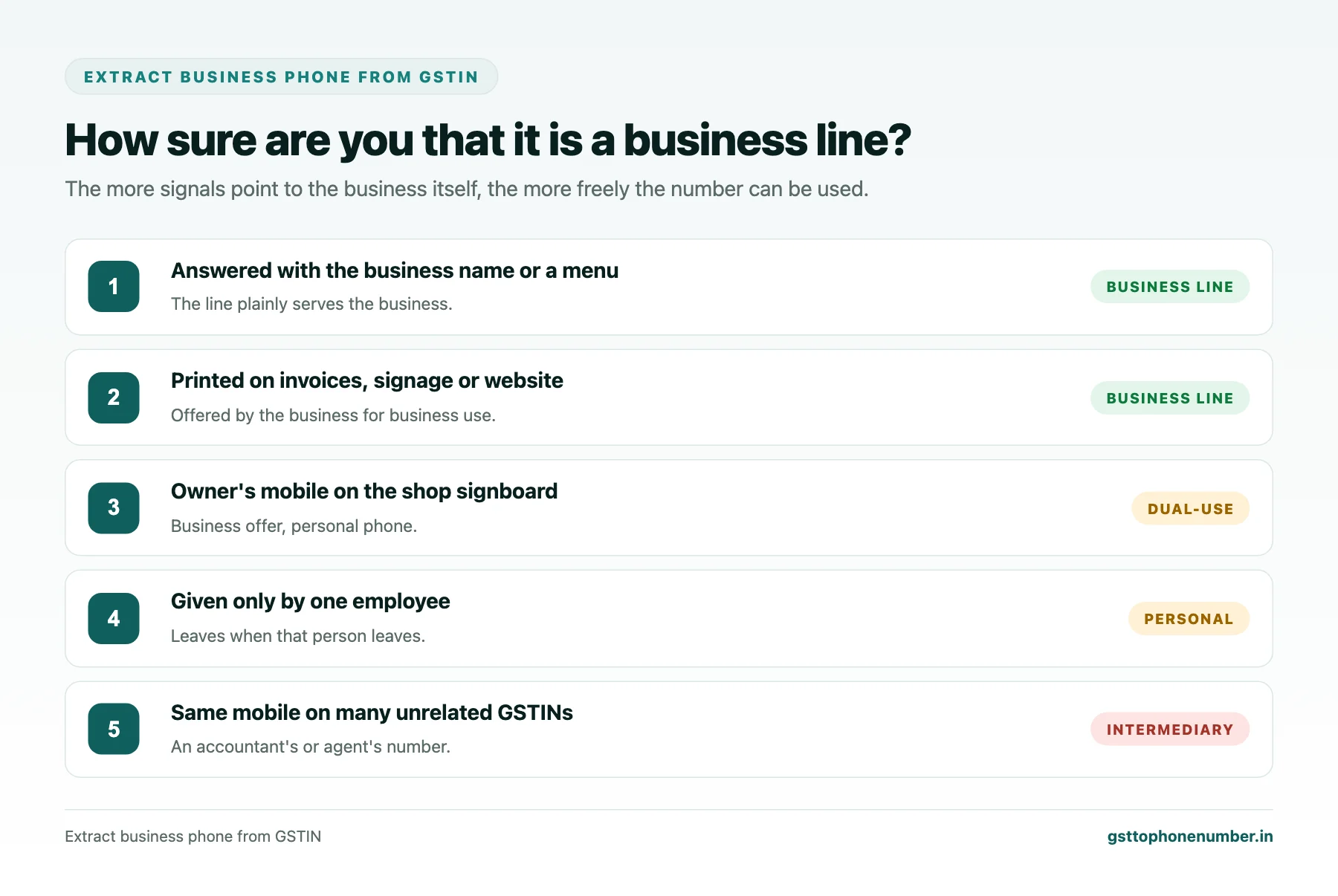
The strongest signal is publication by the business itself. A number printed on invoices, letterheads, packaging, signboards or the business’s own website has been offered for business use. A landline whose city code matches the GST place of business is very likely an office or shop line. A number that is answered with the business’s name, or that leads to a menu or a receptionist, is clearly a business line.
Longevity is another signal. A number that appears on documents across several years, through staff changes, belongs to the business rather than to any one person.
Signals That a Number Is Personal
A mobile answered with a personal greeting, by a family member, or with background sounds that suggest home rather than work is probably personal. So is a number that was given to you by one employee on a visiting card, that appears nowhere on the business’s own documents, or that stops being answered after that employee leaves.
Shared numbers deserve their own label. A mobile that appears against many unrelated GSTINs usually belongs to an accountant or agent. It is a business number for them, but not for any of the businesses it is listed against.
Need the contact behind a GSTIN?Get the sample format with verified business contact fields.
Proprietors: The Grey Zone
For many small proprietorships, the owner’s mobile is both the business line and a personal phone. The owner prints it on invoices and the signboard, so it is clearly offered for business, but it is also the phone their family uses. Treat it as a business line for business matters during business hours, and as a personal phone in every other respect: calling hours, storage and sharing.
A simple courtesy goes a long way here. Ask once whether this is the best number for business calls and what times suit. Many owners appreciate the question and will tell you about a shop landline or an assistant’s number.
How the Label Changes Your Approach
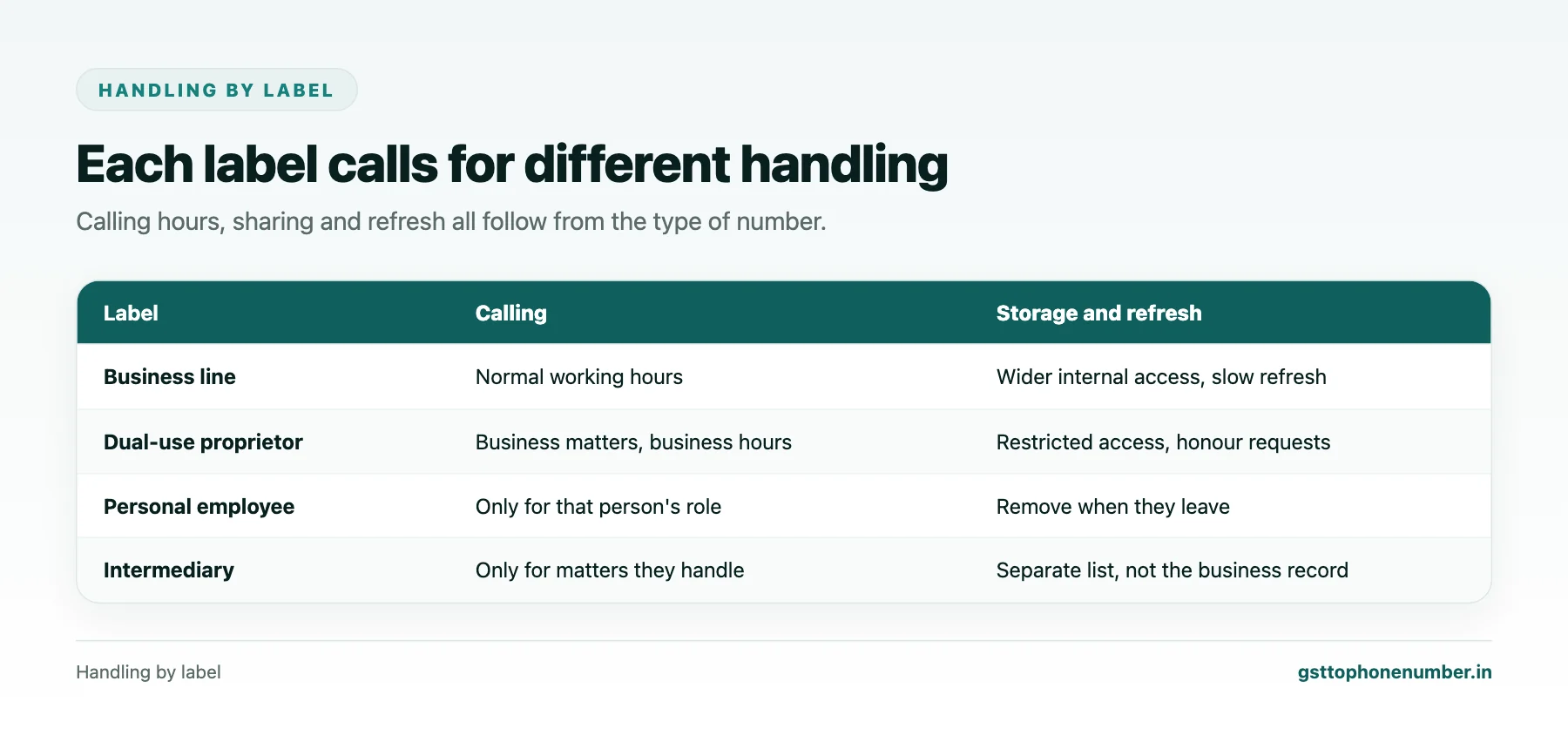
Label every extracted number as business line, personal, proprietor dual-use or intermediary. Business lines can go into general calling queues with normal hours. Personal and dual-use numbers should be restricted to the people and purposes that genuinely need them, called in narrower hours, and removed when the person leaves or asks. Intermediary numbers should be moved to a separate list and used only for matters the intermediary handles, such as tax filing questions.
The label also guides refresh decisions. Business lines decay slowly; personal phones of employees can go stale with a single resignation.
Asking for a Business Line Politely
When the only number you have is clearly personal, ask for a better channel at the first good opportunity. A sentence such as “Is there an office or shop number I should use for orders, so I do not disturb you on your own phone?” is courteous and usually welcomed. Record the business line you receive and mark the personal number as secondary.
Want to see real match quality?See the sample format for your own GST numbers.
Common Labelling Mistakes
The most frequent mistake is labelling every mobile as personal and every landline as business. Many small businesses run entirely on a dedicated shop mobile that nobody uses for family calls, and some landlines are in fact home phones listed against a home-based business. Judge by how the number is published and answered, not by whether it is a mobile.
The second mistake is never revisiting the label. A number that was a business line when the shop was open can become a personal phone after the business closes and the owner keeps the connection. When the GST record shows a cancellation, relabel the numbers attached to it and stop using them for business outreach.
Storing the Two Differently
Keep the number type in its own field so systems can treat each correctly. Restrict visibility of personal and dual-use numbers to roles that need them, exclude them from bulk exports by default, and include them in any deletion request process. Business lines can be shared more widely inside the organisation because they are offered for that purpose.
Have a list of GSTINs?Send a few and we will return matching contact fields.
Related guides
Extract Business Mobile From GSTIN Records Without Breaking Data Protection Rules: a related guide.
Frequently Asked Questions
Why does it matter whether a number is a business line?
A business line stays with the business and suits general business calls. A personal phone stays with the person and needs more restraint in use and storage.
How can I tell a business line when I extract business phone from GSTIN data?
Look for publication on the business’s own documents or signage, a city code matching the GST address, and an answer with the business name.
What about a proprietor's mobile on their signboard?
Treat it as dual-use: fine for business matters during business hours, but handled with personal-data care in every other respect.
What is an intermediary number?
A number, often an accountant’s or agent’s, that appears against many unrelated GSTINs. It does not reach the businesses themselves.
How do I ask for a business line without offending anyone?
Ask whether there is an office or shop number to use for orders so you do not disturb them on their own phone.
Should personal numbers be stored differently?
Yes. Restrict access, exclude them from bulk exports and include them in deletion processes.
 GST To Phone Number
We help sales, procurement and compliance teams turn a GST registration number into a verified, reachable business contact.
Company
Get Sample Format
Send us a few GSTINs and we will return the matching contact fields so you can judge the data before you buy.
© 2026 GST To Phone Number. All rights reserved.
Disclaimer: GST To Phone Number is an independent data service. We are not affiliated with, endorsed by or connected to the Goods and Services Tax Network, the Central Board of Indirect Taxes and Customs, or any government department. GSTIN verification should always be confirmed against the official GST portal. Contact data is provided for legitimate business use and must be used in line with applicable telecom, privacy and data-protection rules.