Home/GST Contact Search Guides/Business Phone Lookup Using GSTIN: Five Methods and When to Use Each
Business Phone Lookup Using GSTIN: Five Methods and When to Use Each
Business phone lookup using GSTIN compared: your own records, web search, directories, a data provider or an API. See which method fits your volume and need.
GST Identification Number
27ABCDE1234F1Z0
- Legal nameSample Traders Pvt Ltd
- StateMaharashtra (27)
- RegistrationActive
- Phone+91 98XXX XXXXX
- Emailc****@example.com
Illustrative result. Request a sample format for live records.
Reading time 6 min
Last reviewed October 2026
Business phone lookup using GSTIN can be done in several quite different ways, and the right one depends less on the GSTIN than on your situation. Someone who needs one supplier’s number before lunch has different needs from an accounts team checking forty new vendors a week, and both differ from a product team that wants a phone field to fill itself inside an app. Picking the wrong method wastes either time or money.
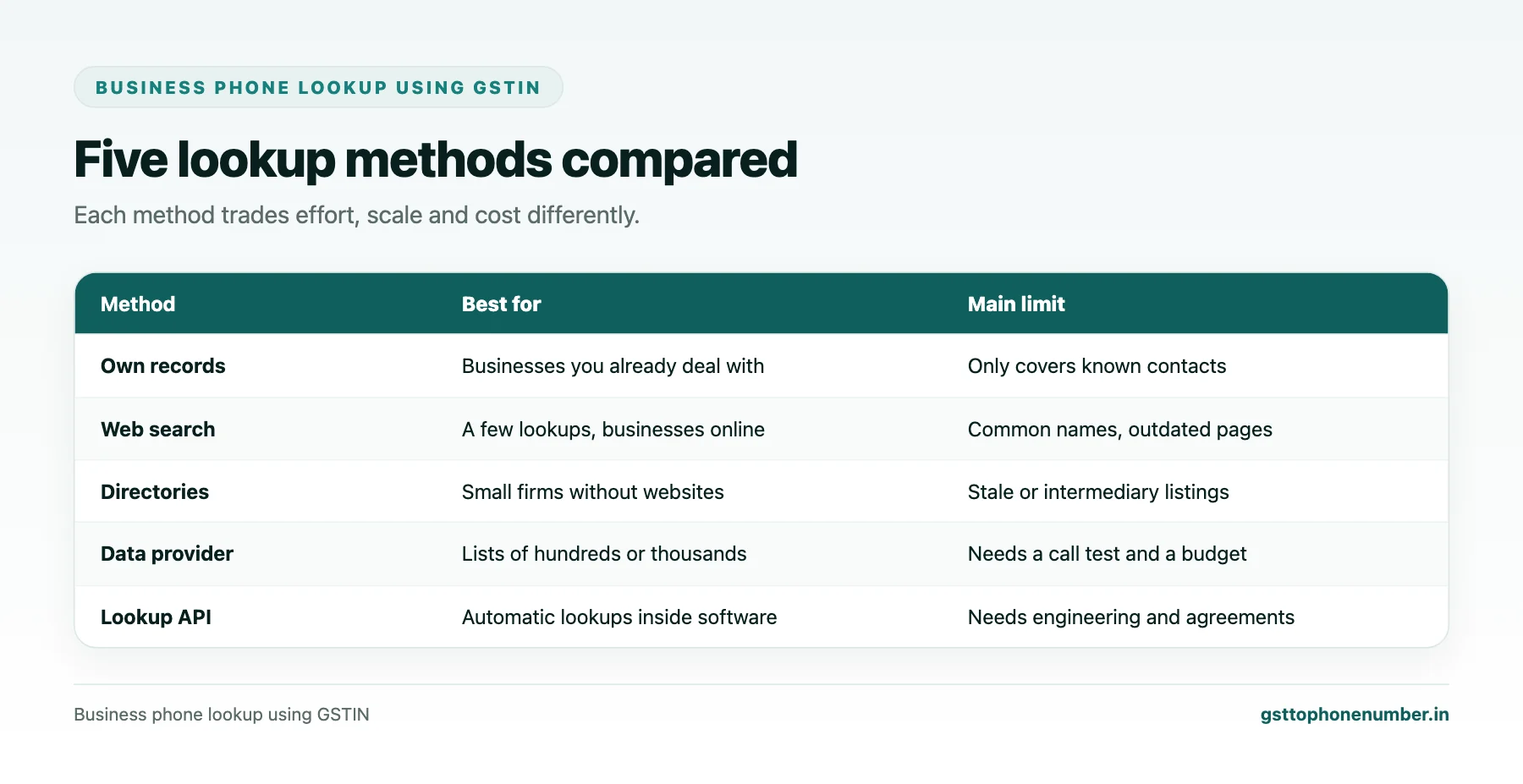
This guide compares the five methods people actually use: searching your own records, searching the open web, using business directories and marketplaces, commissioning a contact data provider, and connecting to a lookup API. For each one it explains how it works, where it shines, where it fails and what it costs in effort. A short decision guide at the end helps you choose.
Quick answer
- Always start with your own records; the number is often already in an old invoice or email.
- Web and directory searches suit a handful of lookups but do not scale.
- A data provider suits lists of hundreds or thousands of GSTINs.
- An API suits software that needs a phone field filled automatically.
- Every method needs the same final step: confirm the number reaches the right business.
First, Validate the GSTIN
Whatever method you choose, check the GSTIN before you look for a phone number. Confirm that it has fifteen characters in the right pattern, run a public taxpayer search to confirm it exists, and note the legal name, trade name, address and status. Every later step depends on this. A typo in the GSTIN can lead you to a real but unrelated business, and an hour of searching then produces a confident wrong answer.
The registry details are also what you will use to judge each candidate number. Without the trade name and address in front of you, there is no way to tell whether the number you find belongs to the right business.
Method One: Your Own Records
The fastest lookup is often in your own systems. If the GSTIN belongs to a supplier, a customer or a past enquiry, its phone number may already sit in an accounting party ledger, an old purchase order, an email signature, a delivery note or a chat thread. Searching your mailbox and document storage for the GSTIN itself often finds the original email in which the business shared its details.
This method costs nothing beyond a few minutes, and numbers found this way have a clear history: you know when and how the business gave them to you. Its limit is obvious. It only works for businesses you have dealt with before.
Method Two: Searching the Open Web
For a business you have never dealt with, a web search on the trade name plus the city from the GST record is the natural next step. Many businesses publish a website, a map listing or a social profile with a contact number. Searching for the GSTIN itself can also turn up a company website, since many businesses print their GSTIN in the footer or on their terms page.
Web search works well for a few lookups and for businesses with an online presence. It struggles with small proprietorships that have no website, with common trade names that match many businesses, and with outdated pages that still show old numbers. Always compare the address on the web page with the GST address before trusting a number.
Need the contact behind a GSTIN?Get the sample format with verified business contact fields.
Method Three: Directories and Marketplaces
Business directories and online B2B marketplaces list many small and mid-sized businesses with contact numbers, often including businesses that have no website. Searching by trade name and city can surface a listing quickly, and some listings even show the GSTIN, which makes the match straightforward.
The drawbacks are that listings are often created once and never updated, that some show an intermediary’s number rather than the business’s own, and that heavy use of marketplace contact features may be restricted by the platform’s terms. Directories are useful for individual lookups and for confirming a number found elsewhere, but they are not a practical way to process a long list.
Method Four: A Contact Data Provider
When the list runs to hundreds or thousands of GSTINs, manual methods stop making sense. A business contact data provider matches each GSTIN to compiled contact records and returns phone numbers in bulk, usually with a match level and a date for each one. You send a file and receive an enriched file.
The strength of this method is scale and consistency. Its weakness is that quality varies between providers and between rows, so it needs a call test on a sample before the results are trusted. It also involves a contract and a cost, which only make sense when the list is long enough and the contacts valuable enough.
Method Five: A Lookup API
An API lets your own software ask for contact details for one GSTIN at a time and receive the answer in seconds. It suits onboarding forms, customer systems and billing tools where a user enters a GSTIN and the phone field should fill itself, or where each new vendor should be checked automatically.
APIs need development time, a commercial agreement and careful handling of the returned data, especially where it includes individuals’ mobile numbers. They are the right choice when lookups happen continuously as part of a process, rather than in occasional batches.
Want to see real match quality?See the sample format for your own GST numbers.
Comparing the Methods Side by Side
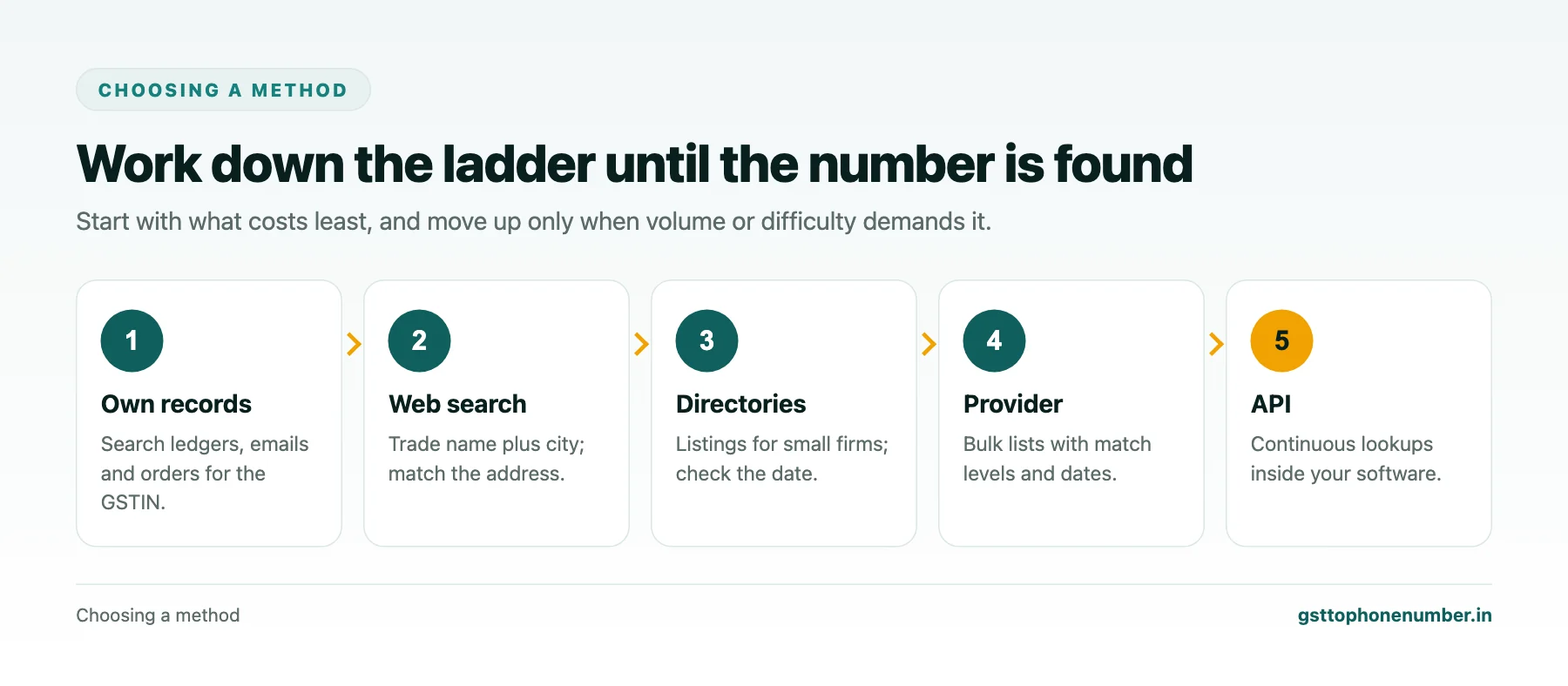
Seen together, the methods form a ladder. Own records and web searches cost only time and work well for a few lookups. Directories add coverage of small businesses but not scale. Providers add scale but require a quality check and a budget. APIs add automation but require engineering. Most organisations end up using two or three of these together: an API or provider for routine volume, and manual methods for the difficult rows that automated matching cannot settle.
A Simple Decision Guide
If you need one number and have dealt with the business before, search your own records first. If you have not, use a web search and directories, and confirm the address. If you have a list of more than a few dozen GSTINs and the contacts matter, test a provider on a sample. If lookups happen every day inside a process, consider an API. And whatever method you use, keep a record of where each number came from and when it was last confirmed.
Confirming the Number, Whatever the Source
No lookup method guarantees that a number reaches the right business today. A brief confirmation call, asking for the business by its trade name or the proprietor by name, settles the question. Record the outcome and the date with the number. Over time, those confirmations make your own records the most reliable source of all, which brings the whole process back to method one.
Have a list of GSTINs?Send a few and we will return matching contact fields.
Related guides
Frequently Asked Questions
What is the quickest business phone lookup using GSTIN?
Search your own records first. If the business has dealt with you before, its number is often in an invoice, ledger or email that mentions the GSTIN.
Can I look up a phone number on the GST portal?
No. The public taxpayer search shows names, address and status but not phone numbers or emails.
Are directory listings reliable?
They are useful but often outdated or created by intermediaries. Compare the listing’s address with the GST address before using the number.
When should I use a contact data provider?
When you have a long list of GSTINs and need contacts consistently, with match levels and dates, and you can test a sample first.
When does an API make sense?
When lookups happen continuously inside a process, such as vendor onboarding or customer registration in your software.
How do I confirm a number from any source?
Call and ask for the business by its trade name or the proprietor by name, then record the outcome and date.
 GST To Phone Number
We help sales, procurement and compliance teams turn a GST registration number into a verified, reachable business contact.
Company
Get Sample Format
Send us a few GSTINs and we will return the matching contact fields so you can judge the data before you buy.
© 2026 GST To Phone Number. All rights reserved.
Disclaimer: GST To Phone Number is an independent data service. We are not affiliated with, endorsed by or connected to the Goods and Services Tax Network, the Central Board of Indirect Taxes and Customs, or any government department. GSTIN verification should always be confirmed against the official GST portal. Contact data is provided for legitimate business use and must be used in line with applicable telecom, privacy and data-protection rules.