Home/GST Contact Search Guides/Check Business Phone From GSTIN: An In-House Check Before Any Campaign
Check Business Phone From GSTIN: An In-House Check Before Any Campaign
Check business phone from GSTIN lists in-house: seven quick checks that catch bad formats, shared accountant numbers, closed firms and opted-out contacts.
GST Identification Number
27ABCDE1234F1Z0
- Legal nameSample Traders Pvt Ltd
- StateMaharashtra (27)
- RegistrationActive
- Phone+91 98XXX XXXXX
- Emailc****@example.com
Illustrative result. Request a sample format for live records.
Reading time 6 min
Last reviewed October 2026
Check business phone from GSTIN lists before you use them, even when the list is small and came from a source you trust. A sales coordinator preparing a few hundred rows for a product launch, an accounts assistant about to send payment reminders, or an event team inviting regional dealers will all find, on close inspection, that a share of the numbers in their sheet are malformed, duplicated, attached to closed businesses or belong to someone who asked not to be contacted. Finding those before the campaign is far cheaper than finding them through complaints.
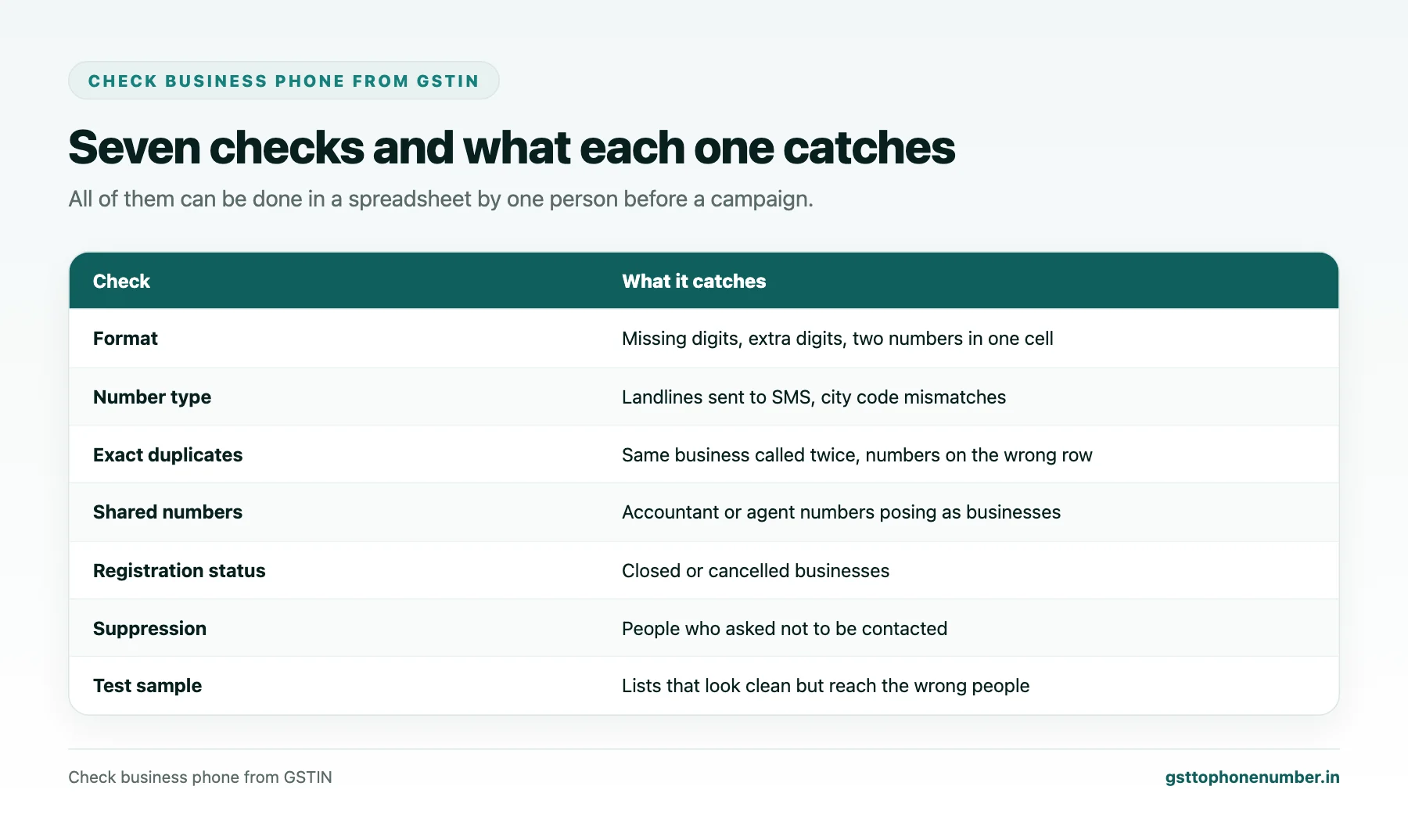
This guide sets out seven checks one person can run in a spreadsheet in an afternoon. Each check catches a specific kind of problem, and together they turn a raw list into one you can use with confidence. No specialist software is needed, though a dialler or customer system can automate several of the steps later.
Quick answer
- Run seven checks: format, type, duplicates, shared numbers, registration status, suppression and a test sample.
- Most problems are visible in the spreadsheet before anyone dials.
- A number repeated across unrelated GSTINs usually belongs to an accountant or agent.
- Closed or cancelled registrations should be separated, not silently dropped.
- A short test-call sample tells you whether the remaining list is fit to use.
Why Small Lists Need Checking Too
People assume that checking is only for big bulk files. In practice, small lists are often messier, because they are assembled by hand from several sources: an old customer export, a trade fair sheet, numbers copied from emails and a few added from memory. Each source has its own formatting habits and its own mistakes, and the combined sheet inherits all of them.
A small list also has less room for error. When you only have a few hundred businesses to contact, losing a fifth of them to wrong or unusable numbers can sink the campaign, and irritating the few who receive a wrong call can do lasting harm in a close-knit trade.
Check One: Format
Copy the phone column into a new column and clean it: remove spaces, hyphens, brackets, dots, a leading zero and the country code. What remains should be exactly ten digits. Use a formula to count the characters and flag every row that is not ten digits long. Typical failures are missing city codes on landlines, an extra digit typed by mistake, two numbers pasted into one cell, and numbers that a spreadsheet converted into scientific notation.
Fix what can be fixed from the original source, and mark the rest as needing a number. Do not guess missing digits.
Check Two: Number Type
Once every number has ten digits, classify it. Numbers beginning 6, 7, 8 or 9 are usually mobiles; others are landlines with a city code. Where a list will be used for SMS or chat messages, only mobiles can receive them, so a type column decides which rows enter which channel. For landlines, compare the city code with the city in the GST record; a mismatch is worth a note.
Need the contact behind a GSTIN?Get the sample format with verified business contact fields.
Check Three: Exact Duplicates
Sort the cleaned phone column and look for repeats. Some are harmless, such as the same business appearing twice under two GSTINs that share a PAN, which means one company registered in two states. Others are mistakes, such as one number copied onto the wrong row. Decide for each repeat whether it represents one business or an error, and keep one row per real business for the campaign so that nobody receives the same call twice.
Check Four: Shared Numbers Across Unrelated Businesses
This is the check most people skip and the one that saves the most embarrassment. Where the same number appears against several GSTINs with different PANs and unrelated names, it almost never belongs to any of those businesses. It usually belongs to a tax practitioner, an accountant, a bookkeeping service or a registration agent who filled in forms on behalf of many clients.
Such numbers can be useful for some purposes, such as reaching the person who handles a client’s GST filings, but they are wrong for a sales or marketing campaign. Mark them as intermediary numbers and remove them from the campaign list.
Check Five: Registration Status
Run each GSTIN through a public taxpayer search, or use your provider’s status field, and record whether the registration is active, suspended or cancelled. A cancelled registration often means the business has closed or been restructured, and its number may no longer work or may now belong to someone else.
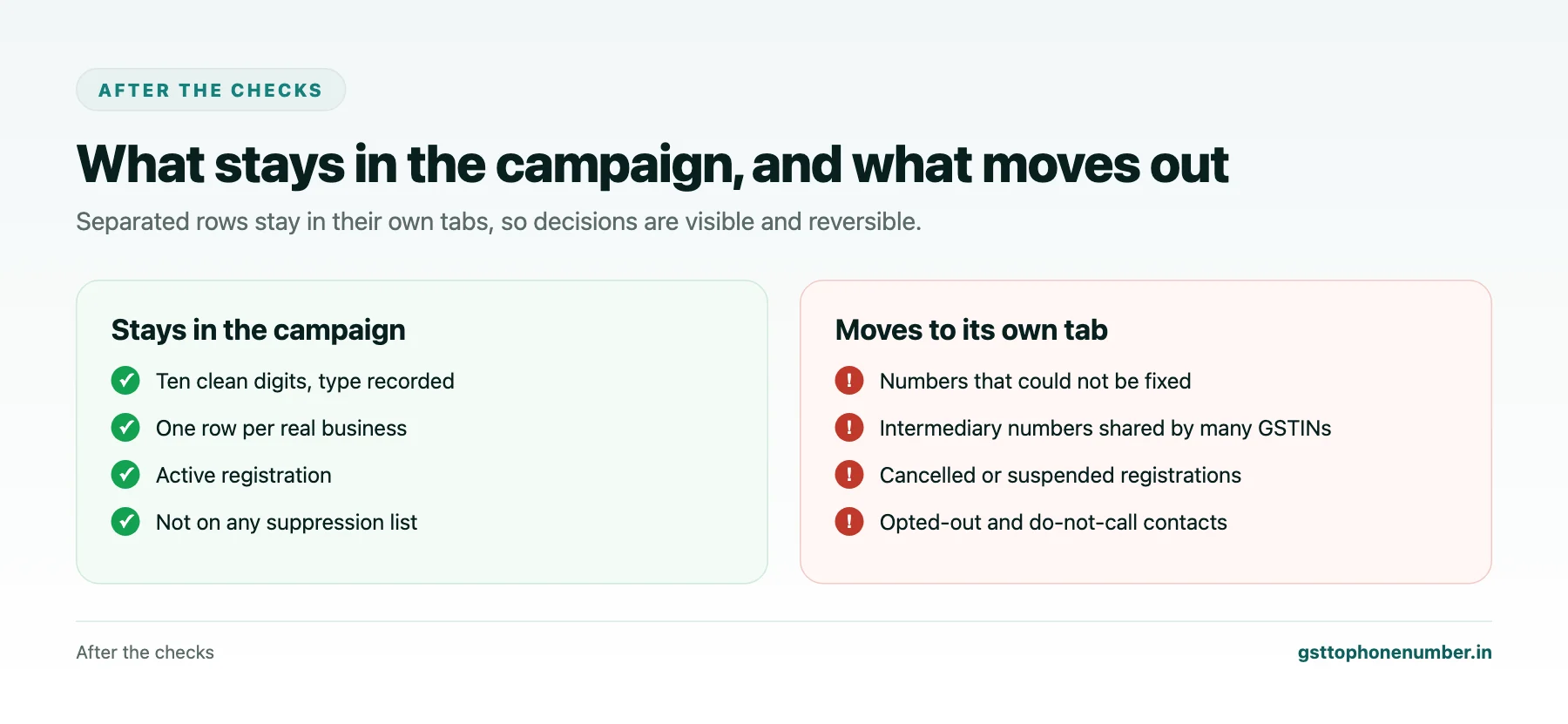
What you do with these rows depends on the purpose. Payment reminders to a cancelled business may still be necessary. Sales offers usually are not. Separate them into their own tab rather than deleting them, so the decision is visible and reversible.
Want to see real match quality?See the sample format for your own GST numbers.
Check Six: Suppression and Consent
Compare the cleaned numbers against your own list of people who have asked not to be contacted, and against any opt-out records for SMS or chat. For promotional calls and messages, also consider the national Do Not Disturb preferences that apply to commercial communication. Remove matched rows from the campaign entirely, not just from the first round.
If your organisation has no suppression list yet, start one now. Every future campaign will need it, and the sooner opt-outs are recorded, the fewer people will be contacted against their wishes.
Check Seven: A Small Test-Call Sample
Finally, take a random handful of rows from the cleaned list and call them. Ask for the business by its trade name or the proprietor by name and record whether the number reached the right business, the wrong business or nobody. The sample does not need to be large to be informative. If most calls reach the right business, the list is fit to use. If many do not, look for a pattern, such as one source or one region, and fix that before the campaign starts.
Keeping the Checks for Next Time
Save the cleaned sheet with its new columns: cleaned number, type, duplicate flag, intermediary flag, registration status, suppression flag and test outcome. Next time, the same checks will take minutes, because most rows will already pass. Add call outcomes from the campaign back into the same sheet, and the list will improve each time it is used.
Have a list of GSTINs?Send a few and we will return matching contact fields.
Related guides
Check contact number from GST number: a related guide.
Frequently Asked Questions
Why check business phone from GSTIN lists that came from a trusted source?
Lists assembled from several sources inherit everyone’s formatting habits and errors, and small campaigns cannot afford to lose many rows to bad numbers.
How do I find accountant or agent numbers in my list?
Look for one phone number repeated across several GSTINs with different PANs and unrelated names. That pattern almost always points to an intermediary.
Should I delete rows with cancelled GST registrations?
Move them to a separate tab instead. Whether to contact them depends on the purpose, such as collections versus sales.
How large should the test-call sample be?
Small is fine as long as it is random. The goal is to see whether most numbers reach the right business and to spot any bad source or region.
Can I check business phone numbers without special software?
Yes. A spreadsheet with text-cleaning and counting formulas, a sort for duplicates and a public taxpayer search cover all seven checks.
What should I save after the checks?
The cleaned number, type, duplicate and intermediary flags, registration status, suppression flag and test outcome, plus call results after the campaign.
 GST To Phone Number
We help sales, procurement and compliance teams turn a GST registration number into a verified, reachable business contact.
Company
Get Sample Format
Send us a few GSTINs and we will return the matching contact fields so you can judge the data before you buy.
© 2026 GST To Phone Number. All rights reserved.
Disclaimer: GST To Phone Number is an independent data service. We are not affiliated with, endorsed by or connected to the Goods and Services Tax Network, the Central Board of Indirect Taxes and Customs, or any government department. GSTIN verification should always be confirmed against the official GST portal. Contact data is provided for legitimate business use and must be used in line with applicable telecom, privacy and data-protection rules.