Home/Bulk GST Contact Data Guides/Bulk GST Number to Phone Number: Building a Calling List Your Team Can Use
Bulk GST Number to Phone Number: Building a Calling List Your Team Can Use
Bulk GST number to phone number for telecalling teams: shape the list for a dialler, respect DND rules, order calls well and feed outcomes back into data.
GST Identification Number
27ABCDE1234F1Z0
- Legal nameSample Traders Pvt Ltd
- StateMaharashtra (27)
- RegistrationActive
- Phone+91 98XXX XXXXX
- Emailc****@example.com
Illustrative result. Get sample format for live records.
Reading time 7 min
Last reviewed October 2026
Bulk GST number to phone number conversion is usually requested by one kind of team: people who will spend the next few weeks on the phone. An inside sales desk, a dealer recruitment cell, a collections team or a survey unit all receive a list of GSTINs and need, at the end of it, a list of numbers they can dial in a sensible order. The conversion itself is only half the work. The other half is shaping the output so that callers waste as little time as possible on dead lines, wrong parties and people who have asked not to be called.
This article looks at the conversion from the caller’s chair. It covers what a calling-ready file looks like, how to order rows, how Indian telemarketing rules affect a business-to-business list, which call outcomes to capture, and how to send those outcomes back so the data gets better with every round.
Quick answer
- A converted list is only useful once it is shaped for the people dialling it.
- Put the most certain numbers and the most valuable accounts at the top of the queue.
- Business calls still need care with Do Not Disturb preferences and calling hours.
- Capture a fixed set of call outcomes, not open-ended notes.
- Feed wrong-number and not-reachable results back to clean the source list.
Why Telecalling Teams Need More Than a Number
A raw file with a GSTIN and a phone number on each row looks finished, but a caller cannot do much with it. They need to know who they are asking for, what the business does, where it is, and whether the number is likely to reach the owner, the accounts desk or a shop counter. Without that context, the first thirty seconds of every call are spent working out who answered.
For that reason a good conversion carries forward the legal name, the trade name and the city from the GST record, and adds the type of number and how confident the match is. A caller who can open with the trade name the business actually uses sounds informed rather than random, and is far more likely to get past the first person who picks up.
What a caller should see on every row
Trade name to ask forLegal name for confirmationCity and stateNumber typeMatch confidenceReason for the callShaping the File for a Dialler
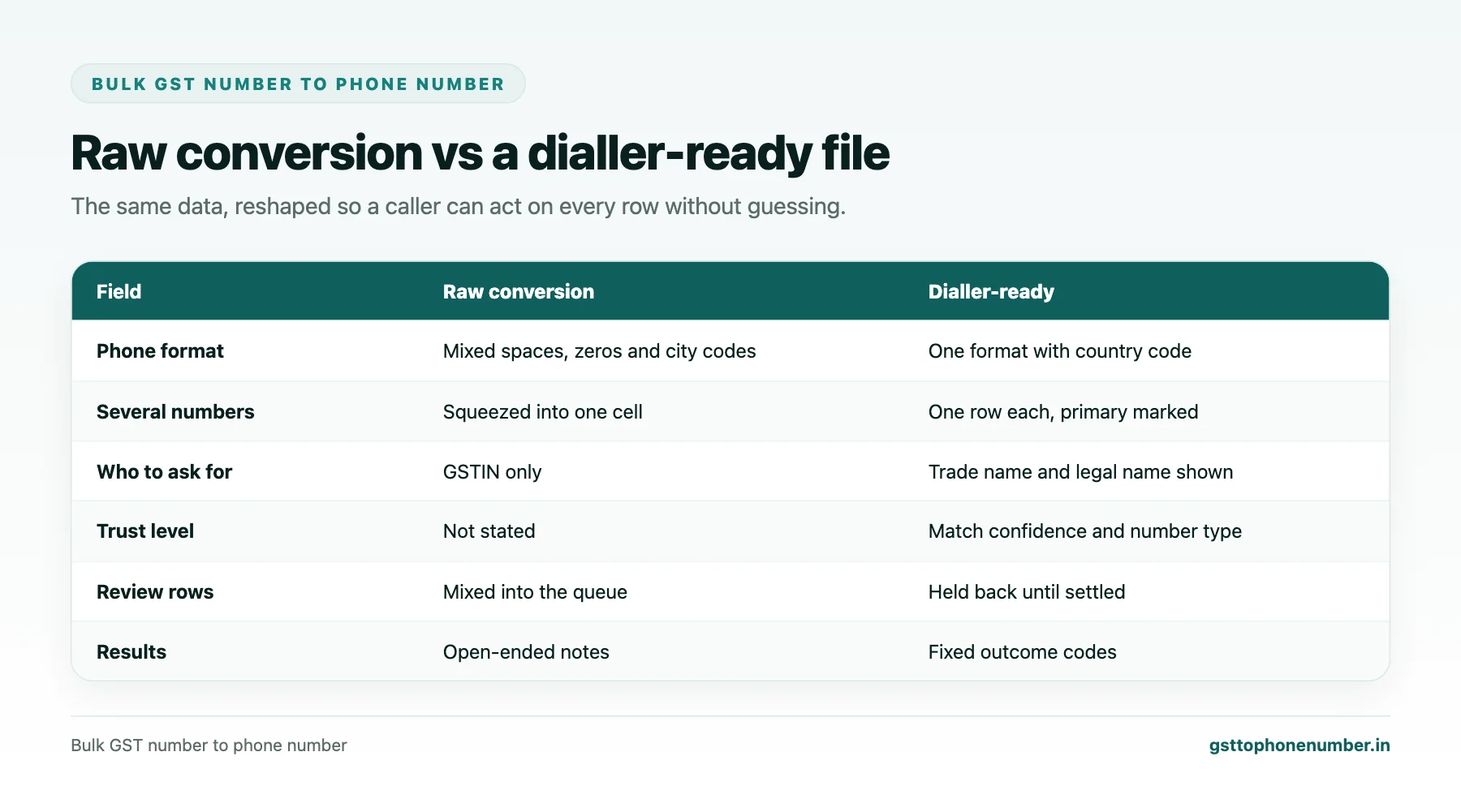
Most calling software expects one phone number per row in a consistent format, a unique identifier, and a few display fields. A converted list rarely arrives that way. Some GSTINs will have two or three candidate numbers, some numbers will be written with spaces or a leading zero, and some will be landlines with a city code.
Normalise every number to one format that includes the country code, split rows where a GSTIN has more than one number so each candidate can be tried in turn, and mark which candidate is primary. Keep the GSTIN on every row so that results can be grouped back to the business later. Remove any row where the number is clearly not a phone number, such as a short code or a number with too few digits.
Deciding the Calling Order
The order in which rows are called matters more than most teams expect. Callers are freshest at the start of a shift and at the start of a campaign, so those hours should go to the rows most likely to produce a result.
A practical order is to sort first by the value of the account to you, then by match confidence, then by number type. A high-value account with a directly matched landline at the business address should come before a low-value account with a mobile number found through a trade name. Rows that need human review should not be in the dialling queue at all until someone has settled them.
Grouping by state also helps. Calls to one region can be scheduled for its business hours, regional language skills can be matched to the right callers, and any local holiday that would leave offices empty can be avoided.
Need the contact behind a GSTIN?Get the sample format with verified business contact fields.
Do Not Disturb, Calling Hours and Courtesy
India’s telecom regulator maintains a framework that lets subscribers block unsolicited commercial calls and messages, commonly known as the Do Not Disturb registry, and sets rules for commercial communication. How these rules apply to a particular business-to-business campaign depends on the nature of the calls and the numbers being used, so take advice for your own setup rather than assuming business calls are outside the rules.
Whatever the legal position, the practical rules are the same. Call during normal business hours, say who you are and why you are calling within the first sentence, and record any request not to be called again so that the number is suppressed in every future list. Proprietors in particular often use one mobile for both business and family, and a call at the wrong time costs goodwill that no script can recover.
The Call Outcomes Worth Recording
Open-ended notes feel thorough but are almost impossible to analyse later. Give callers a short, fixed list of outcomes and ask them to pick one for every attempt. The list below works for most business campaigns and maps directly onto actions in the data.
Two more outcomes are worth adding. One is “right business, wrong department”, which means the number is real but reaches a counter or warehouse rather than the person you need. The other is “asked not to call”, which must suppress the number everywhere, not only in the current campaign.
Feeding Results Back Into the Data
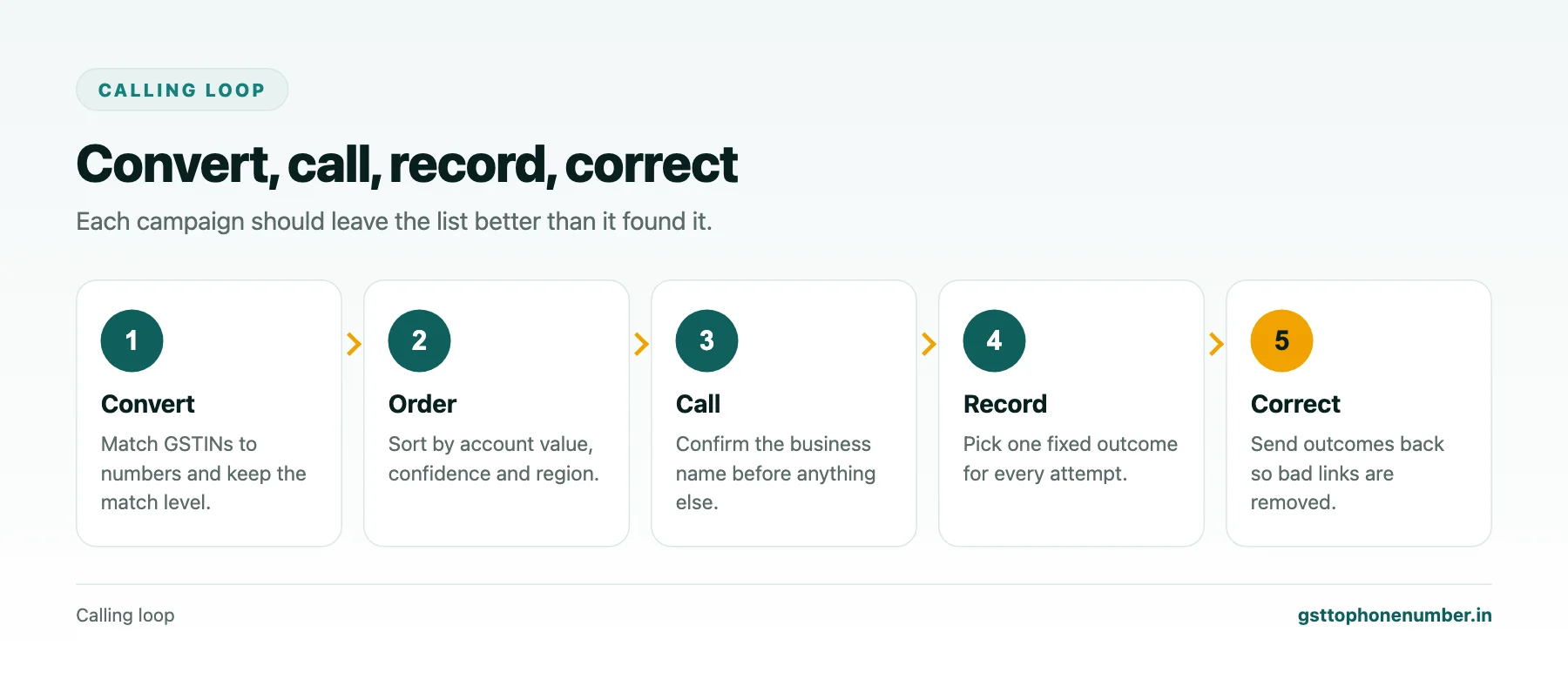
The most valuable output of a calling campaign is not the deals or payments it produces; it is the corrected data. Every confirmed number becomes a stronger row for the next campaign. Every wrong-business result removes a bad link that would otherwise confuse the next caller.
Send the outcomes back to whoever maintains the contact list in a simple file: GSTIN, number dialled, outcome and date. Over two or three campaigns, the share of confirmed numbers in the list rises steadily, and the share of wasted dials falls. Teams that skip this step end up paying to convert the same GSTINs again and again.
Want to see real match quality?See the sample format for your own GST numbers.
Measuring Whether the Conversion Worked
Judge the converted list by what happens on the phone. Useful measures are the share of dialled rows that reach the right business, the share that are wrong numbers, and the number of attempts needed per confirmed contact. Compare these across match levels and number types; the comparison tells you where the list is strong and where it needs work.
Avoid judging only by the share of GSTINs that received a number. A list where every row has a number but a third of them reach the wrong business is worse than a list with fewer, better numbers, because wrong-party calls burn caller time and confuse the people who answer.
Scripts That Respect the Data's Limits
A converted phone number tells you how to reach a business; it does not tell you that the business expects your call. Open by confirming the business name, explain the reason for the call in one sentence, and ask whether you have reached the right person or department. If not, ask who handles the subject and whether there is a better number for them.
That last question is where many of the best numbers come from. A receptionist who tells you the purchase head’s direct line has just given you better data than any lookup can, and it should be recorded against the GSTIN with the date and the source.
Keeping the List Secure
A calling list combines business identity with phone numbers, and some of those numbers belong to individuals. Keep it inside the calling system rather than in spreadsheets passed around by email, limit exports, and remove access when people leave the team. When the campaign ends, archive the list with its outcomes rather than leaving copies on personal devices.
Have a list of GSTINs?Send a few and we will return matching contact fields.
- Why Telecalling Teams Need More Than a Number
- Shaping the File for a Dialler
- Deciding the Calling Order
- Do Not Disturb, Calling Hours and Courtesy
- The Call Outcomes Worth Recording
- Feeding Results Back Into the Data
- Measuring Whether the Conversion Worked
- Scripts That Respect the Data's Limits
- Keeping the List Secure
Related guides
Get GST Owner Phone Number, Then Make a First Call That Works: a related guide.
Frequently Asked Questions
What is the best format for a bulk GST number to phone number list?
One phone number per row in a single format with the country code, the GSTIN kept on every row, and display fields for trade name, legal name, city, number type and match confidence.
Do Do Not Disturb rules apply to business calls?
The rules on unsolicited commercial communication can apply depending on the nature of the call and the numbers used, so take advice for your setup and always honour any request not to be called.
Which rows should telecallers call first?
Start with high-value accounts that have high-confidence numbers, then work down. Keep rows that need review out of the queue until they are settled.
Why record fixed call outcomes instead of notes?
Fixed outcomes can be counted and fed back into the data. Notes are hard to analyse and rarely lead to corrections.
How do I know if the conversion was good?
Measure how many dialled rows reach the right business, how many are wrong numbers and how many attempts each confirmed contact needs, broken down by match level.
What should happen to wrong numbers after a campaign?
Send them back with the GSTIN and date so the link is removed from the source list and the same mistake is not repeated next time.
 GST To Phone Number
We help sales, procurement and compliance teams turn a GST registration number into a verified, reachable business contact.
Company
Get Sample Format
Send us a few GSTINs and we will return the matching contact fields so you can judge the data before you buy.
© 2026 GST To Phone Number. All rights reserved.
Disclaimer: GST To Phone Number is an independent data service. We are not affiliated with, endorsed by or connected to the Goods and Services Tax Network, the Central Board of Indirect Taxes and Customs, or any government department. GSTIN verification should always be confirmed against the official GST portal. Contact data is provided for legitimate business use and must be used in line with applicable telecom, privacy and data-protection rules.