Home/GST Contact Search Guides/Business Contact by GST Number: Building a Prospect List That Fits
Business Contact by GST Number: Building a Prospect List That Fits
Business contact by GST number for B2B prospecting: filter by state code, constitution, business activity and HSN codes, then add contacts that fit.
GST Identification Number
27ABCDE1234F1Z0
- Legal nameSample Traders Pvt Ltd
- StateMaharashtra (27)
- RegistrationActive
- Phone+91 98XXX XXXXX
- Emailc****@example.com
Illustrative result. Request a sample format for live records.
Reading time 7 min
Last reviewed October 2026
Business contact by GST number is a powerful idea for B2B sales because a GST registration describes a business in a structured way that most other sources do not. From a GSTIN and its public record you can tell which state the business is in, what legal form it takes, whether it manufactures, trades or provides services, which goods or services it deals in and whether it is still active. Those attributes let you decide whether a business is worth contacting before you spend any effort finding its phone number.
This guide is about using that structure for prospecting. It shows how to turn GST attributes into filters that describe your ideal customer, how to build a target list from them, how to attach contacts only to the rows that pass, and how to approach those businesses in a way that earns a second conversation.
Quick answer
- A GST record tells you location, legal form, activity, goods or services and status.
- Use those attributes to qualify a business before looking for its contact.
- HSN and SAC codes are often the sharpest filter for product-led sales.
- Attach contacts only to rows that pass your filters, to save time and money.
- Open the first conversation with something specific the record told you.
Why GST Attributes Make Good Filters
Many prospect lists are built from loose sources such as trade fair visitor lists, old directories or scraped web pages. They contain names and numbers, but very little that tells you whether the business is a good fit. A GST record is different. Because the registration is a legal filing, its fields are filled in to a standard format, and they describe the business’s actual tax identity.
That makes it possible to qualify prospects on facts rather than guesses. A company selling packaging machinery can look for manufacturers. A distributor of electrical goods can look for traders dealing in the relevant goods. A software firm selling billing tools can look for regular taxpayers in a particular state. In each case, the GST record narrows the field before any contact data is bought.
The Attributes That Matter Most
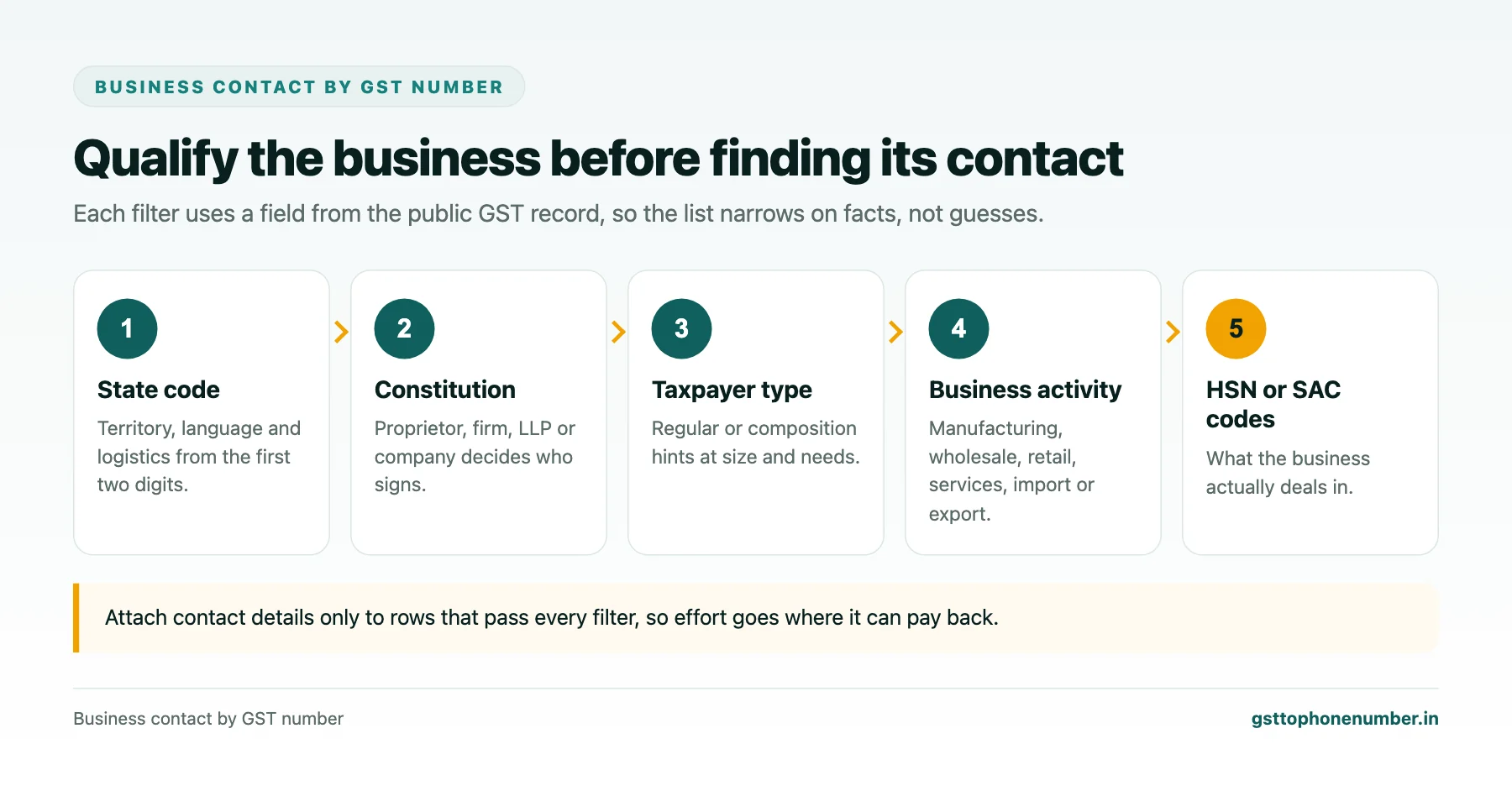
The state code in the first two characters of the GSTIN tells you the state of registration, which decides territory, language and logistics. The constitution of business shows whether you are dealing with a proprietorship, partnership, LLP, private or public limited company, trust or government body, which changes who makes decisions and how formal the sale will be.
The taxpayer type separates regular taxpayers from composition taxpayers and other categories. A composition taxpayer is usually a smaller business with simpler needs, which may suit some offers and rule out others. The nature of business activity lists what the business does at its places of business, such as manufacturing, wholesale, retail, warehousing, services, import or export. And the goods and services section of the record, where shown, lists HSN or SAC codes for the main items the business deals in.
Describing Your Ideal Customer in GST Terms
Before building any list, write down your ideal customer as a combination of GST attributes. For example: active regular taxpayers in two neighbouring states, constituted as companies or partnership firms, with manufacturing among their activities and dealing in a specific group of HSN codes. That description is precise enough to apply to a list and easy enough for colleagues to understand.
Then add the attributes you cannot get from GST, such as company size or the software they use, as questions to answer during the first conversation rather than as filters. Trying to filter on facts the record does not contain only creates guesses.
An ideal-customer profile in GST terms
- States to cover
- Constitutions to include
- Taxpayer types to include
- Business activities to match
- HSN or SAC codes to match
- Registration status: active only
Need the contact behind a GSTIN?Get the sample format with verified business contact fields.
Building the Target List Step by Step
Start with the widest relevant set of GSTINs you can lawfully obtain, such as existing customer records, enquiries, partner referrals or a licensed business dataset. Validate the format of every GSTIN and remove duplicates. Then enrich each row with the public registration attributes and apply your filters one by one, keeping a note of how many rows each filter removes.
That note is useful in itself. If one filter removes almost everything, your profile may be too narrow, or the starting set may be the wrong one. If no filter removes much, the profile may be too loose to guide your team. Adjust until the list is small enough to work properly and large enough to meet your targets.
Adding Contacts Only Where They Count
The point of filtering first is to avoid paying for, or spending time on, contacts you will never use. Once the list is qualified, attach contact details to the remaining rows, through your own records where possible and a business contact data provider where not. Ask for the number type and match level with every contact, so that your team knows whether a number reaches an owner, a desk or a switchboard.
For larger companies, consider whether you need a general contact at all. A procurement or plant head is often the right person, and their contact may come from a referral or a professional network rather than from a phone lookup.
Using the Record to Open the Conversation
The GST record does more than qualify a prospect; it gives the caller something specific to say. Mentioning that you work with manufacturers of a particular product group, or with traders in the buyer’s city, shows that the call is not random. That small signal of relevance often decides whether a busy owner stays on the line.
Avoid quoting the record back in a way that feels intrusive. Saying that you looked up their registration and noticed they import certain goods can sound like surveillance. Saying that you help importers of those goods with a specific problem sounds like help.
Want to see real match quality?See the sample format for your own GST numbers.
Segmenting the List for Better Campaigns
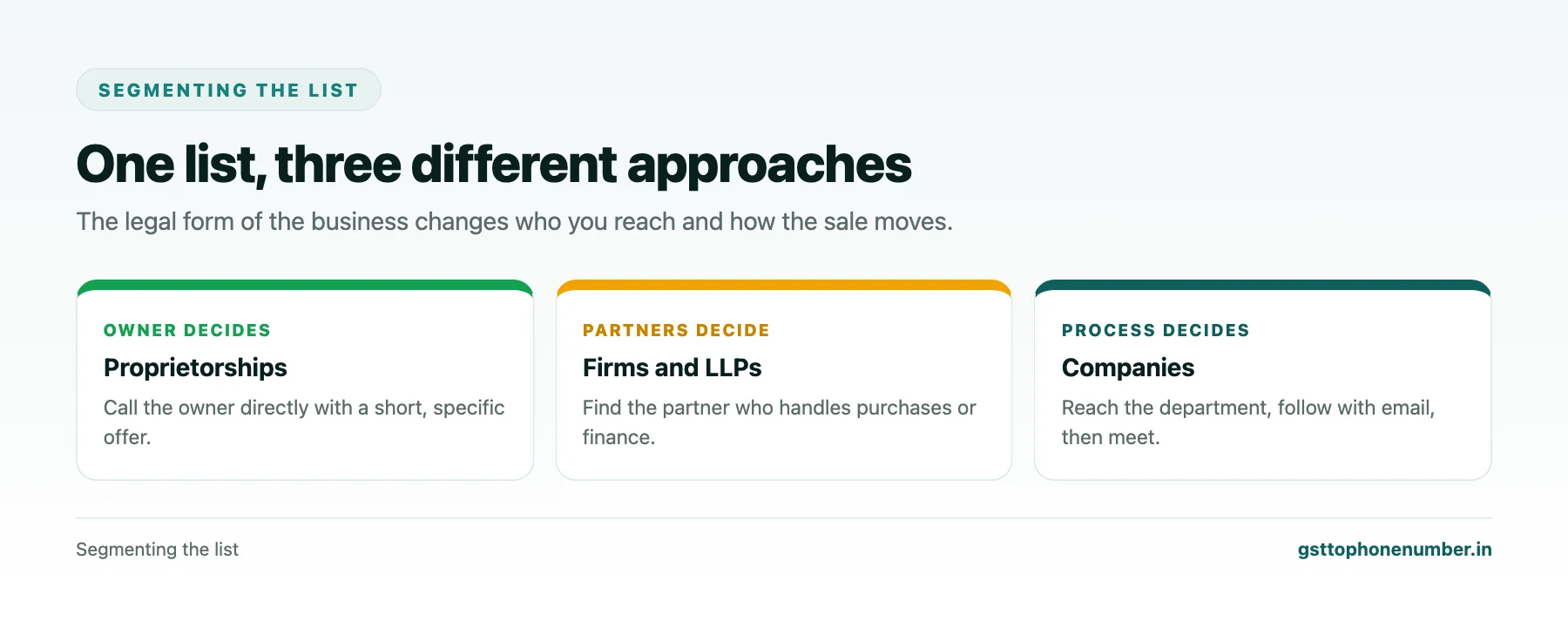
Once contacts are attached, split the list into segments that need different approaches. Proprietorships and small partnerships usually respond to a direct call to the owner with a simple offer. Companies may need a sequence: a call to reach the right department, an email with details, and a follow-up meeting. Composition taxpayers and regular taxpayers may need different offers altogether.
Segmenting by state also lets you plan calls around language, local holidays and the times when markets are busiest. A message that suits a wholesaler in one city on a market day may be ignored entirely if the call lands during peak trading hours.
Keeping the List Lawful and Respectful
Business contact data still involves people, especially in proprietorships where the business mobile is also the owner’s personal number. Use the contacts for the business purpose they were obtained for, introduce yourself clearly, honour requests not to be contacted and keep the list in a controlled system. A prospect list that is handled carefully keeps producing results for longer.
Measuring Prospecting Results by Segment
Track outcomes for each segment you created: right-party reach, conversations, meetings and deals. Over a few campaigns, these numbers show which GST attributes predict good customers for you. That learning feeds straight back into your ideal-customer profile, and each new list becomes more accurate than the last.
Have a list of GSTINs?Send a few and we will return matching contact fields.
- Why GST Attributes Make Good Filters
- The Attributes That Matter Most
- Describing Your Ideal Customer in GST Terms
- Building the Target List Step by Step
- Adding Contacts Only Where They Count
- Using the Record to Open the Conversation
- Segmenting the List for Better Campaigns
- Keeping the List Lawful and Respectful
- Measuring Prospecting Results by Segment
Related guides
Discover business contact from GSTIN: a related guide.
Frequently Asked Questions
How can a GST number help with B2B prospecting?
The public GST record shows state, constitution, taxpayer type, business activities, main goods or services and status, which let you qualify a business before looking for its contact.
What are HSN and SAC codes?
They are classification codes for goods (HSN) and services (SAC). Where a GST record lists them, they show what the business mainly deals in.
Should I buy contacts for every GSTIN I have?
No. Filter on GST attributes first and attach contacts only to the businesses that fit your ideal-customer profile.
Does the GST record include the owner's phone number?
No. The public record shows registration details but not phone numbers or emails, which come from separate business contact sources.
How should I open a prospecting call?
Mention something relevant to their business, such as the product group or city you serve, without quoting their registration back in an intrusive way.
How do I improve the prospect profile over time?
Track results by segment and keep the GST attributes that predict good customers, dropping the ones that do not.
 GST To Phone Number
We help sales, procurement and compliance teams turn a GST registration number into a verified, reachable business contact.
Company
Get Sample Format
Send us a few GSTINs and we will return the matching contact fields so you can judge the data before you buy.
© 2026 GST To Phone Number. All rights reserved.
Disclaimer: GST To Phone Number is an independent data service. We are not affiliated with, endorsed by or connected to the Goods and Services Tax Network, the Central Board of Indirect Taxes and Customs, or any government department. GSTIN verification should always be confirmed against the official GST portal. Contact data is provided for legitimate business use and must be used in line with applicable telecom, privacy and data-protection rules.