Home/GST Mobile Number Guides/Extract Business Mobile From GSTIN Records Without Breaking Data Protection Rules
Extract Business Mobile From GSTIN Records Without Breaking Data Protection Rules
Extract business mobile from GSTIN records lawfully: when a proprietor’s mobile is personal data, what India’s data protection law expects, and safe habits.
GST Identification Number
27ABCDE1234F1Z0
- Legal nameSample Traders Pvt Ltd
- StateMaharashtra (27)
- RegistrationActive
- Phone+91 98XXX XXXXX
- Emailc****@example.com
Illustrative result. Get sample format for live records.
Reading time 5 min
Last reviewed October 2026
Extract business mobile from GSTIN records and you will quickly notice that many of the numbers are not really business numbers at all. In a proprietorship, the business is the owner, the legal name in the GST record is the owner’s own name, and the mobile is very often the phone the owner uses for family as well as customers. That makes a list of proprietors’ mobiles, linked to their names, a list of personal data about identifiable individuals. India’s Digital Personal Data Protection Act, 2023 sets out how such data may be handled, and anyone extracting and keeping business mobiles should understand the basics.
This guide is a practical orientation, not legal advice. It explains when a business mobile counts as personal data, what the law broadly expects of organisations that hold it, which everyday habits keep you on the right side of those expectations, and when to take professional advice.
Quick answer
- A proprietor’s mobile linked to their name is usually personal data.
- The data protection law expects a lawful basis, notice, security and respect for people’s rights.
- Use extracted mobiles only for the purpose you obtained them for.
- Respond promptly when someone asks how you got their number or asks you to delete it.
- Take legal advice for large-scale or sensitive uses.
When a Business Mobile Is Personal Data
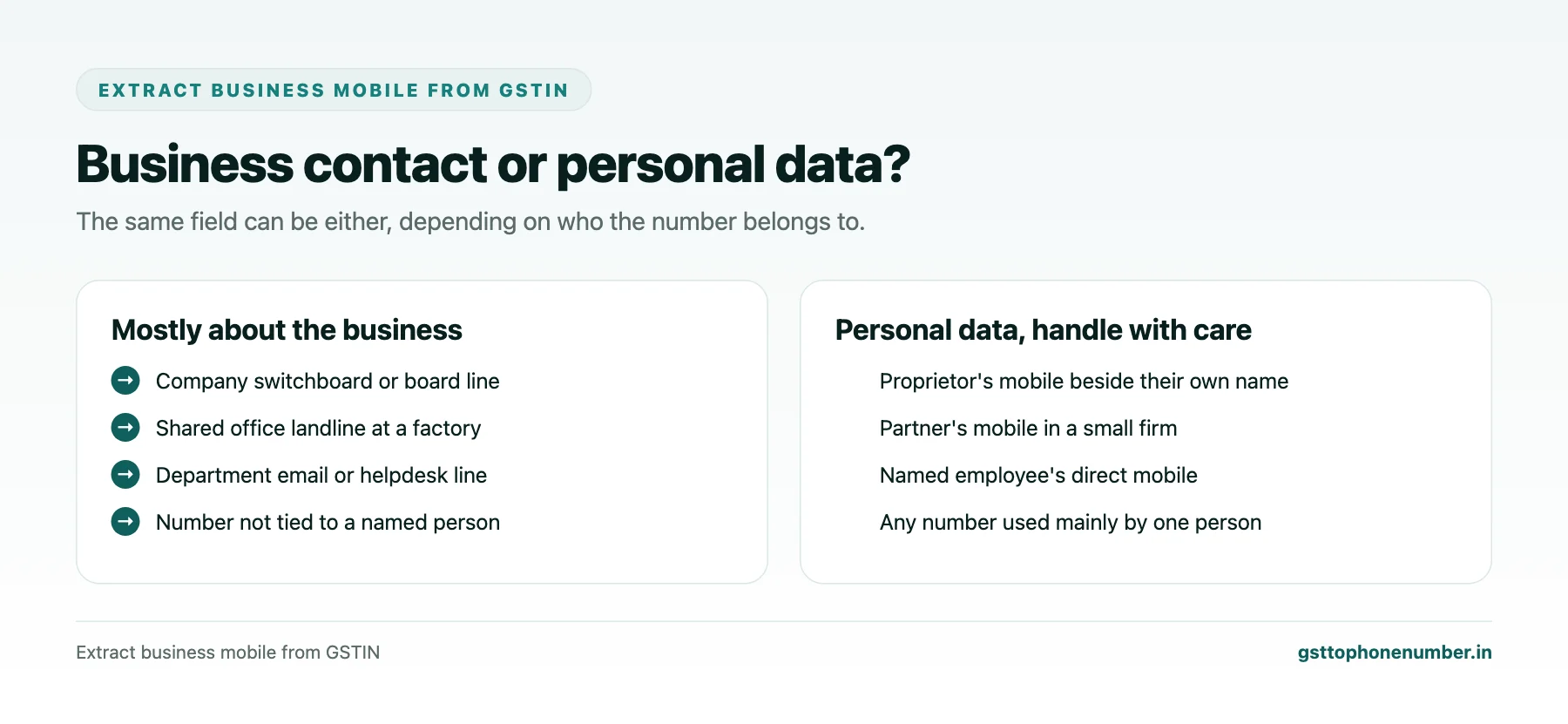
Personal data, in broad terms, is data about an individual who can be identified from it. A company’s switchboard number, on its own, is about the company. A proprietor’s mobile listed against a GST record whose legal name is that proprietor’s own name is about a person: it lets you contact them, and it is tied to their identity.
The same applies to mobiles of partners in small firms and of named employees in any business. A good working rule is that any mobile linked to a named person, or used mainly by one person, should be treated as personal data.
The Basic Expectations of the Law
The Act places obligations on organisations that decide how personal data is used, which it calls data fiduciaries. In broad terms, processing should rest on the person’s consent or on certain legitimate uses recognised by the law; people should be given notice of what data is collected and why when consent is sought; data should be kept accurate where it is used to make decisions; reasonable security safeguards are required; data should be erased when the purpose is served unless the law requires retention; and breaches must be reported.
The Act also gives individuals rights, including the right to obtain information about the processing of their data, to have it corrected or erased, and to have grievances addressed. Rules under the Act set out how many of these duties work in practice, with obligations phasing in over time, so check the current position before designing a large programme.
Publicly Available Does Not Mean Any Use Is Fine
Some people assume that a number printed on a signboard or a website can be used for anything. The law has specific provisions for data that a person has made publicly available themselves, but how they apply depends on the facts, including who published the number and for what purpose. A number a proprietor publishes so customers can call about orders is a reasonable channel for customer enquiries; it is not an invitation to add the number to an unrelated marketing list or to sell it on.
When in doubt, use the number for the kind of contact its owner evidently intended, and take advice before using it for anything broader.
Need the contact behind a GSTIN?Get the sample format with verified business contact fields.
Everyday Habits That Keep You Safe
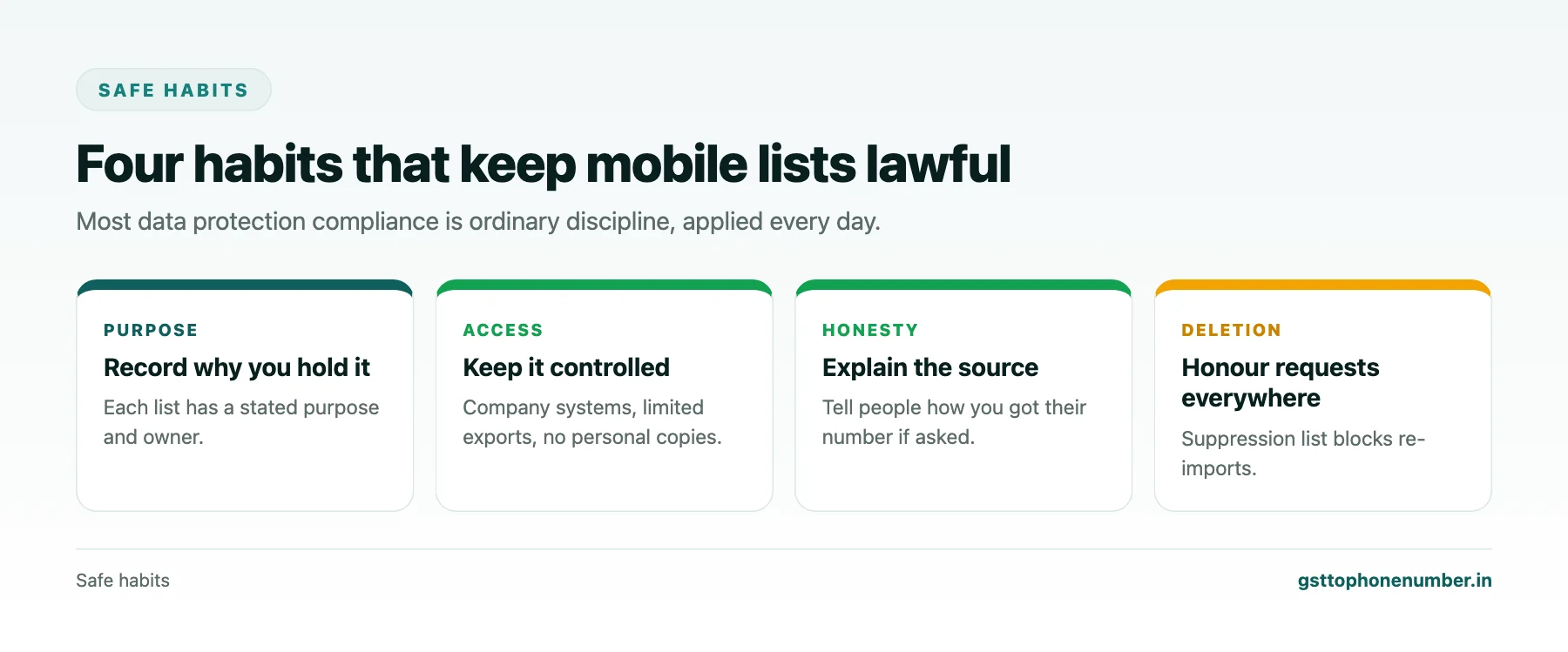
Most compliance comes down to habits. Record why each list of mobiles was extracted and which team may use it. Keep lists in systems with access controls rather than in emailed spreadsheets. Do not copy them to personal phones or chat groups. Remove numbers when the purpose ends or when a person asks. Keep a suppression list so that deleted or opted-out numbers are not re-imported from another source.
When you contact someone using an extracted mobile, say who you are and why you are calling. If they ask how you got their number, tell them honestly. If they ask you not to contact them again, record it immediately and honour it everywhere.
Handling Requests From Individuals
Sooner or later someone will ask what data you hold about them, ask for a correction, or ask you to delete their number. Decide in advance who handles such requests, how quickly, and how deletion reaches every system and list, including backups used for re-imports. A simple log of requests and actions shows that you take them seriously.
Working With Data Providers
If you obtain mobiles from a provider rather than extracting them yourself, you still decide how they are used and remain responsible for that use. Ask the provider how the data was collected, on what basis it may be used, and how corrections and deletions are passed on. Prefer providers who can supply sources and dates, and who can remove a number across their data when asked.
Want to see real match quality?See the sample format for your own GST numbers.
Security Is Part of Compliance
A leaked spreadsheet of proprietors’ names and mobiles can cause real harm: spam, fraud attempts and harassment. Reasonable security for such data includes access controls, limiting exports, using company systems rather than personal storage, and removing access when staff leave. These measures cost little and protect both the people on the list and your organisation.
When to Take Advice
Take professional advice when you plan large-scale outreach to extracted mobiles, when you intend to combine contact data with other personal information, when you share data with partners, or when a complaint or breach occurs. A short consultation before a programme launches is far cheaper than dealing with problems afterwards.
Have a list of GSTINs?Send a few and we will return matching contact fields.
Related guides
Enrich GST Number With Mobile Number for an SMS Programme That Stays Compliant: a related guide.
Frequently Asked Questions
Is a proprietor's mobile personal data?
Usually yes. When a mobile is linked to an identifiable individual, such as the proprietor named in the GST legal name, it should be treated as personal data.
What does India's data protection law expect when I extract business mobile from GSTIN records?
Broadly, a lawful basis, notice where consent is sought, accuracy, reasonable security, erasure when the purpose ends and respect for individuals’ rights.
Can I use any number published on a signboard or website?
Use it for the kind of contact its owner evidently intended, such as genuine business enquiries. Broader uses need careful thought and advice.
What should I do if someone asks me to delete their number?
Log the request, find every copy, delete it, add the number to a suppression list and confirm to the person.
Am I responsible if a provider supplied the mobiles?
You decide how the data is used, so you remain responsible for that use. Ask providers about sources, permitted use and deletion.
When should I take legal advice?
Before large-scale outreach, combining contact data with other personal data, sharing with partners, or after a complaint or breach.
 GST To Phone Number
We help sales, procurement and compliance teams turn a GST registration number into a verified, reachable business contact.
Company
Get Sample Format
Send us a few GSTINs and we will return the matching contact fields so you can judge the data before you buy.
© 2026 GST To Phone Number. All rights reserved.
Disclaimer: GST To Phone Number is an independent data service. We are not affiliated with, endorsed by or connected to the Goods and Services Tax Network, the Central Board of Indirect Taxes and Customs, or any government department. GSTIN verification should always be confirmed against the official GST portal. Contact data is provided for legitimate business use and must be used in line with applicable telecom, privacy and data-protection rules.