Home/GST Contact Search Guides/Enrich GSTIN With Contact Details: What a Full Profile Realistically Holds
Enrich GSTIN With Contact Details: What a Full Profile Realistically Holds
Enrich GSTIN with contact details beyond a phone: which fields you can expect for proprietors, firms and companies, and how to govern a full contact profile.
GST Identification Number
27ABCDE1234F1Z0
- Legal nameSample Traders Pvt Ltd
- StateMaharashtra (27)
- RegistrationActive
- Phone+91 98XXX XXXXX
- Emailc****@example.com
Illustrative result. Request a sample format for live records.
Reading time 6 min
Last reviewed October 2026
Enrich GSTIN with contact details is a broader request than a phone lookup. Teams asking for it usually want a full profile for each registration: a phone, a mobile, an email address, a website, a named contact with a role, and sometimes an indication of size or online presence. The appeal is obvious. A complete profile lets sales, marketing, accounts and support teams all work from the same record. The risk is that buyers expect every field on every row, and are disappointed or misled when the reality is patchier.
This guide sets realistic expectations for full-profile enrichment. It describes each field, how likely it is to be available for different kinds of business, where each field typically comes from, and how to govern a database of full profiles responsibly once you have it.
Quick answer
- A full profile adds email, website and named contacts to the phone number.
- Coverage differs sharply between proprietorships, firms and companies.
- Each field should carry its own source and date, not one date for the whole row.
- Named contacts are the most valuable and the most sensitive fields.
- Govern full profiles with clear purpose, access limits and retention rules.
What a Full Profile Contains
Beyond the identity fields from the GST record, a full profile typically holds a main phone number, one or more mobiles, a general email address, a website, social or marketplace profiles, and one or more named contacts with designation, direct number and email. Some profiles also carry descriptive fields such as product categories or an approximate size band.
Each of these fields comes from a different kind of source and decays at a different rate. A website may stay unchanged for years; a named purchase manager may leave within months. A full profile is therefore not one fact but a bundle of facts with different reliability.
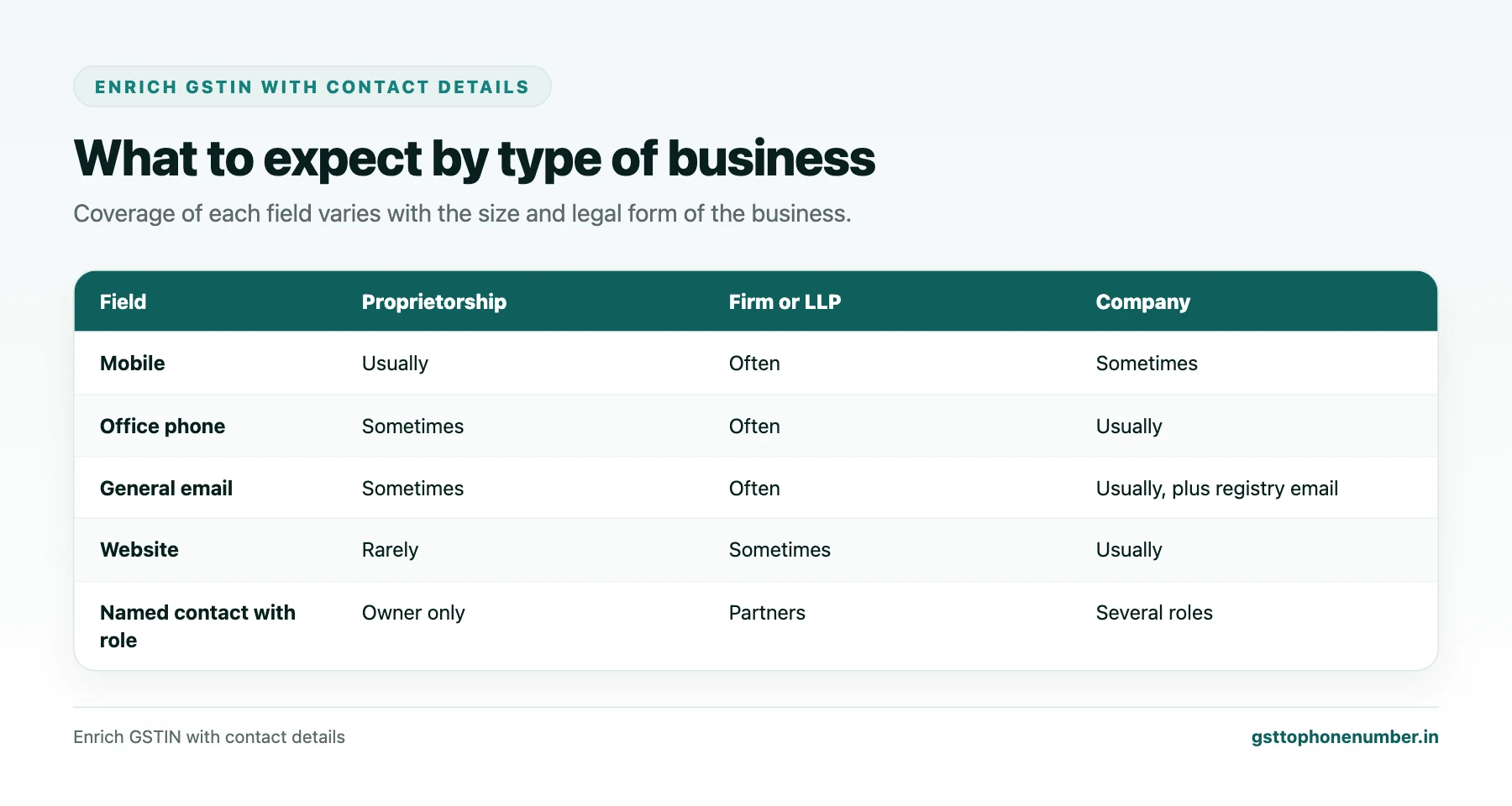
Coverage by Type of Business
Proprietorships make up a large share of GST registrations. Many have a reachable mobile, often the owner’s, but fewer have a general email, a website or named staff. Expect good mobile coverage and patchy coverage of everything else.
Partnership firms and LLPs sit in between. Established firms often have an office number, an email and a website; small ones look much like proprietorships. Companies, particularly larger private and public ones, usually have an office number, an official email recorded in the corporate registry, a website and identifiable roles, though direct numbers for named staff are harder to obtain.
Where Each Field Comes From
Phone numbers come from business listings, websites, documents the business has issued and compiled contact sources. Emails come from websites, corporate registry records for companies, and business correspondence. Websites are found through search and through listings. Named contacts come from company websites, professional profiles, event participation, industry directories and the business’s own communications.
Knowing the source matters because it tells you how far to trust the field. An email published on the company’s own website is more reliable than one scraped from an old directory. A named contact confirmed in a recent conversation is far more reliable than one inferred from a professional profile that may be years old.
Need the contact behind a GSTIN?Get the sample format with verified business contact fields.
Per-Field Dates, Not Per-Row Dates
A common design mistake is giving the whole profile one date. If the phone was confirmed last month but the named contact was added two years ago, a single date tells the user nothing useful. Record a source and a last-confirmed date for each field. Users can then trust the fresh fields and treat the old ones with caution.
The same applies to refreshes. You may refresh phone numbers often and websites rarely; per-field dates make that possible without pretending the whole profile is equally current.
The Special Weight of Named Contacts
Named contacts turn a business profile into information about people. Under India’s data protection law, details that identify an individual, such as a person’s name with their mobile or email, are personal data, and holding them brings obligations: a lawful purpose, reasonable security, accuracy, and responsiveness to requests about the data.
Hold named contacts only where they serve a clear business purpose, such as account management or procurement. Keep them accurate, remove them when people leave, and be ready to explain how you obtained them.

Governing a Full-Profile Database
Decide in writing what the profiles are for and who may use them. Limit access by role: sales may need named contacts, a reporting analyst may not. Control exports, because full profiles leaked as spreadsheets are hard to recall. Set a retention rule, such as removing named contacts not confirmed for a long period, and apply it.
If you buy enrichment, ask the provider how each field was collected, on what basis it can be used, and whether it can be corrected or removed on request. Put the answers in your agreement.
Want to see real match quality?See the sample format for your own GST numbers.
Questions to Settle Before Ordering a Full Profile
Before commissioning a full-profile enrichment, agree internally on three things. First, which fields each team will actually use, because paying for named contacts that nobody calls is waste with a privacy cost attached. Second, what counts as a usable value for each field: a general enquiry email may suit marketing but not accounts, and a switchboard number may suit a first call but not a renewal conversation. Third, who owns the profiles afterwards and keeps them current.
Teams that settle these questions first tend to order fewer fields, pay less and use more of what they receive. Teams that skip them often end up with a large, impressive file that slowly goes stale in a shared folder.
Getting Value From Partial Profiles
Since full coverage is unrealistic, design processes that work with partial profiles. Route rows with mobiles to phone teams, rows with emails to email programmes, and rows with websites to research. Use every interaction to fill gaps: a call that reaches the owner can confirm an email; an email reply can confirm a named contact. Over time, the profiles that matter most to your business become the most complete.
Have a list of GSTINs?Send a few and we will return matching contact fields.
Related guides
Enrich GST Number With Phone Number: a related guide.
Frequently Asked Questions
What does it mean to enrich GSTIN with contact details?
Adding a full contact profile to each registration: phone, mobile, email, website and named contacts with roles, each with its own source and date.
Will every GSTIN get every field?
No. Coverage varies by type of business. Proprietorships usually have a mobile but fewer emails and websites; companies usually have office numbers, emails and websites.
Why record a date for each field?
Fields decay at different rates. Per-field dates let users trust fresh fields and treat old ones with caution.
Are named contacts personal data?
Yes. A person’s name with their mobile or email identifies an individual, so it needs a lawful purpose, security, accuracy and responsiveness to requests.
How should a full-profile database be governed?
Define its purpose, limit access by role, control exports, set retention rules and handle correction or deletion requests.
How can partial profiles still be useful?
Route each row to the channel its fields support and use every interaction to fill the gaps that matter most.
 GST To Phone Number
We help sales, procurement and compliance teams turn a GST registration number into a verified, reachable business contact.
Company
Get Sample Format
Send us a few GSTINs and we will return the matching contact fields so you can judge the data before you buy.
© 2026 GST To Phone Number. All rights reserved.
Disclaimer: GST To Phone Number is an independent data service. We are not affiliated with, endorsed by or connected to the Goods and Services Tax Network, the Central Board of Indirect Taxes and Customs, or any government department. GSTIN verification should always be confirmed against the official GST portal. Contact data is provided for legitimate business use and must be used in line with applicable telecom, privacy and data-protection rules.