Home/Bulk GST Contact Data Guides/Bulk GSTIN to Mobile Number: Getting Mobile-Only Lists Right
Bulk GSTIN to Mobile Number: Getting Mobile-Only Lists Right
Bulk GSTIN to mobile number lists explained: how mobiles differ from landlines, SMS DLT rules, chat consent, portability and checks before sending.
GST Identification Number
27ABCDE1234F1Z0
- Legal nameSample Traders Pvt Ltd
- StateMaharashtra (27)
- RegistrationActive
- Phone+91 98XXX XXXXX
- Emailc****@example.com
Illustrative result. Get sample format for live records.
Reading time 7 min
Last reviewed October 2026
Bulk GSTIN to mobile number requests are different from general phone lookups in one important way: the buyer specifically wants ten-digit mobile numbers, not office landlines or switchboards. The reason is usually the channel. Mobiles can receive SMS and business chat messages, they tend to reach a decision maker directly in smaller businesses, and they are the only practical way to contact many proprietors who never installed a landline in the first place.
That focus brings its own rules and its own risks. A mobile number is far more likely to be personal, sending commercial messages to it is regulated, and the same number can move between operators or even change hands over time. This guide covers what a mobile-only bulk list should look like, the messaging rules that apply in India, and the checks that keep a mobile list clean and lawful.
Quick answer
- Ask for mobiles only when your channel needs them: SMS, chat or direct reach to an owner.
- In small firms the mobile is often also the owner’s personal number, so handle it with extra care.
- Commercial SMS in India runs through registered headers and approved templates.
- Chat messaging generally needs the recipient’s opt-in before you message at scale.
- Operator portability means the number’s prefix no longer tells you the network.
Why Teams Ask for Mobiles Specifically
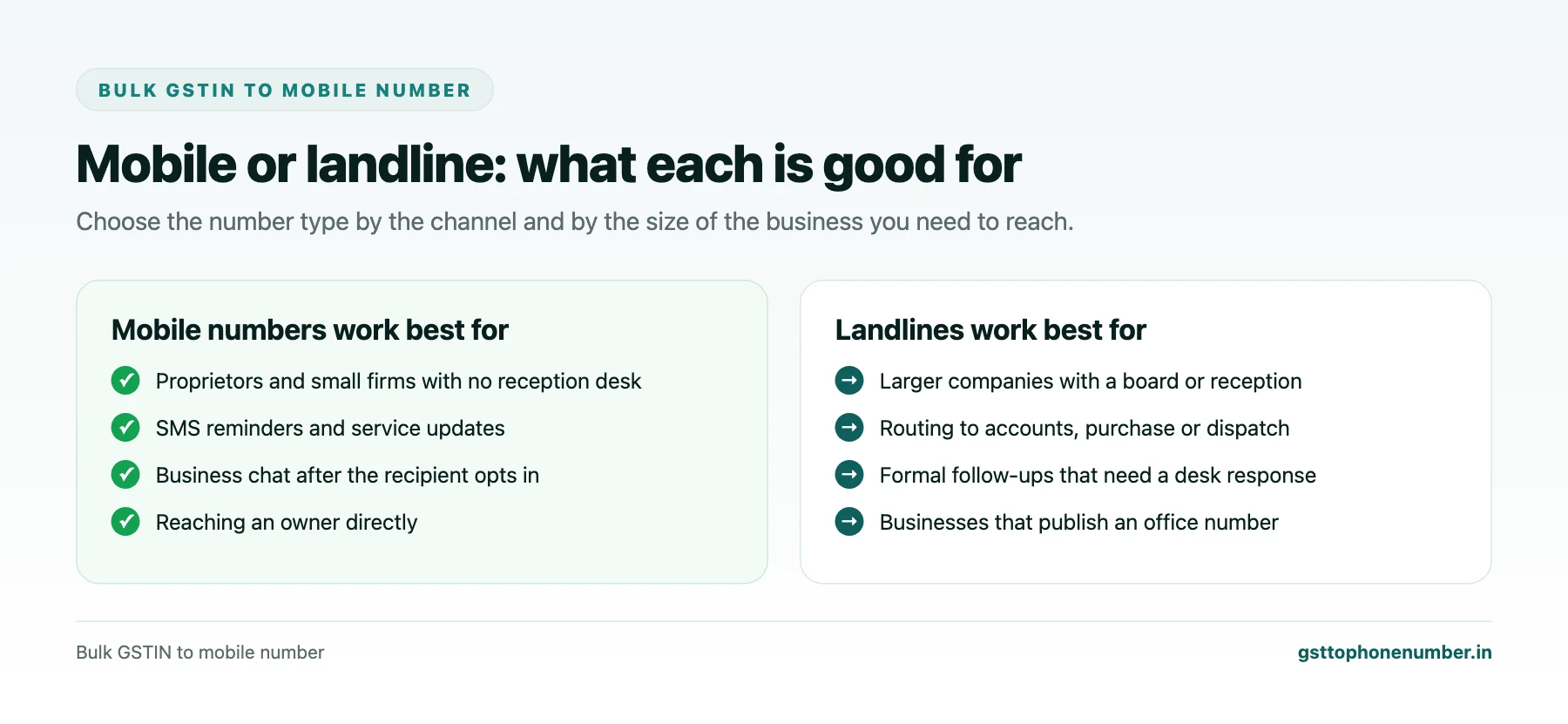
In large companies, a landline or board number reaches a reception desk that can route a call. In the many proprietorships, partnership firms and small private companies that make up most GST registrations, there is often no reception desk at all. The owner’s mobile is the business line, the accounts line and the after-hours line rolled into one.
So a mobile-only list is attractive for anyone who needs to reach small businesses directly: distributors recruiting retailers, lenders offering working capital, software companies selling billing tools, or suppliers announcing a price change. It is also the only kind of list that works for SMS reminders and business chat updates.
What a Mobile Number Can and Cannot Tell You
An Indian mobile number has ten digits and begins with 6, 7, 8 or 9. That simple rule is enough to separate mobiles from landlines in a mixed file, and it should be the first filter applied to any bulk output that claims to be mobile-only. Numbers stored with a leading zero or with the country code should be normalised so the ten core digits are easy to test.
What the number no longer tells you is the operator or the home circle with any certainty. Mobile number portability lets a subscriber keep their number when switching operators, and numbers often travel with their owners when they move cities. Do not rely on the prefix of a number to infer where a business is or which network it uses; rely on the GST record’s address instead.
Commercial SMS Rules in India
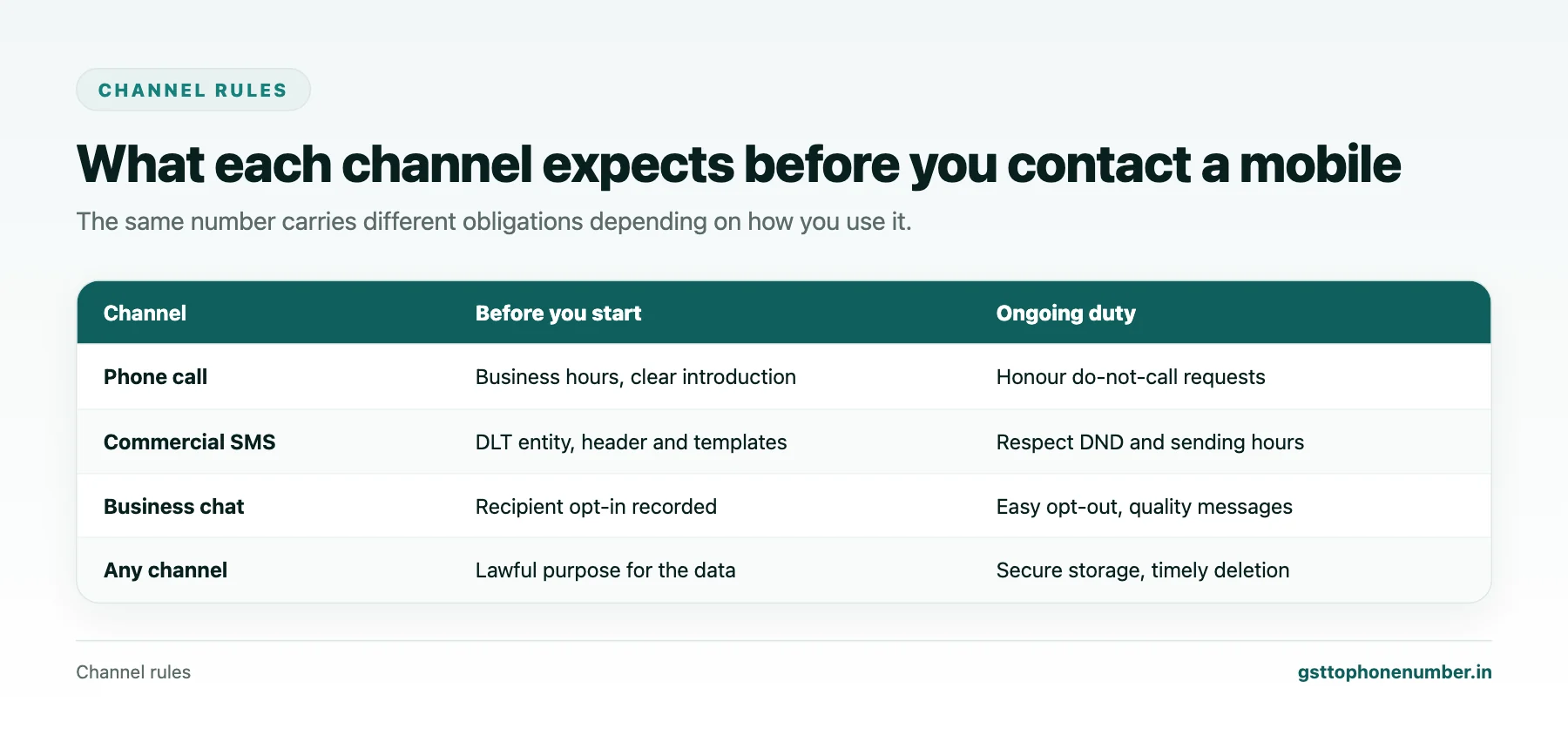
If the purpose of the list is to send SMS, the rules matter before the first message goes out. India’s telecom regulator requires businesses that send commercial SMS to register as principal entities on the operators’ distributed ledger platform, commonly called DLT. Each sender uses a registered header, the short sender name that appears on the phone, and each message follows a content template registered in advance.
Messages are also classified. Transactional and service messages, such as an order update or payment reminder to an existing customer, follow different rules from promotional messages sent to people who have no relationship with you. Promotional messages are restricted by the recipient’s Do Not Disturb preferences and by permitted sending hours. Treat this summary as orientation and confirm the current rules with your messaging partner before launching.
Need the contact behind a GSTIN?Get the sample format with verified business contact fields.
Business Chat Messaging and Consent
Business chat platforms have become a common way to share catalogues, order confirmations and payment links with small traders. Most of these platforms expect a business to have the recipient’s opt-in before sending messages at scale, and they restrict unsolicited promotional messages through their own policies and quality ratings. A number that appears in a purchased list has not opted in to anything.
The practical route is to use the bulk mobile list for a first contact through a channel that allows it, such as a courteous call, and to collect explicit agreement to receive chat updates during that conversation. Record the date and method of consent against the number. That record protects the account you message from and keeps message quality high.
The Privacy Weight of a Mobile List
India’s Digital Personal Data Protection Act treats information about an identifiable individual as personal data. A landline at a company office is mostly about the business. A mobile number used by a proprietor is about a person. That difference should shape how a mobile list is stored, who can open it, how long it is kept and how requests to stop contact are handled.
Keep mobile lists inside systems with access controls rather than in shared spreadsheets, avoid copying them to personal devices, and delete numbers that are no longer needed for the purpose they were obtained for. When someone asks how you got their number, have a clear and honest answer ready.
Checks Before You Use a Bulk Mobile List
Run a short set of checks on every bulk GSTIN to mobile number output before it reaches a caller or a messaging tool. Remove anything that is not ten digits starting with 6 to 9 after normalisation. Flag numbers that appear against many unrelated GSTINs, because they usually belong to accountants or agents. Flag numbers attached to cancelled registrations if your purpose is sales. And compare the result with your own suppression list so that people who asked not to be contacted are removed before anyone else sees the file.
Pre-use checks for a mobile list
- Ten digits, starting 6 to 9
- One normalised format
- Not shared across unrelated GSTINs
- Registration status noted
- Suppression list applied
- Consent status recorded
Want to see real match quality?See the sample format for your own GST numbers.
Mixing Mobiles With Landlines
Some teams ask for mobiles only and then discover that larger companies in the list have no reachable mobile at all, only a board number. For those rows, a landline is not a failure; it is the right channel. A sensible request is mobile first, landline as fallback, with a column that tells the team which type was returned.
That approach keeps SMS and chat sends restricted to mobile rows, while callers can still use the landlines to reach larger businesses through their reception desks.
Keeping a Mobile List Fresh
Mobile numbers change hands more than people think. When a subscriber gives up a number, it can eventually be reissued to someone else, which means a number that belonged to a trader two years ago may now belong to a student or a family. Calls and messages to recycled numbers cause confusion and complaints.
Recheck numbers that have not produced a confirmed contact for a long time, retire numbers that repeatedly reach someone unconnected with the business, and record the last date each number was confirmed. A mobile list maintained this way stays both effective and respectful.
Have a list of GSTINs?Send a few and we will return matching contact fields.
Related guides
Enrich GST Number With Mobile Number for an SMS Programme That Stays Compliant: a related guide.
Extract Business Mobile From GSTIN Records Without Breaking Data Protection Rules: a related guide.
Find GST Business Mobile Number for Small Shops and Traders: a related guide.
Find Mobile Number with GSTIN and Confirm It Is a Business Line: a related guide.
Frequently Asked Questions
How do I tell mobiles from landlines in a bulk list?
After removing spaces, leading zeros and the country code, an Indian mobile has ten digits starting with 6, 7, 8 or 9. Landlines carry a city code and a shorter local number.
Can I send SMS to a bulk GSTIN to mobile number list?
Commercial SMS in India must go through a registered principal entity, header and approved templates on the DLT platform, and promotional messages must respect Do Not Disturb preferences.
Can I message these numbers on a business chat app?
Chat platforms generally expect the recipient’s opt-in before businesses message them at scale. Collect consent first, often during a call, and record it.
Does a mobile number's prefix show the business location?
No. Portability and people moving cities mean the prefix is unreliable. Use the address in the GST record instead.
Are proprietor mobile numbers personal data?
A mobile used by an identifiable individual is personal data under India’s data protection law, so store it securely, use it for a clear purpose and honour requests to stop contact.
What if a company has no mobile number?
Accept a landline as a fallback for larger businesses and mark the number type so that SMS and chat sends are limited to mobile rows.
 GST To Phone Number
We help sales, procurement and compliance teams turn a GST registration number into a verified, reachable business contact.
Company
Get Sample Format
Send us a few GSTINs and we will return the matching contact fields so you can judge the data before you buy.
© 2026 GST To Phone Number. All rights reserved.
Disclaimer: GST To Phone Number is an independent data service. We are not affiliated with, endorsed by or connected to the Goods and Services Tax Network, the Central Board of Indirect Taxes and Customs, or any government department. GSTIN verification should always be confirmed against the official GST portal. Contact data is provided for legitimate business use and must be used in line with applicable telecom, privacy and data-protection rules.