Home/GST Contact Search Guides/Discover Company Contact From GSTIN for Partnerships, Investment and Acquisitions
Discover Company Contact From GSTIN for Partnerships, Investment and Acquisitions
Discover company contact from GSTIN when you want to partner with, invest in or buy a company: read its footprint, find the decision makers and approach well.
GST Identification Number
27ABCDE1234F1Z0
- Legal nameSample Traders Pvt Ltd
- StateMaharashtra (27)
- RegistrationActive
- Phone+91 98XXX XXXXX
- Emailc****@example.com
Illustrative result. Request a sample format for live records.
Reading time 5 min
Last reviewed October 2026
Discover company contact from GSTIN details for a very different reason than a salesperson does when the goal is a deal rather than an order. Private equity analysts screening targets, corporate development teams looking for acquisitions, larger firms seeking distribution or manufacturing partners, and founders exploring a merger all start with the same problem: they have identified an interesting company, often through its GST footprint, and now need to reach the people who own and control it, discreetly and credibly.
This guide covers that kind of approach. It explains what a company’s GST registrations reveal about its operations, how corporate records identify the owners and directors, which public documents add depth, and how to make a first approach that leads to a serious conversation instead of a polite refusal.
Quick answer
- GST registrations map where a company actually operates and what it does.
- Corporate records identify directors and, through filings, the shareholders.
- For deals, the right contact is an owner or director, not a department.
- Warm introductions through advisers, bankers or associations work far better than cold calls.
- Keep the first approach brief, confidential and clear about intent.
Why GST Data Helps Deal Scouting
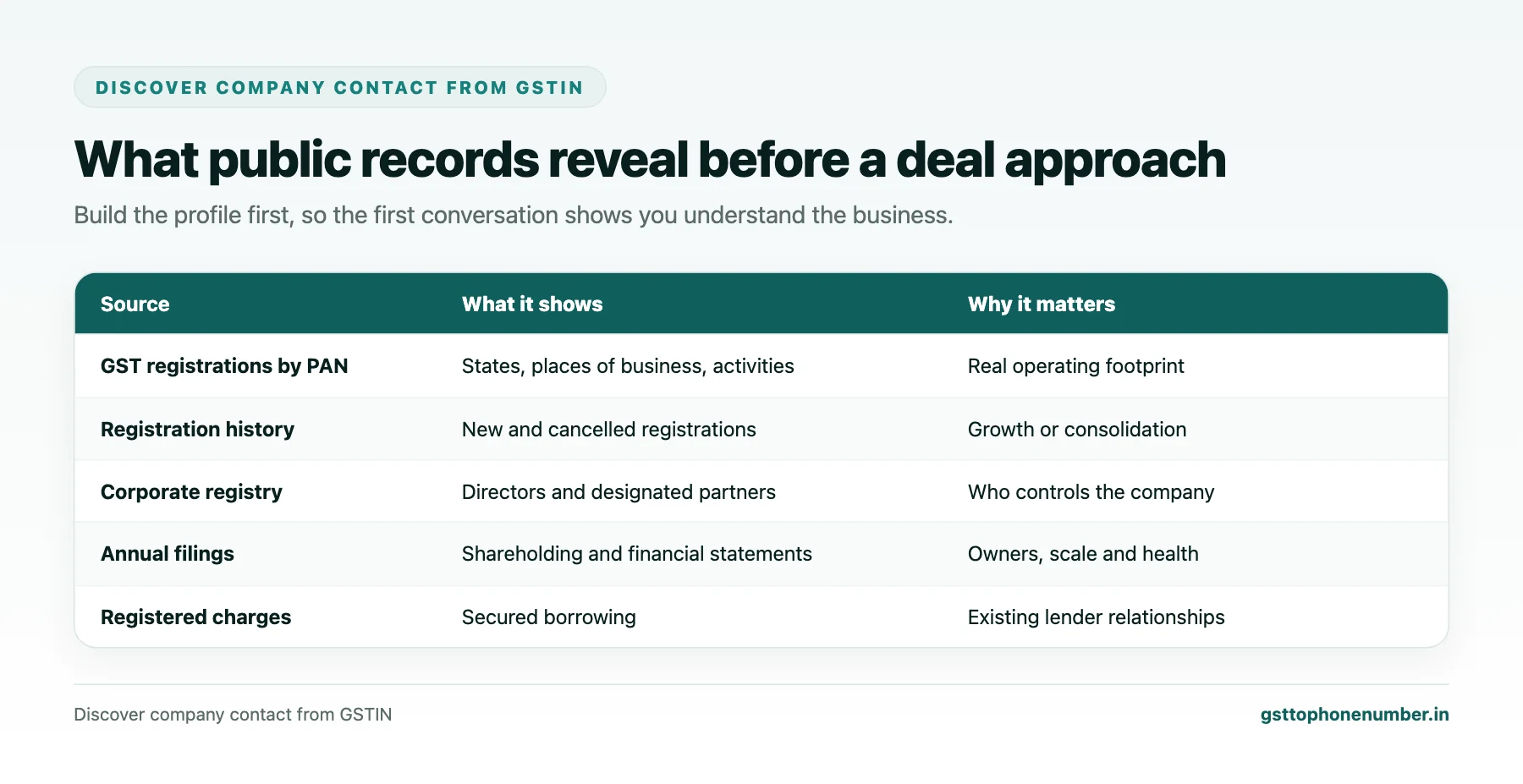
When screening for targets or partners, the questions are often about operations: where does the company manufacture, which states does it sell into, what goods does it deal in, how long has it been operating and is it compliant? The GST footprint answers many of these. A search by PAN shows every state registration, the places of business within each, the declared activities, the dates of registration and the filing record.
That operational picture is often more current than any directory or press article. A company that has added registrations in three new states in recent years is expanding; one whose registrations are being cancelled may be consolidating or in difficulty.
Identifying the Owners and Directors
For companies and LLPs, the corporate registry lists the current directors or designated partners. In closely held private companies, these are usually the owners or their family members. The annual returns filed by companies include details of shareholding, and financial statements are filed each year; these documents can be viewed through the official portal’s public document service for a fee.
From these records you can usually identify the promoter family, the directors with executive roles and any institutional investors already on the shareholder register. Those are the people who decide on partnerships, investment and sale.
Building a Profile Before Any Contact
Before reaching out, assemble what is publicly available: the GST footprint, the corporate details, recent financial statements, the company’s website and product range, any press coverage and its standing in industry associations. Note anything that would affect your approach, such as a recent change of directors, a new plant or a large registered charge.
A well-prepared first conversation shows the owners that you understand their business, which matters a great deal to founders who have spent decades building it. It also prevents embarrassing mistakes, such as approaching the wrong entity in a group of similarly named companies.
Need the contact behind a GSTIN?Get the sample format with verified business contact fields.
Finding a Route to the Decision Makers
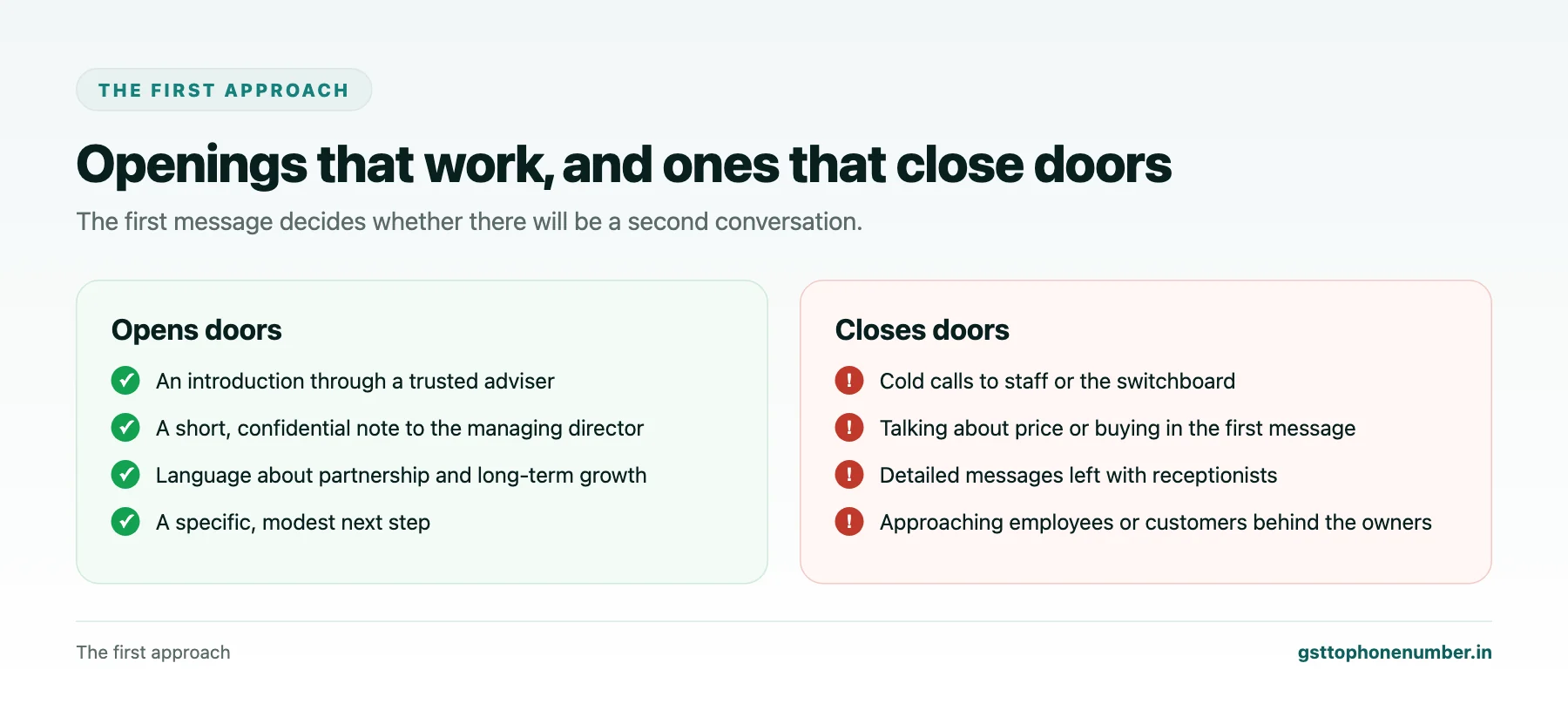
The best route is almost always an introduction. Chartered accountants, bankers, lawyers, industry association office-bearers and mutual customers or suppliers often know the promoters personally. An introduction through someone they trust gets a meeting that a cold message would not. Ask your own network who knows the company, and be specific about why you want to meet.
If no introduction is available, write formally. The registered office address and the official email address on the corporate record are proper channels for correspondence addressed to the directors. A short letter addressed to the managing director by name, marked confidential, stating who you are and the nature of your interest in general terms, is appropriate and is usually passed to the right person.
What to Say in the First Approach
Keep it short. Introduce your organisation and its credibility in one or two sentences, explain why this company interests you without revealing more of your strategy than necessary, and propose a specific next step, such as an introductory call. Make clear that the approach is confidential and that you would be glad to sign a non-disclosure agreement before any detailed discussion.
Avoid mentioning valuation, price or anything that sounds like a takeover in the first message. Founders often react badly to a stranger talking about buying their company. Language about partnership, growth and long-term interest opens more doors.
Approaching Proprietorships and Partnerships
Not every interesting business is a company. Many strong manufacturers and distributors are still proprietorships or partnership firms. For these, the GST legal name identifies the proprietor or firm, but there is no corporate record of owners beyond that. Introductions matter even more here, because the owner’s personal reputation and relationships are the business. Industry associations, local chambers and long-standing suppliers are the best channels.
Want to see real match quality?See the sample format for your own GST numbers.
Discretion and Confidentiality
Deal approaches can unsettle employees, customers and competitors if word spreads. Contact owners directly rather than through staff, avoid leaving detailed messages with receptionists, and keep your internal notes about targets secure. If the company declines, respect the decision and do not approach its staff or customers about the matter.
Keeping the Relationship Warm
Many deals take years. A first conversation that ends without agreement can still be valuable if you keep in touch respectfully: share relevant industry insights, congratulate them on milestones, and check in when circumstances change. Track the company’s GST footprint and filings from time to time, since new registrations, new directors or changes in charges can signal that the timing is right for a second conversation.
Have a list of GSTINs?Send a few and we will return matching contact fields.
Related guides
Company Phone by GSTIN for Listed Companies: a related guide.
Discover Business Contact From GSTIN: a related guide.
Check Company Contact From GST Number Before Offering Credit Terms: a related guide.
Frequently Asked Questions
How do I discover company contact from GSTIN for a deal?
Map the company’s GST footprint, identify directors and shareholders through corporate records, build a profile, then approach the owners through an introduction or a formal confidential letter.
Can GST data show where a company operates?
Yes. A search by PAN lists every state registration, and each shows places of business, activities and registration dates.
How do I find who owns a private company?
The corporate registry lists directors, and annual filings with shareholding details can be viewed through the official public document service.
Is it better to call or write?
An introduction through a trusted adviser or banker is best. Without one, a short confidential letter to the managing director at the registered office works better than a cold call.
What should the first message avoid?
Price, valuation and takeover language. Focus on who you are, why the company interests you and a modest next step.
What if the business is a proprietorship?
There is no corporate record of owners beyond the GST legal name, so introductions through associations, chambers and long-standing partners matter even more.
 GST To Phone Number
We help sales, procurement and compliance teams turn a GST registration number into a verified, reachable business contact.
Company
Get Sample Format
Send us a few GSTINs and we will return the matching contact fields so you can judge the data before you buy.
© 2026 GST To Phone Number. All rights reserved.
Disclaimer: GST To Phone Number is an independent data service. We are not affiliated with, endorsed by or connected to the Goods and Services Tax Network, the Central Board of Indirect Taxes and Customs, or any government department. GSTIN verification should always be confirmed against the official GST portal. Contact data is provided for legitimate business use and must be used in line with applicable telecom, privacy and data-protection rules.