Bulk GST Contact Data Guides: A Reading Path From Planning to Upkeep
Bulk GST contact data guides in one place: plan a list, buy wisely, structure the file, use it on calls and keep it fresh, with the right article for each step.
GST Identification Number
27ABCDE1234F1Z0
- Legal nameSample Traders Pvt Ltd
- StateMaharashtra (27)
- RegistrationActive
- Phone+91 98XXX XXXXX
- Emailc****@example.com
Illustrative result. Request a sample format for live records.
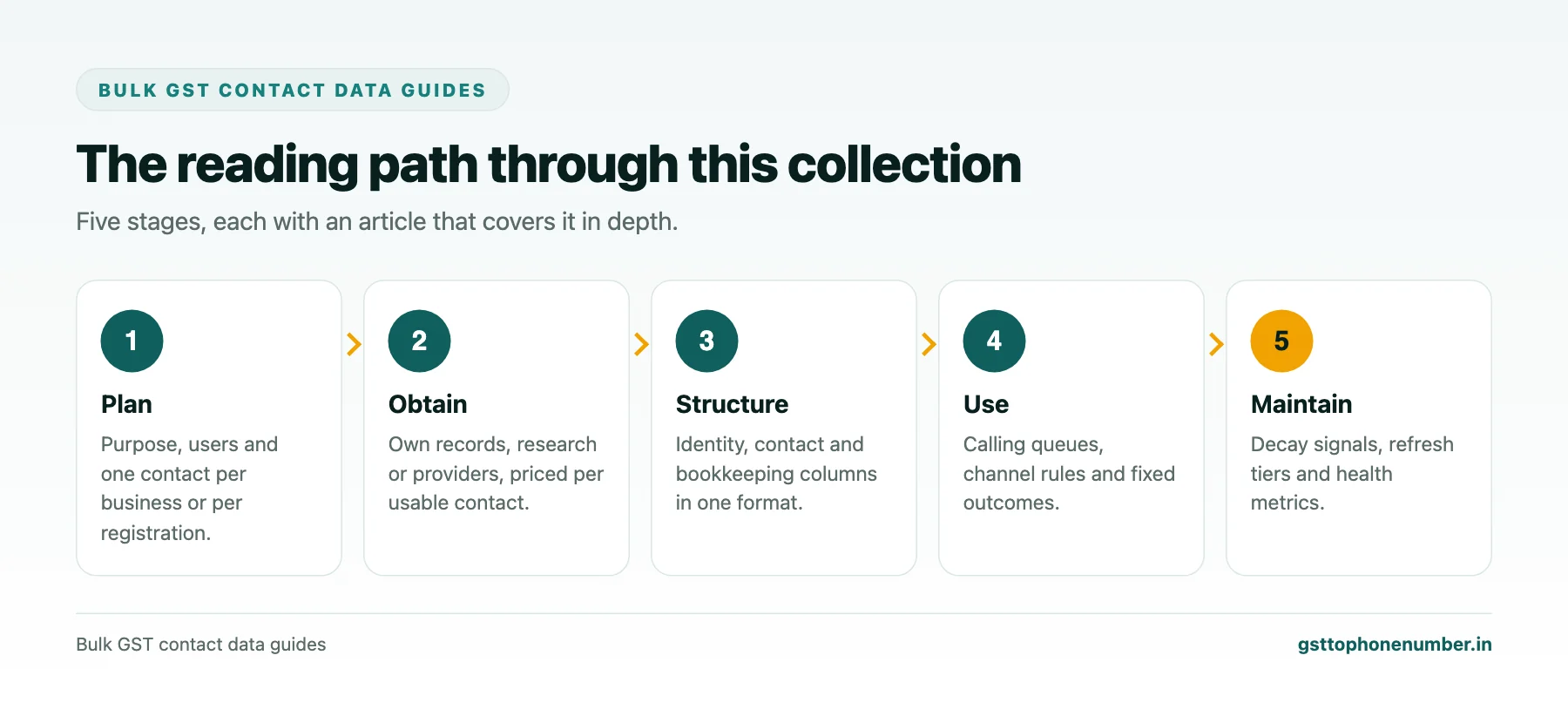
Bulk GST contact data guides on this page are arranged as a reading path rather than a pile of articles. Working with contact details for hundreds or thousands of GST registrations is a sequence of decisions: deciding what list you need, choosing how to obtain contacts, structuring the file, putting it to work and keeping it accurate. Each decision has its own pitfalls, and each article in this collection deals with one of them in depth. This page tells you which article to read at which stage, and what you should know before you start.
The collection is written for people who handle GST-linked contact lists as part of their job: sales operations and inside sales teams, procurement and vendor management, accounts and collections staff, channel and dealer teams, and the analysts who support them. You do not need technical training to use any of it, though a working knowledge of spreadsheets helps.
Quick answer
- Read the collection in order: plan, buy, structure, use, maintain.
- Start with the bulk lookup job guide if you are new to the topic.
- Read the pricing guide before you collect quotes from any provider.
- Read the file design guide before you receive or build any bulk file.
- Revisit the decay and refresh guide a few months after every delivery.
Why Bulk Contact Work Needs Its Own Guides
Looking up one business’s phone number is a short task. Doing the same for a long list is a different kind of work. Small error rates that do not matter for one lookup become hundreds of wrong calls across a large file. Formatting habits that are harmless in a single entry break diallers and customer systems at scale. And a list that was accurate on delivery begins to decay within weeks, which matters little for a one-off lookup but a great deal for a list a team will use for months.
That is why this collection treats bulk work separately from single lookups. The articles share a common thread: identity first, through a validated GSTIN, then evidence for every contact, then disciplined use and upkeep.
Stage One: Planning the List
Before any contact is looked up, decide what the list is for and who will use it. A sales team, a collections team and a vendor-onboarding team need different contacts, different fields and different levels of certainty. The planning stage also decides whether you need one contact per business or one per registration, because companies registered in several states share a PAN and often a head office.
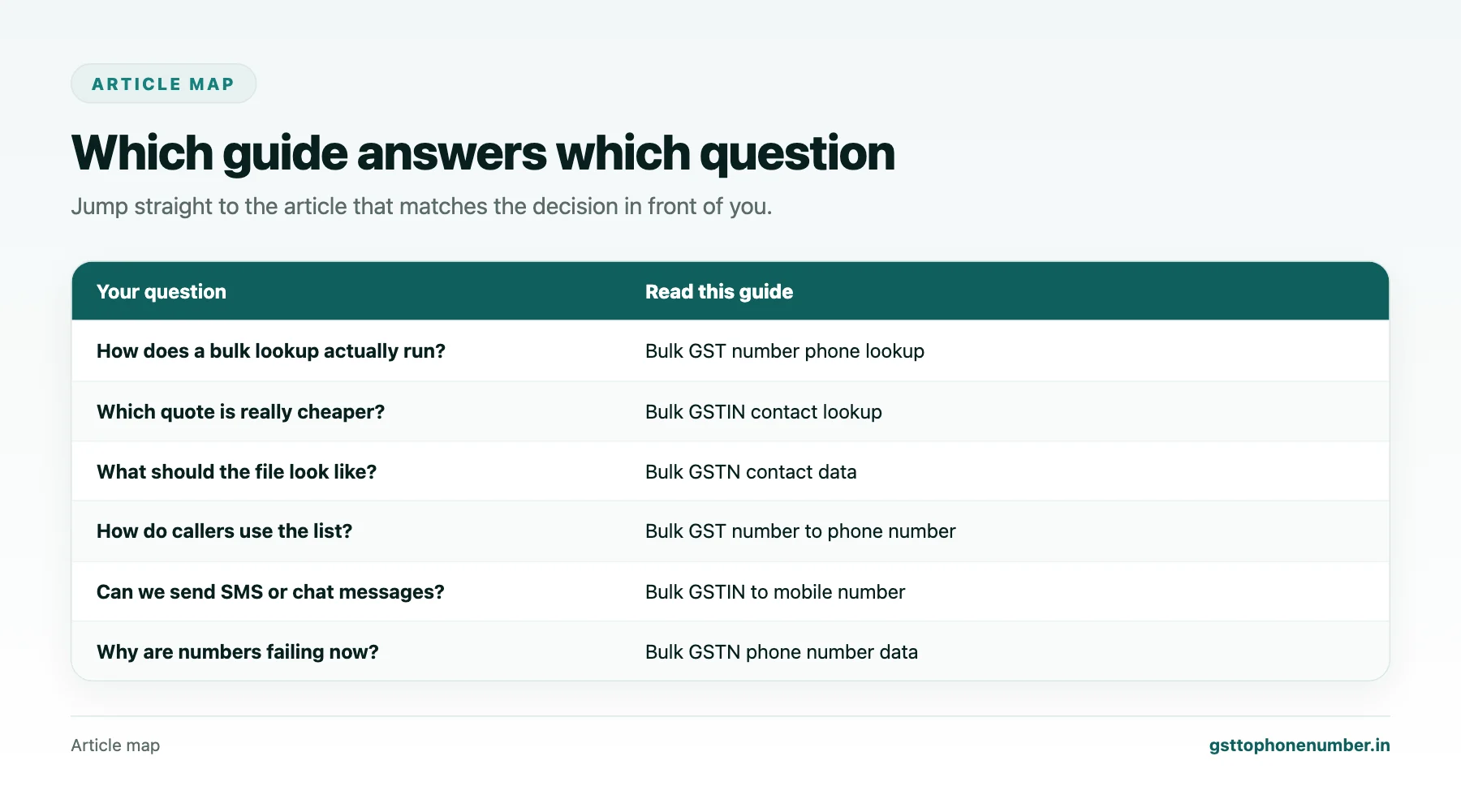
The guide to how a bulk GST number phone lookup job runs walks through intake, cleaning, validation and the rest of the process, and it is the best starting point for anyone new to the subject.
Stage Two: Obtaining Contacts Wisely
Contacts can come from your own records, from careful manual research or from business contact data providers. For long lists, providers are usually involved, and the way they charge has a large effect on the true cost. The guide to bulk GSTIN contact lookup pricing explains per-row, per-match and subscription models and shows how to compare quotes on the cost per usable contact rather than the headline rate.
If your campaign depends on mobiles specifically, for SMS or business chat, read the bulk GSTIN to mobile number guide at this stage as well, because the channel rules affect what you should ask for.
Need the contact behind a GSTIN?Get the sample format with verified business contact fields.
Stage Three: Structuring the File
A well-structured file is cheaper to use and cheaper to maintain. The bulk GSTN contact data guide sets out a three-block structure of identity, contact and bookkeeping columns, a single phone format, one contact per row and a PAN column that keeps multi-state companies together. Reading it before a file arrives lets you specify what you want; reading it afterwards lets you judge what you received.
The database-focused articles in the collection cover related ground from the point of view of searching and maintaining a contact database keyed on GST details, which suits teams that look up contacts continuously rather than in one large batch.
Stage Four: Putting the List to Work
Most bulk lists end up in front of people making calls. The bulk GST number to phone number guide shows how to reshape a converted list for a dialler, order the calling queue, respect telecom rules and capture fixed call outcomes that feed back into the data. The same principles apply to collections drives, dealer recruitment and supplier outreach.
The supplier, vendor and dealer database articles add context for teams whose lists are about their own trading partners rather than prospects.
Stage Five: Keeping the Data Fresh
Contact data decays as businesses move, change hands and change numbers, and as mobile numbers are recycled. The bulk GSTN phone number data guide explains the causes of decay, the early warnings visible in GST records, a tiered refresh schedule and the metrics that show whether a list is getting healthier or worse. It is the article most worth rereading a few months after any delivery.
Want to see real match quality?See the sample format for your own GST numbers.
Terms Used Across the Collection
A few terms appear throughout. A GSTIN is the fifteen-character GST identification number; its first two digits are the state code and characters three to twelve are the PAN. A match level records how strongly a contact is linked to a GSTIN, from a direct identity link down to a reviewer’s judgement. Right-party reach measures how often a call actually connects to the intended firm rather than a stranger or an empty line. A suppression list holds contacts who must not be contacted. Last confirmed is the date a contact was most recently verified by a call or reply.
Terms you will meet
GSTIN and PANState codeMatch levelRight-party reachSuppression listLast confirmed dateResponsible Use Runs Through Every Stage
Many contacts in GST-linked lists belong to proprietors whose business mobile is also personal. Every article in the collection returns to the same principles: use contacts for a clear business purpose, introduce yourself honestly, honour requests not to be contacted, keep files in controlled systems, and delete contacts that are no longer needed. These habits protect the people on your list and the reputation of the team using it.
Where to Go Next
If you need a single business’s contact rather than a bulk list, the phone lookup, mobile number and contact search collections linked from the resources page cover individual lookups in detail. If you want to see what a matched file looks like before planning your own, request sample data and compare it against the structure described in the file design guide.
Have a list of GSTINs?Send a few and we will return matching contact fields.
- Why Bulk Contact Work Needs Its Own Guides
- Stage One: Planning the List
- Stage Two: Obtaining Contacts Wisely
- Stage Three: Structuring the File
- Stage Four: Putting the List to Work
- Stage Five: Keeping the Data Fresh
- Terms Used Across the Collection
- Responsible Use Runs Through Every Stage
- Where to Go Next
Articles in this collection
Follow a bulk lookup job through all six stages, from intake to an accepted file.
Compare pricing models and work out what each usable contact really costs.
Design the columns, formats and row layout that keep a contact file usable.
Turn a converted list into a calling queue that telecallers can work quickly.
Handle mobile-only lists, SMS registration rules and chat consent properly.
Understand why phone data decays and set a refresh schedule that fits.
What a GSTIN-keyed database with contact fields should contain.
Using a business database where each GST record carries a phone number.
Contact databases built only from active GST registrations.
Searching a business contact database by GST details.
Running GSTIN-based searches against a contact database.
Searching for incorporated companies in a GST contact database.
Company-level searches keyed on the GSTIN and PAN.
Building and searching a database of supplier contacts by GSTIN.
Keeping vendor contacts organised against their GST registrations.
Phone numbers in databases of GST-registered businesses.
Company phone numbers in databases of GST-registered companies.
Frequently Asked Questions
Where should I start with the bulk GST contact data guides?
Start with the bulk GST number phone lookup guide, which explains the whole job from intake to delivery, then follow the reading path stage by stage.
Which guide should I read before collecting quotes?
The bulk GSTIN contact lookup guide, which compares pricing models and shows how to calculate the cost per usable contact.
Is there guidance on file structure?
Yes. The bulk GSTN contact data guide covers columns, formats, one contact per row and handling companies with several GSTINs.
Do the guides cover SMS and chat rules?
The bulk GSTIN to mobile number guide covers SMS registration requirements, chat consent and the privacy weight of mobile lists.
How do I keep a bulk list accurate?
The bulk GSTN phone number data guide explains decay, refresh schedules and the metrics that show a list’s health.
Are these guides only for sales teams?
No. They also suit procurement, vendor management, collections and channel teams who work with GST-linked contact lists.
 GST To Phone Number
We help sales, procurement and compliance teams turn a GST registration number into a verified, reachable business contact.
Company
Get Sample Format
Send us a few GSTINs and we will return the matching contact fields so you can judge the data before you buy.
© 2026 GST To Phone Number. All rights reserved.
Disclaimer: GST To Phone Number is an independent data service. We are not affiliated with, endorsed by or connected to the Goods and Services Tax Network, the Central Board of Indirect Taxes and Customs, or any government department. GSTIN verification should always be confirmed against the official GST portal. Contact data is provided for legitimate business use and must be used in line with applicable telecom, privacy and data-protection rules.