Home/Bulk GST Contact Data Guides/Bulk GST Number Phone Lookup: How a Large Lookup Job Actually Runs
Bulk GST Number Phone Lookup: How a Large Lookup Job Actually Runs
Bulk GST number phone lookup, start to finish: prepare the file, clean and dedupe GSTINs, run matching passes and read the output before anyone dials.
GST Identification Number
27ABCDE1234F1Z0
- Legal nameSample Traders Pvt Ltd
- StateMaharashtra (27)
- RegistrationActive
- Phone+91 98XXX XXXXX
- Emailc****@example.com
Illustrative result. Get sample format for live records.
Reading time 9 min
Last reviewed October 2026
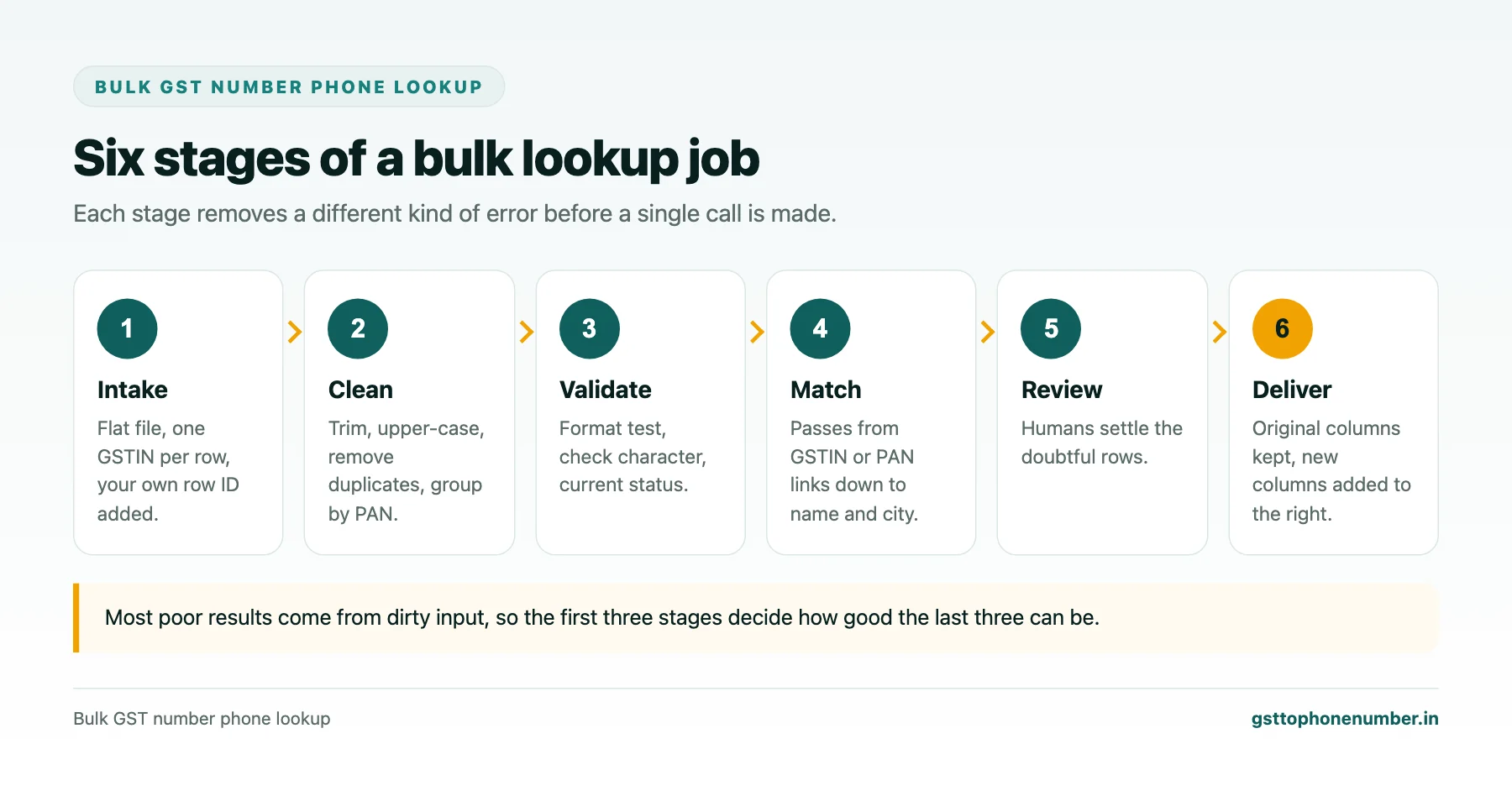
Bulk GST number phone lookup means taking a long list of GST identification numbers, often hundreds or thousands of rows, and attaching a working phone number to as many of them as can be matched with confidence. It sounds like one action, but in practice it is a small production job with distinct stages: receiving the file, cleaning it, validating every GSTIN, running the matching passes, reviewing the doubtful rows and handing back an output that a sales or accounts team can actually use. Each stage removes a different kind of error, and skipping any of them shows up later as wasted calls.
This guide follows a bulk job from the moment a spreadsheet arrives to the moment the finished file is accepted. It is written for the person who owns the list, whether that is a sales operations lead, a procurement analyst or an accounts manager, so that you know what to prepare, what to ask for and how to judge the result.
Quick answer
- A bulk job has six stages: intake, cleaning, GSTIN validation, matching, review and delivery.
- Most failed matches trace back to dirty input, not to the matching itself.
- Remove duplicates by PAN as well as by GSTIN before you count rows.
- Every returned number should carry a match level and a source date.
- Accept the file only after a sample of rows has been called and confirmed.
Stage One: What the Input File Should Look Like
A lookup can only be as good as the list it starts from. The minimum is one column of GSTINs, but a file that also carries the legal or trade name, the city and any phone number you already hold gives the matching process far more to work with. The name column in particular helps resolve rows where the registry record and the business’s public footprint use different spellings.
Keep the file flat: one row per registration, one value per cell, no merged cells, no colour coding that carries meaning, and no notes typed into the GSTIN column. A spreadsheet that has passed through many hands often has trailing spaces, lower-case letters, or numbers that a spreadsheet program has quietly converted into scientific notation. Fix those before the file leaves your desk.
It also helps to add your own row identifier, such as a customer code or ledger ID. When the file comes back you can join the results to your own system on that key rather than on the GSTIN, which protects you if a GSTIN was corrected during cleaning.
Columns worth sending with a bulk lookup
- Your own row ID
- GSTIN
- Legal name
- Trade name
- City or pincode
- Any existing phone number
- Why the row is on the list
Stage Two: Cleaning and De-duplication
Cleaning is unglamorous and decisive. The first pass trims spaces, converts every GSTIN to upper case and strips hidden characters that come from copying out of PDFs or web pages. The second pass removes exact duplicate GSTINs, which are common when a list was assembled from several exports.
The third pass is the one people forget: grouping rows by PAN. Characters three to twelve of every GSTIN are the PAN of the business, so two different GSTINs with the same middle section belong to the same legal entity registered in two states, or holding two registrations in one state. For a calling campaign, those rows usually lead to the same head office and the same decision maker. Decide in advance whether you want one contact per PAN or one per registration, because the answer changes how many rows you are really paying to match.
Stage Three: Validating Every GSTIN Before Matching
A GSTIN has a fixed shape: two digits for the state, ten characters of PAN, an entity character, a default letter and a final check character calculated from the other fourteen. Software can test every row against that pattern and recompute the check character in a fraction of a second. Rows that fail are almost always typing errors, and sending them into matching only produces wrong or empty results.
After the format test, the registration status matters. A list built a year ago will contain registrations that have since been cancelled or suspended. Whether you still want contacts for those businesses depends on the purpose. A collections team chasing old dues may still need them; a sales team generally does not. Mark the status in a column and let the purpose decide.
Need the contact behind a GSTIN?Get the sample format with verified business contact fields.
Stage Four: How the Matching Passes Work
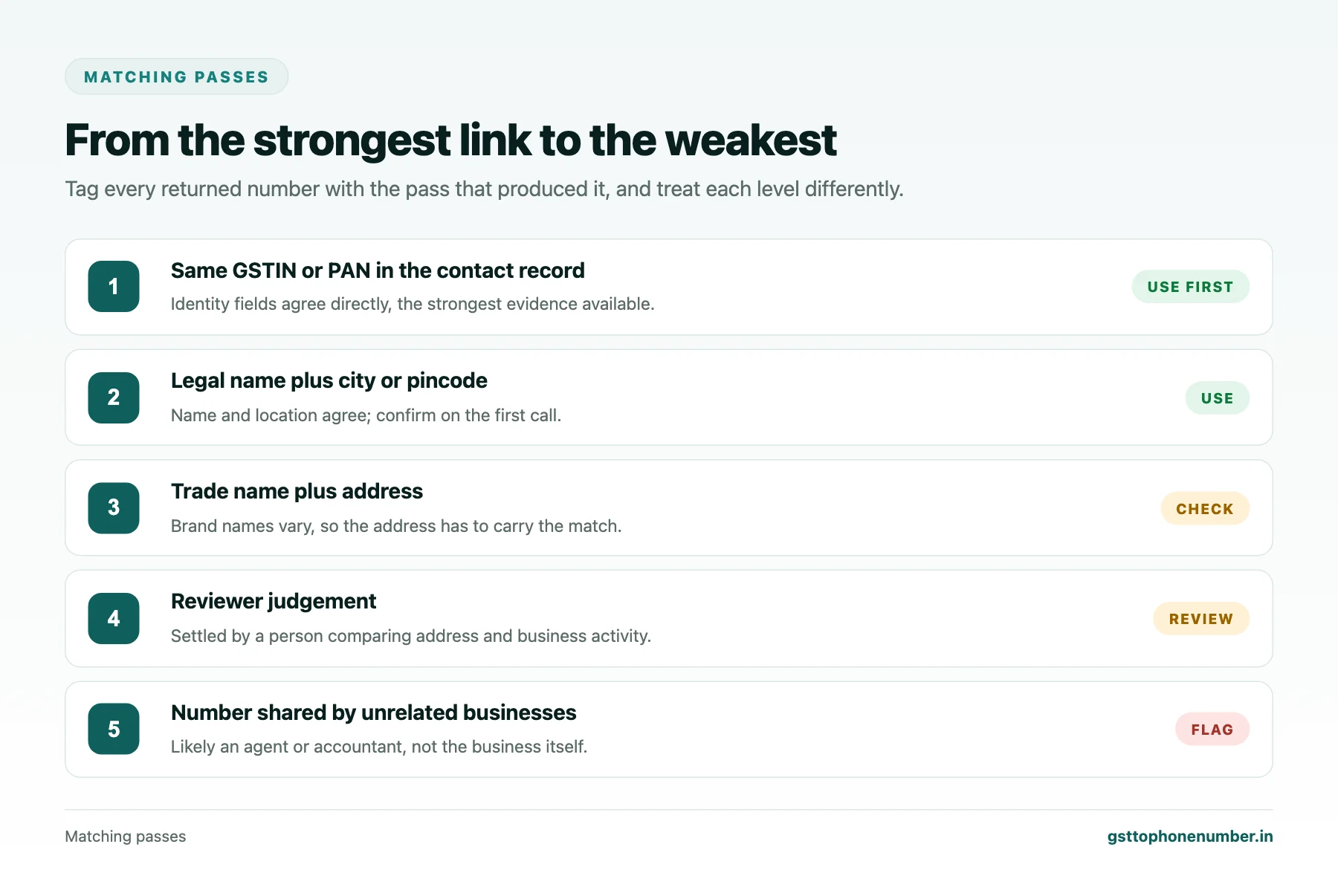
The GST registry itself does not publish phone numbers, so a bulk lookup works by connecting each validated GSTIN to separately compiled business contact records. The connection is made through identity fields that both sides share, and it is done in passes, from the most certain to the least certain.
The first pass looks for records that carry the same GSTIN or the same PAN. These are the strongest links. The second pass looks for the legal name or trade name together with the same city or pincode. The third pass handles harder cases, such as businesses that trade under a brand name quite unlike their legal name, where a human reviewer has to compare addresses and business activity before accepting a number.
Each returned number should be tagged with the pass that produced it. That tag becomes the match level in your output and tells your team how much to trust the row before the first call.
Stage Five: Reviewing the Rows That Need a Human
Every bulk job leaves a band of rows that are neither clearly matched nor clearly unmatched. Typical examples are a proprietorship whose owner runs two shops under different names, a company whose registered office is a professional’s address, or a common trade name that appears in several towns. These rows should go to a review queue rather than being forced into a yes or no.
A reviewer compares the registry address with the address attached to the candidate number, looks at the nature of business, and checks whether the number appears in more than one unrelated record. A number shared by many unrelated businesses is usually an agent, an accountant or a bookkeeping office, which may be useful for some purposes but is not the business itself. Recording that distinction is worth more than adding one more matched row.
Stage Six: What the Output File Should Contain
A good output keeps your original columns untouched and adds new ones to the right. At a minimum you should receive the phone number in a single normalised format, the type of number where it is known, the match level, the date the number was last seen in a source, and a note column for reviewer comments. Rows that could not be matched should stay in the file with an empty phone cell and a reason, not disappear.
Ask for the phone numbers in one consistent format with the country code, so that the file can be loaded into a dialler or customer system without another round of cleaning.
Output columns to insist on
Phone number with country codeNumber typeMatch levelLast seen dateReviewer noteUnmatched reasonPlanning the Size and Timing of a Job
Small lists of a few hundred rows can move through all six stages in a short time, because review is light. Large lists take longer mainly because of the review band, not because of the automated passes. If a deadline is tight, it is reasonable to accept the high-confidence rows first and receive the reviewed rows in a second delivery.
Splitting a very large file by state code can also help. Teams that work a territory at a time can start calling the first region while the next one is still in review, and any problems found in the first region can be fixed before they repeat across the whole list.
Want to see real match quality?See the sample format for your own GST numbers.
Accepting the File: A Simple Call Test
Before the output is loaded into any system, pick a random sample across every match level and have someone call those numbers. The question for each call is simple: did the person who answered confirm that this number belongs to the business named in the row? Record the result as confirmed, wrong business, not reachable or declined to say.
The call test gives you a real accuracy figure for each match level, which is far more useful than any promise made before the job. If one match level performs poorly, you can exclude it from the campaign without throwing away the whole file.
Mistakes That Waste a Bulk Lookup
The most common mistake is sending an uncleaned file and then judging the result by its match rate. A list with many invalid GSTINs will always look poor, no matter how good the matching is. The second is asking for a number on every row. Forcing a match where the evidence is thin is how wrong-party numbers enter a campaign.
The third mistake is losing the metadata. Once the match level and last-seen date are dropped during a copy and paste, nobody can tell a strong row from a weak one, and the first few wrong calls make the whole file look untrustworthy. Keep those columns attached to the number for as long as the number is in use.
The fourth is treating the delivery as the end of the job. Numbers decay as businesses move, change staff or switch lines. Note the delivery date and plan when the list will be checked again.
Using the Numbers Responsibly
Business contact data is collected for business purposes, and the people who answer those numbers are often proprietors using a line that is also personal. Call at sensible hours, say clearly who you are and why you are calling, honour any request not to be called again, and keep the file where only the people who need it can open it. Responsible use protects your reputation and keeps the list useful for longer.
Have a list of GSTINs?Send a few and we will return matching contact fields.
- Stage One: What the Input File Should Look Like
- Stage Two: Cleaning and De-duplication
- Stage Three: Validating Every GSTIN Before Matching
- Stage Four: How the Matching Passes Work
- Stage Five: Reviewing the Rows That Need a Human
- Stage Six: What the Output File Should Contain
- Planning the Size and Timing of a Job
- Accepting the File: A Simple Call Test
- Mistakes That Waste a Bulk Lookup
- Using the Numbers Responsibly
Related guides
Enrich GST Number With Phone Number: a related guide.
Frequently Asked Questions
How long does a bulk GST number phone lookup take?
Automated passes are quick; the time goes into cleaning and reviewing doubtful rows. Small lists finish fast, large ones are often delivered in stages with high-confidence rows first.
Why did my bulk lookup return numbers for only part of the list?
Invalid GSTINs, cancelled registrations, duplicates and businesses with very little public footprint all reduce the matched share. A clean input file is the biggest single improvement you can make.
Should I remove duplicate PANs before a lookup?
Decide first whether you want one contact per legal entity or one per registration. If you only need the head office, grouping by PAN avoids paying to match the same business several times.
What is a match level?
It records which matching pass produced the number, from a direct GSTIN or PAN link down to a reviewer’s judgement. It tells your team how much to trust each row.
How do I check the accuracy of a bulk lookup?
Call a random sample from each match level and record whether the business named in the row confirms the number. Keep the levels that pass and send the rest back for review.
Does the GST registry provide phone numbers in bulk?
No. Public registration records show names, addresses and status but not phone numbers, so bulk lookups depend on separately compiled business contact records matched to each GSTIN.
 GST To Phone Number
We help sales, procurement and compliance teams turn a GST registration number into a verified, reachable business contact.
Company
Get Sample Format
Send us a few GSTINs and we will return the matching contact fields so you can judge the data before you buy.
© 2026 GST To Phone Number. All rights reserved.
Disclaimer: GST To Phone Number is an independent data service. We are not affiliated with, endorsed by or connected to the Goods and Services Tax Network, the Central Board of Indirect Taxes and Customs, or any government department. GSTIN verification should always be confirmed against the official GST portal. Contact data is provided for legitimate business use and must be used in line with applicable telecom, privacy and data-protection rules.