Home/GST Contact Search Guides/Check Business Phone From GST Number When a Caller Claims to Be Someone
Check Business Phone From GST Number When a Caller Claims to Be Someone
Check business phone from GST number when a caller claims to represent a business you know. Use a verified-number register and a call-back rule to stop fakes.
GST Identification Number
27ABCDE1234F1Z0
- Legal nameSample Traders Pvt Ltd
- StateMaharashtra (27)
- RegistrationActive
- Phone+91 98XXX XXXXX
- Emailc****@example.com
Illustrative result. Request a sample format for live records.
Reading time 6 min
Last reviewed October 2026
Check business phone from GST number becomes urgent the moment an unexpected call arrives. The caller says they are from a supplier you buy from every month, or from the accounts team of a customer who owes you money, and they want something: a payment released early, a delivery redirected, a copy of an invoice sent to a new email, or confirmation of your bank details. Their voice is confident, they know the business name and they may even read out its GSTIN. None of that proves they work there.
Phone impersonation works because people trust what they hear and because names, GSTINs and invoice numbers are easy to obtain. This guide explains how to check whether a caller really represents the business they name, using the GST record and a simple call-back rule, and how to build a register of verified numbers so that the check takes seconds instead of minutes.
Quick answer
- Knowing a business’s name, GSTIN or invoice numbers does not prove a caller works there.
- Caller ID can be spoofed, so the number shown on your screen is not proof either.
- Hang up and call back on a number you already hold for that business.
- Keep a register of verified numbers for every regular supplier and customer.
- Never change payment or delivery details on the strength of one inbound call.
Why Callers Are Easy to Fake
The details an impersonator needs are not secret. A business’s name, trade name and GSTIN appear on every invoice it issues and in the public GST record. Invoice numbers and amounts can come from an intercepted email or a careless forward. Names of staff appear on websites, letterheads and professional profiles. Someone who has collected a few of these can sound completely convincing on a short call.
The number displayed on your phone offers little comfort. Caller ID can be manipulated, and calls can come from a new mobile number with a plausible story attached: the regular phone is not working, the person is travelling, the office has moved. Each story is ordinary on its own, which is exactly why it works.
The Call-Back Rule
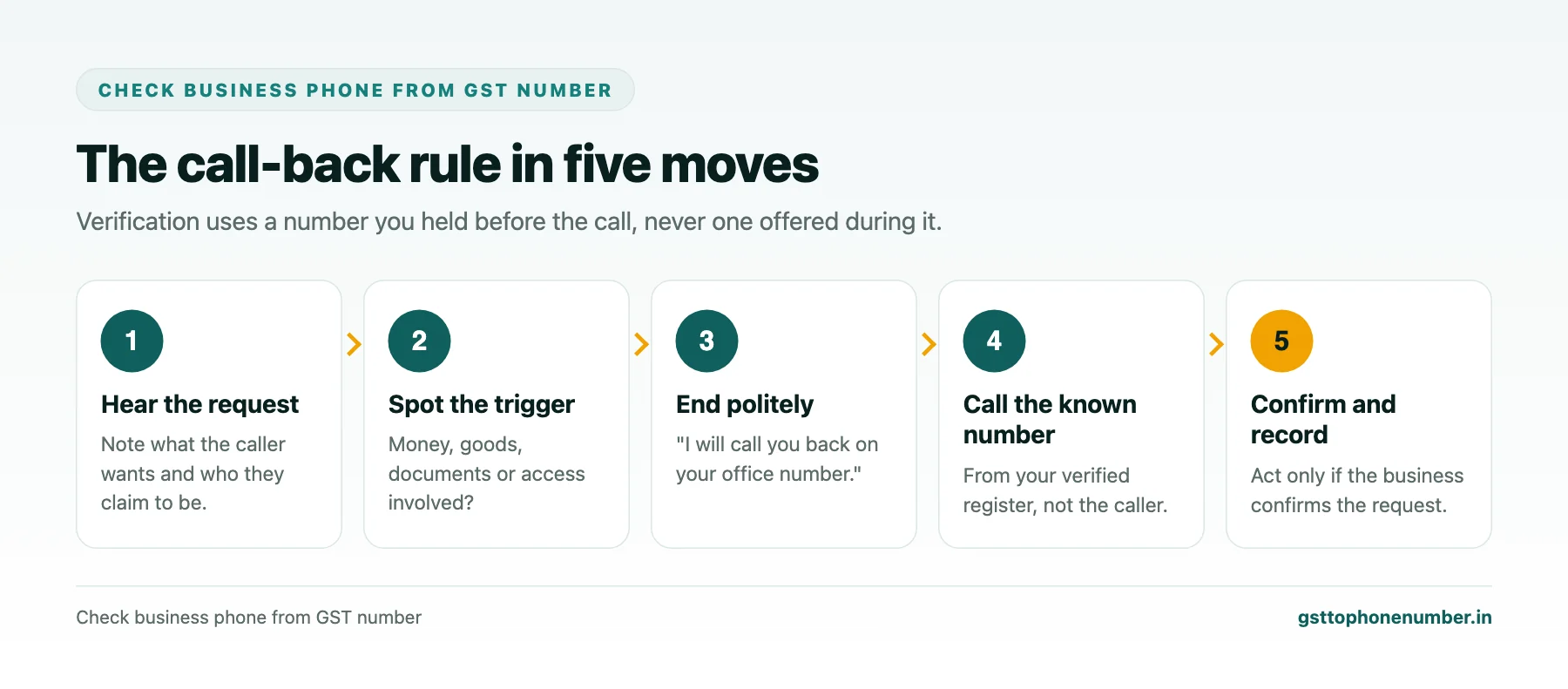
The single most effective defence is a call-back rule. If an inbound caller asks for anything that moves money, goods or sensitive information, end the call politely and call back on a number you already hold for that business, not on any number the caller gives you. If the request is genuine, the person at the known number will confirm it. If it is not, the impersonator has no way to answer a call to the real business’s line.
Make the rule a written policy and apply it to everyone, including callers who sound senior or impatient. When it is policy, staff do not have to judge each caller personally, and genuine callers quickly learn that the business is careful rather than suspicious of them in particular.
Building a Register of Verified Numbers
A call-back rule only works if you have a trusted number to call. Build a register that lists, for each regular supplier and customer, the GSTIN, legal and trade names, the verified office number, the names of the people you normally deal with and their direct numbers, and the date each number was verified. Verification should come from a source independent of any single email or call: a contract, an onboarding form signed by the business, a call made to a number from its official website, or an in-person meeting.
Keep the register where finance, purchase and sales staff can read it, but where only a small group can edit it. A register that anyone can update by email can itself be manipulated by an impersonator who asks for their new number to be added.
What the verified number register should hold
- GSTIN and legal name
- Trade name used on calls
- Verified office number
- Named contacts and direct numbers
- How each number was verified
- Date of verification
- Who may edit the entry
Need the contact behind a GSTIN?Get the sample format with verified business contact fields.
Using the GST Record During a Suspicious Call
The GST record will not give you a phone number, but it gives you facts that a caller may not know or may get wrong. While the caller is talking, you can open the record and ask questions that a genuine employee would answer without hesitation: which city the main office is in, whether the business recently opened a new branch, or which of their locations is sending the goods. Mismatches between the caller’s answers and the record are a reason to end the call and call back.
The record also shows the registration status. A caller representing a business whose registration was recently cancelled or suspended should prompt questions before any payment or credit decision, whatever the reason given for the call.
Requests That Should Always Trigger a Check
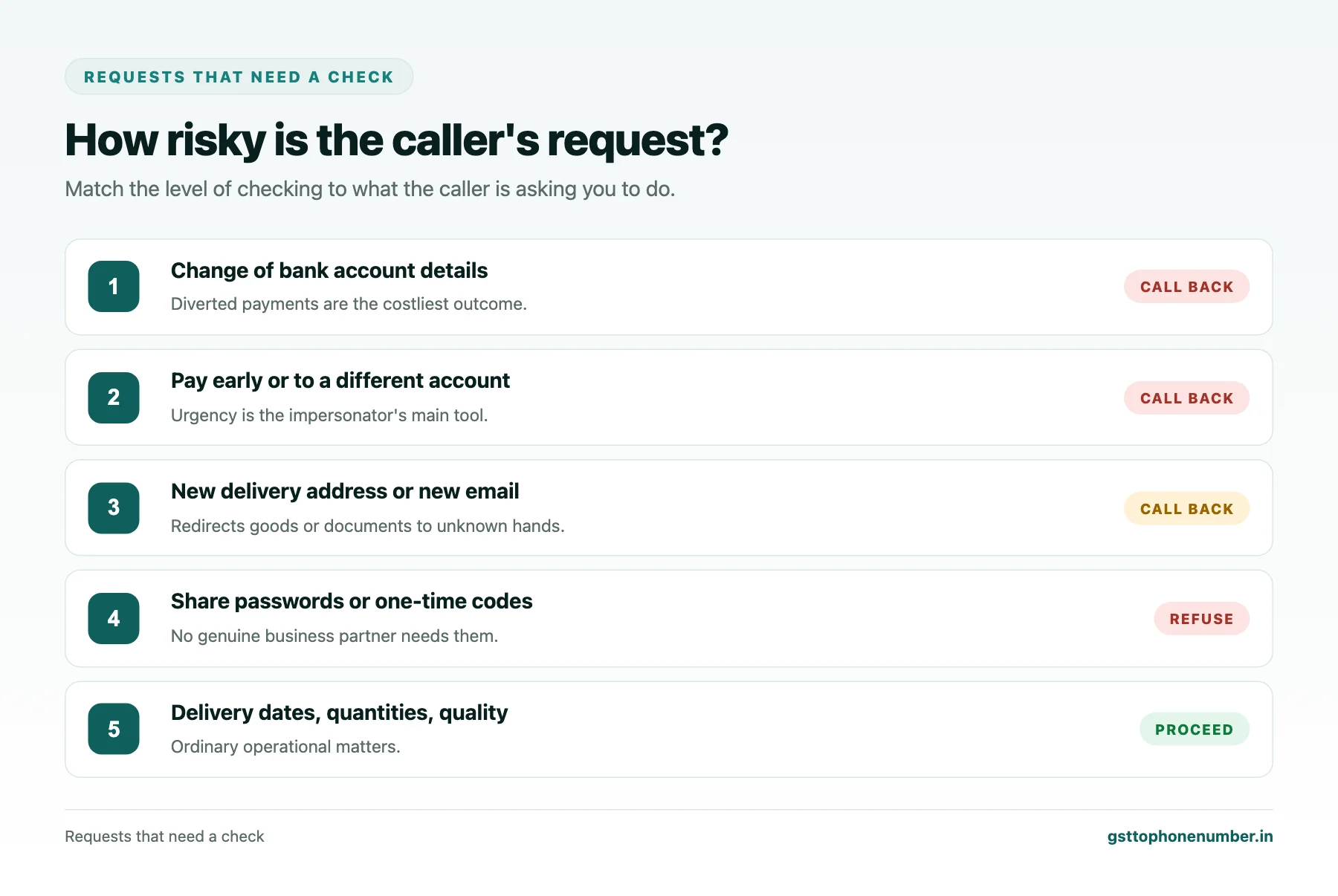
Some requests are so commonly abused that they should always trigger the call-back rule, however routine they sound. These include changes to bank account details, requests to pay an invoice early or to a different account, changes to a delivery address, requests to send documents to a new email address, and requests to share passwords, one-time passwords or portal access.
Train everyone who answers calls to recognise these requests and to respond with the same polite sentence: “Thank you, I will call you back on your office number to confirm.” Genuine callers accept that sentence. Impersonators often push back, which tells you what you need to know.
When the Caller Uses a Mobile Number
Many genuine contacts in small businesses use their personal mobile for work, so a call from a mobile is not suspicious by itself. What matters is whether the mobile is one you have verified before. If a known contact calls from a new mobile, treat the new number as unverified until you have confirmed it through the known office line or the contact’s previously verified number.
Once confirmed, add the new number to the register with the date and the method of confirmation. That way, the next call from the same number can be handled quickly and safely.
Want to see real match quality?See the sample format for your own GST numbers.
Training Staff Without Slowing the Business
The aim is not to make every call an interrogation. Most calls from suppliers and customers are about ordinary matters such as delivery dates, quantities and quality questions, and those need no special check. The call-back rule applies only to requests that move money, goods or sensitive information. Make that distinction clear in training, practise the polite call-back sentence, and review real incidents together so that staff can recognise the patterns.
If You Have Already Acted on a Fake Call
If you realise that money or goods have gone somewhere they should not have, act immediately. Contact your bank to try to stop or recall the payment, inform the genuine business through its verified number, preserve call logs, emails and documents, and report the incident through the national cybercrime reporting channel. Then review how the call got through and tighten the register or the training so it cannot happen the same way again.
Have a list of GSTINs?Send a few and we will return matching contact fields.
Related guides
Check Business Contact From GST Number Before You Trust a New Buyer: a related guide.
Find vendor mobile number by GST number: a related guide.
Check contact number from GST number: a related guide.
Frequently Asked Questions
Can I trust a caller who knows our supplier's GSTIN?
No. GSTINs appear on every invoice and in the public record, so knowing one proves nothing about who the caller works for.
Is the caller ID on my phone reliable?
Not for verification. Caller ID can be manipulated, and fraudsters often use new mobiles with a plausible story.
What is the call-back rule?
For any request involving money, goods or sensitive information, end the call and call back on a number you already held for that business.
What is a verified number register?
A controlled list of each regular partner’s GSTIN, names, verified office number and named contacts, with how and when each number was verified.
What if a known contact calls from a new mobile?
Treat the new number as unverified until you confirm it through the known office line, then add it to the register with the date.
What should I do if I acted on a fake call?
Contact your bank immediately, inform the genuine business via its verified number, keep all records and report through the national cybercrime reporting channel.
 GST To Phone Number
We help sales, procurement and compliance teams turn a GST registration number into a verified, reachable business contact.
Company
Get Sample Format
Send us a few GSTINs and we will return the matching contact fields so you can judge the data before you buy.
© 2026 GST To Phone Number. All rights reserved.
Disclaimer: GST To Phone Number is an independent data service. We are not affiliated with, endorsed by or connected to the Goods and Services Tax Network, the Central Board of Indirect Taxes and Customs, or any government department. GSTIN verification should always be confirmed against the official GST portal. Contact data is provided for legitimate business use and must be used in line with applicable telecom, privacy and data-protection rules.