Home/GST Mobile Number Guides/Enrich GST Number With Mobile Number for an SMS Programme That Stays Compliant
Enrich GST Number With Mobile Number for an SMS Programme That Stays Compliant
Enrich GST number with mobile number for SMS: sort customers from prospects, pick message categories, register headers and templates, and record consent.
GST Identification Number
27ABCDE1234F1Z0
- Legal nameSample Traders Pvt Ltd
- StateMaharashtra (27)
- RegistrationActive
- Phone+91 98XXX XXXXX
- Emailc****@example.com
Illustrative result. Request a sample format for live records.
Reading time 5 min
Last reviewed October 2026
Enrich GST number with mobile number projects are often started with SMS in mind. A distributor wants to send price updates to its retailers, a manufacturer wants to send dispatch alerts to its dealers, a lender wants to remind small business borrowers of due dates, or a software company wants to announce a feature to registered businesses. In each case, the business has GSTINs and wants mobiles beside them so that messages can go out. The enrichment is the easy part; running the SMS programme lawfully is where the real work lies.
India regulates commercial SMS closely. Senders register on the operators’ distributed ledger platforms, use registered sender headers and pre-approved templates, and must respect consent and preference rules that differ by message category. This guide connects the enrichment to that framework: which enriched numbers can receive which kinds of message, how to set up headers and templates, how to record consent, and how to measure whether the programme is working.
Quick answer
- Split enriched numbers into existing relationships and prospects before any message is planned.
- Each message must fit a category: transactional, service or promotional.
- Headers and message templates are registered in advance on the operator platform.
- Explicit consent, recorded with date and method, widens what you may send.
- Track delivery, replies and opt-outs per template, and act on them.
Start by Separating Relationships From Prospects
An enriched list usually mixes two groups. The first is businesses you already deal with: customers, dealers, suppliers and borrowers. Messages to them about an order, a delivery, an invoice or an account are service messages, closely tied to an existing relationship. The second group is prospects who have never dealt with you. Anything you send them about your products is promotional.
Mark every row with this distinction before planning any message. It decides which category applies, which header type you use, whether preference registrations matter and how much consent you need.
The Message Categories
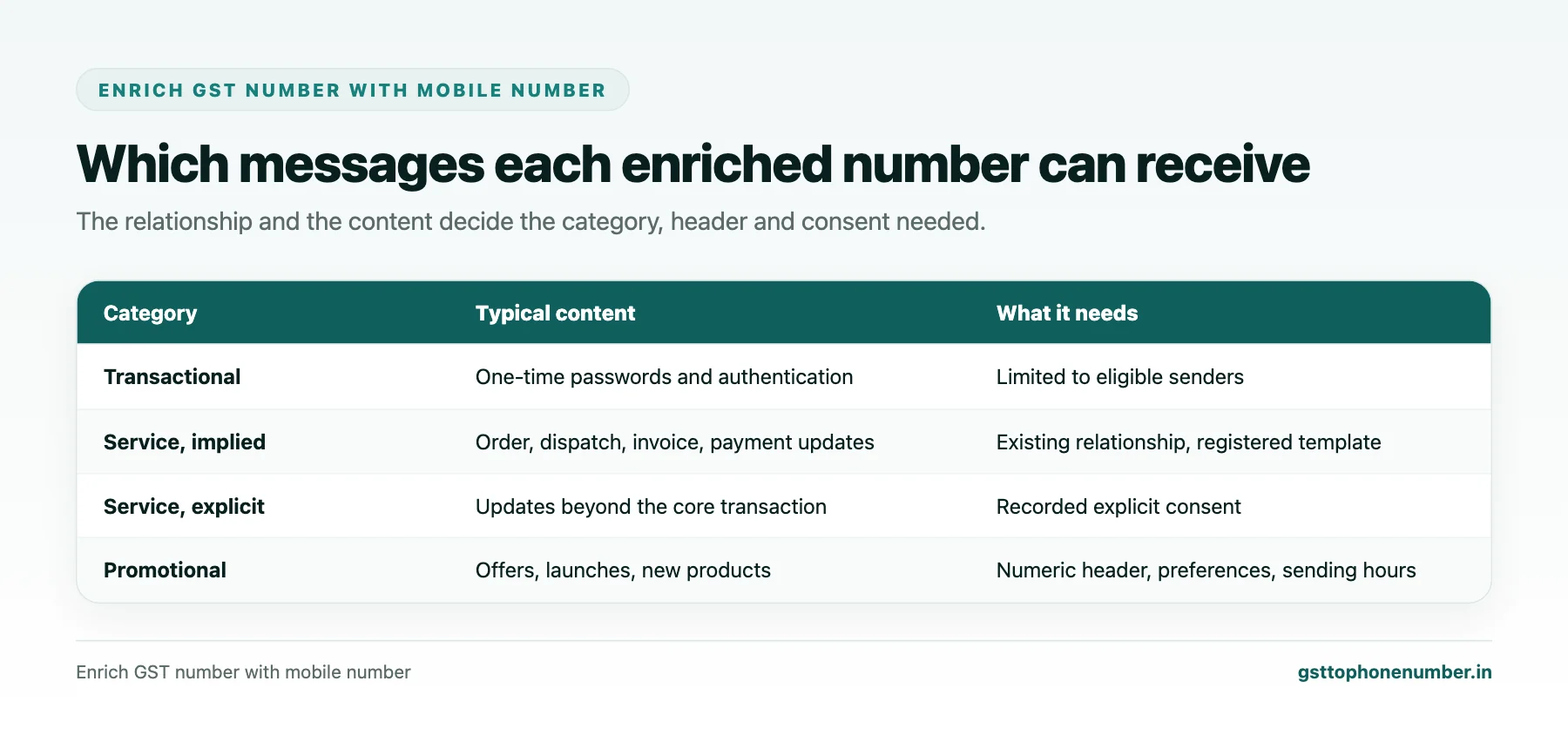
The commercial communication framework recognises broad categories. Transactional messages are tightly limited, typically to one-time passwords and similar authentication messages from banks and certain regulated entities. Service messages relate to a customer’s existing relationship, such as order confirmations, delivery updates, payment reminders and account alerts; some service messages are allowed by implication from the relationship, while others need the customer’s explicit consent. Promotional messages offer products or services and are restricted by the recipient’s preferences and by permitted sending hours.
Your messaging provider will help classify each template, but the business remains responsible for choosing honestly. A promotional offer disguised as a service update is a common reason for templates being rejected or headers being blocked.
Registering as a Sender
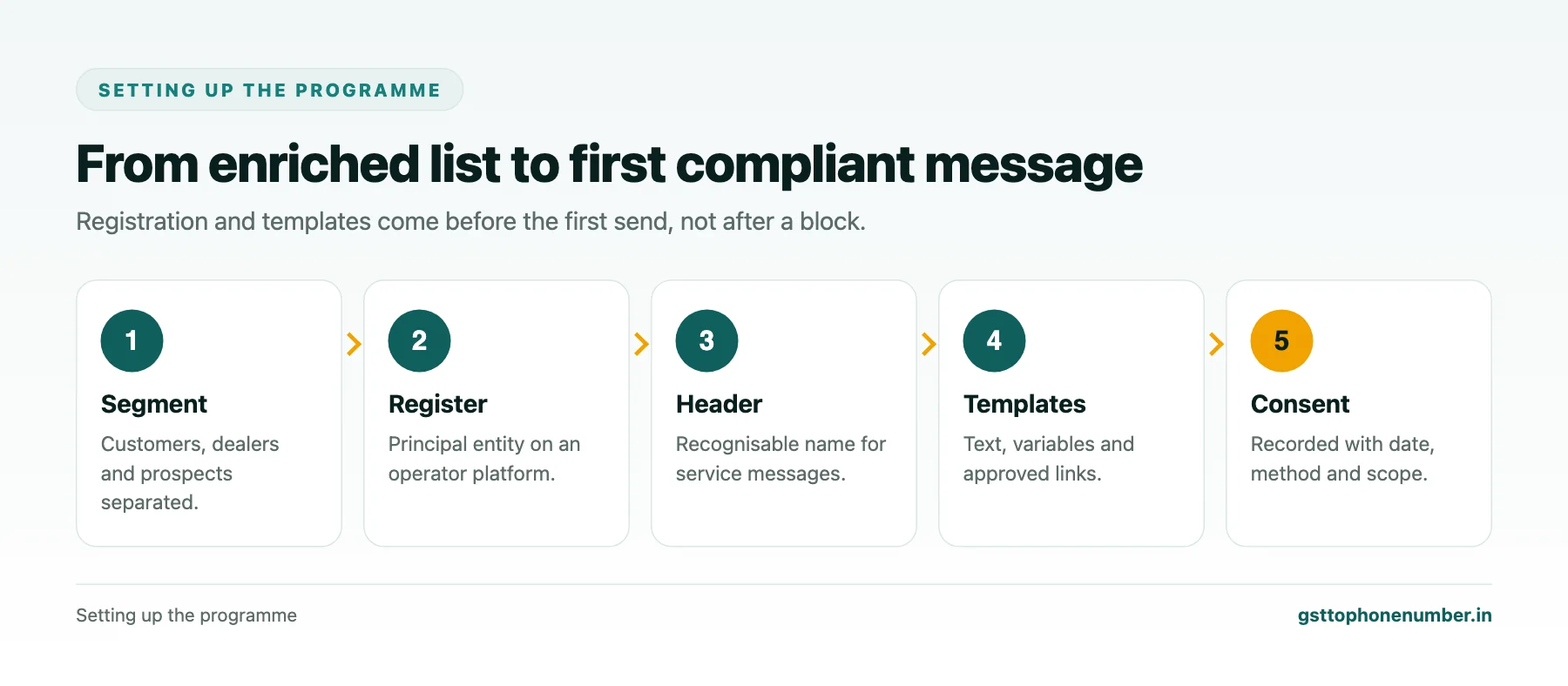
Before any commercial SMS goes out, the business registers as a principal entity on an operator’s distributed ledger platform, providing business identity documents. Registration on one operator’s platform is recognised across operators. Many businesses use their GST registration details as part of this identity verification.
Once registered, the business requests sender headers. Service and transactional messages typically use a short alphabetic header that recipients recognise, such as an abbreviation of the business name. Promotional messages use numeric headers. Choose a service header that clearly identifies your business, because recipients decide in a glance whether to trust a message.
Need the contact behind a GSTIN?Get the sample format with verified business contact fields.
Designing and Registering Templates
Each message pattern is registered as a template, with fixed text and marked variable fields for things like names, order numbers, amounts and dates. Messages that do not match a registered template are blocked. Design templates around the moments that matter in your relationship with businesses: order received, dispatched, delivered, invoice raised, payment due, payment received.
Recent rules also require that any links and callback numbers included in messages be registered in advance, and messages carrying unregistered links can be blocked. Plan the links you will use, such as a payment page or tracking page, and register them with the templates.
Recording Consent Properly
Consent widens what you can send and protects you if a complaint arises. The framework provides for consent to be captured and recorded through the operator platform’s consent mechanisms, and for consent templates to be registered. Outside the platform, your own records should also show when and how each business agreed to receive messages, such as a checkbox on an order form, a signed dealer agreement or a recorded call.
For enriched numbers, assume no consent exists until you obtain it. A mobile number found through enrichment shows how to reach someone, not that they agreed to hear from you.
Sending to the Right Person
Enriched mobiles in small businesses often belong to the owner, but sometimes they reach an accountant, a family member or a shop counter. For service messages such as dispatch alerts, confirm the right recipient during onboarding or the first order, and let each business choose which mobile should receive which kind of message. Payment reminders may belong with the accountant; offers with the owner.
Want to see real match quality?See the sample format for your own GST numbers.
Measuring the Programme
Track delivery rates, replies, clicks on registered links and opt-outs for each template. A template with high opt-outs is annoying recipients, and a header with falling delivery may be at risk. For service messages, measure what matters to the business: fewer calls asking about dispatch, faster payments after reminders, fewer missed deliveries.
Act on opt-outs immediately and permanently, across every header you use. The preference framework treats ignoring them seriously, and so do recipients.
Keeping the Mobile Data Fresh for SMS
SMS failures are an early warning that enriched mobiles are going stale. Undelivered messages over several attempts, replies from people unconnected with the business and opt-outs that say “wrong number” should all trigger a recheck of the mobile against the GSTIN. Removing those numbers quickly keeps delivery rates healthy and spares strangers from messages meant for someone else.
Have a list of GSTINs?Send a few and we will return matching contact fields.
Related guides
Frequently Asked Questions
Can I send SMS to every number after I enrich GST number with mobile number data?
Only within the commercial SMS rules. Service messages to existing customers, promotional messages under preference rules, all through registered headers and templates.
Do I need to register before sending business SMS?
Yes. Senders register as principal entities on an operator distributed ledger platform and register their headers and templates.
What is the difference between service and promotional SMS?
Service messages relate to an existing relationship, such as order or payment updates. Promotional messages offer products or services and face stricter restrictions.
Can I include links in my messages?
Links and callback numbers should be registered in advance with your templates, as messages with unregistered links may be blocked.
Does an enriched mobile number mean the person has consented?
No. It shows how to reach someone, not that they agreed to receive messages. Obtain and record consent separately.
How do I know if my SMS programme is working?
Track delivery, replies, link clicks and opt-outs per template, plus business outcomes such as faster payments or fewer delivery queries.
 GST To Phone Number
We help sales, procurement and compliance teams turn a GST registration number into a verified, reachable business contact.
Company
Get Sample Format
Send us a few GSTINs and we will return the matching contact fields so you can judge the data before you buy.
© 2026 GST To Phone Number. All rights reserved.
Disclaimer: GST To Phone Number is an independent data service. We are not affiliated with, endorsed by or connected to the Goods and Services Tax Network, the Central Board of Indirect Taxes and Customs, or any government department. GSTIN verification should always be confirmed against the official GST portal. Contact data is provided for legitimate business use and must be used in line with applicable telecom, privacy and data-protection rules.