Home/GST Contact Search Guides/Check Business Contact From GST Number Before You Trust a New Buyer
Check Business Contact From GST Number Before You Trust a New Buyer
Check business contact from GST number when a new buyer contacts you first. Spot fake purchase orders, borrowed GSTINs and look-alike emails before you ship.
GST Identification Number
27ABCDE1234F1Z0
- Legal nameSample Traders Pvt Ltd
- StateMaharashtra (27)
- RegistrationActive
- Phone+91 98XXX XXXXX
- Emailc****@example.com
Illustrative result. Request a sample format for live records.
Reading time 6 min
Last reviewed October 2026
Check business contact from GST number is the right instinct when an unfamiliar buyer gets in touch first. A purchase order arrives by email from a business you have never dealt with, quoting a GSTIN, a delivery address and a contact person. The order is large, the terms look normal and the buyer wants to move quickly. Many such enquiries are genuine. Some are not, and the losses from the ones that are not can be severe: goods shipped on credit and never paid for, advance fees paid for a “vendor registration” that does not exist, or samples sent to an address that disappears.
This guide is for sellers, manufacturers and service providers who receive inbound orders. It explains the common patterns behind fake buyers, how to check the contact details against the GST record, and a short routine that separates a real new customer from an impersonator without insulting the genuine ones.
Quick answer
- A valid GSTIN on an order proves a registration exists, not that the sender belongs to it.
- Fake buyers often borrow the GSTIN of a real, well-known business.
- Check the email domain, phone and delivery address against the GST record independently.
- Call back on a number you found yourself, never only on the one in the order.
- Be wary of any request to pay a fee before you receive an order.
How Fake Buyer Schemes Usually Work
The patterns repeat. In one, the scammer impersonates a large company or a government body and sends a convincing purchase order, then asks the seller to pay a vendor registration fee, a tender deposit or a quality certificate charge before the order can be released. The order never comes. In another, the scammer places a genuine-looking order on credit terms, gives a delivery address that is not the buyer’s real premises, takes the goods and vanishes. In a third, a small trial order is paid promptly to build trust, followed by a much larger order on credit that is never paid.
What these schemes share is that the paperwork looks real. The GSTIN quoted is often perfectly valid, because it belongs to a real business that has nothing to do with the order. That is why checking only the GSTIN is not enough.
Step One: Read the GST Record Carefully
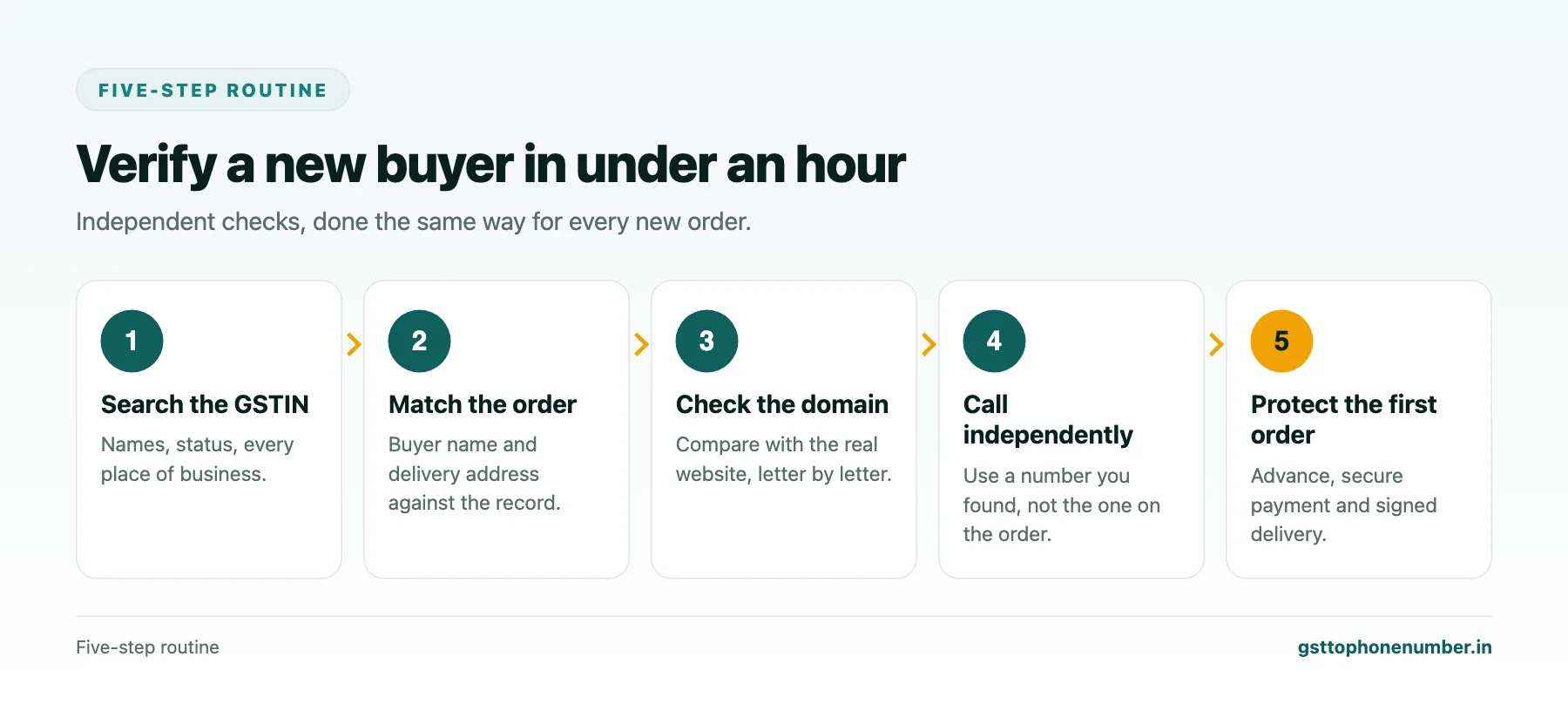
Run a public taxpayer search on the GSTIN in the order and note the legal name, trade name, constitution, status, principal place of business and any additional places of business. Then compare each one with the order. Does the buyer name on the order match the legal or trade name? Is the registration active? Does the delivery address match a place of business in the record, or at least the same city?
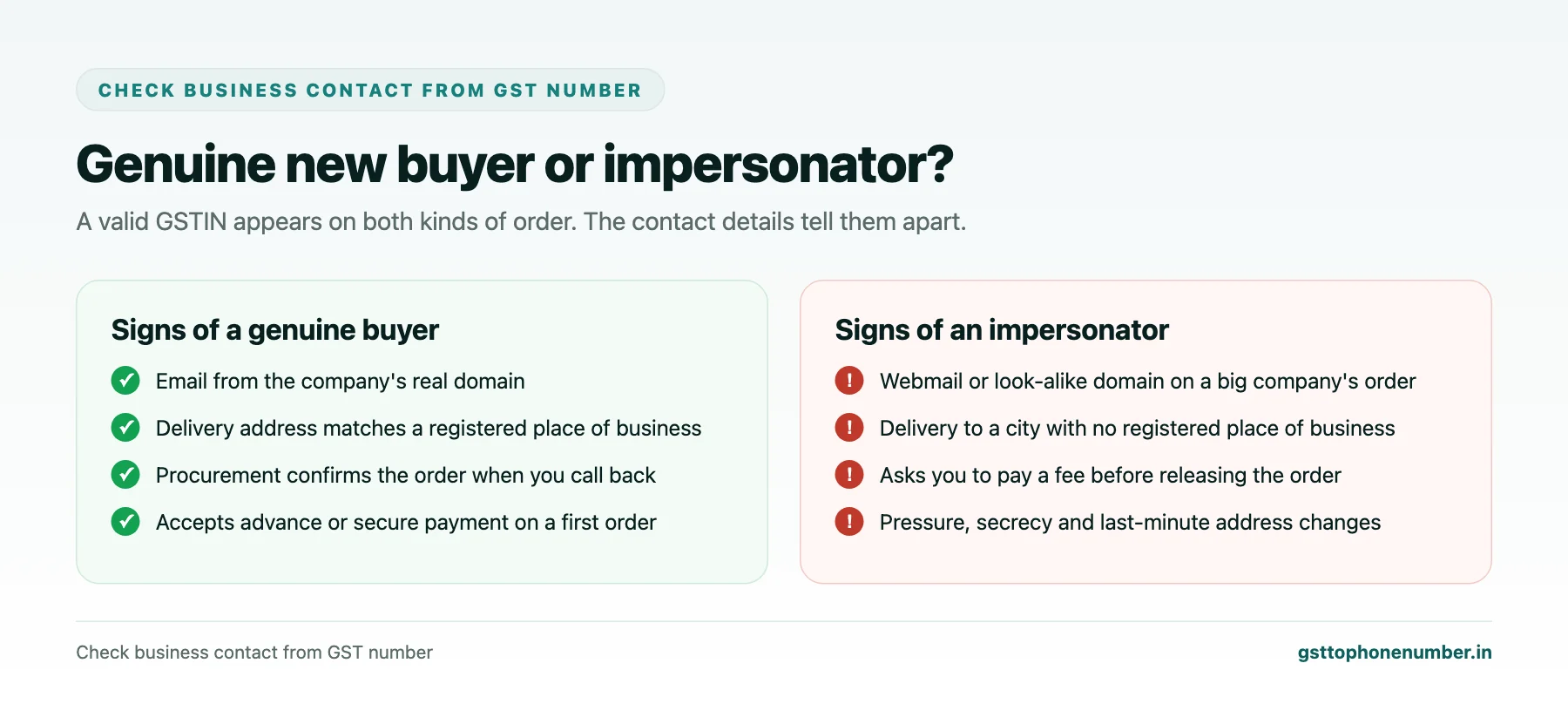
A delivery address in a different city from every place of business listed is a significant warning sign. Genuine businesses do sometimes ask for delivery to a project site or a warehouse they have not yet registered, but they can explain it, and the explanation can be checked.
Step Two: Check the Email Address
Look at the domain of the email address that sent the order. Established companies usually email from their own domain. A purchase order from a large company sent from a generic webmail account, or from a domain that differs from the company’s real one by a letter or a hyphen, deserves suspicion. Look-alike domains are a favourite tool because they pass a quick glance.
Find the company’s real website independently, by searching its name rather than clicking any link in the email, and compare the domain character by character. If the company lists its GSTIN on its website, compare that too.
Need the contact behind a GSTIN?Get the sample format with verified business contact fields.
Step Three: Call Back on a Number You Found Yourself
The phone number printed on the order belongs to whoever wrote the order. If that is a scammer, calling it only confirms the scam’s own story. Instead, find the business’s contact independently: from its official website, from a reliable directory listing whose address matches the GST record, or from a business contact data source matched to the GSTIN. Call that number, ask for the purchase or procurement department, and ask whether the order and the named contact person are genuine.
Genuine buyers rarely mind this call. Many large organisations expect it and will confirm the order and the buyer’s name readily. If the business says it has never heard of the order or the person, you have your answer.
Step Four: Look at the Terms and the Pressure
Fraudulent orders often carry pressure: a deadline that leaves no time for checks, a request to keep the matter confidential, or a sudden change in the delivery address after the order is accepted. Any request to pay money before you are paid, whether called a registration fee, an earnest money deposit for a private order, or a certification charge, should stop the process until it has been verified through an independent contact.
Large buyers and public bodies have formal vendor registration processes, but legitimate ones do not ask suppliers to transfer fees to personal or unrelated bank accounts on the strength of an email.
Step Five: Protect Yourself on the First Order
Even after the checks pass, the first order with a new buyer deserves some protection. Ask for an advance or a part payment, use a letter of credit or a secure payment arrangement for large values, ship to an address that matches the GST record, and get a signed delivery acknowledgement from a named person at the buyer’s premises. These steps are standard business practice and genuine buyers expect them.
Record the contact details you verified, the date of the check and the person who confirmed the order. That record helps your team on the next order and serves as evidence should a dispute arise.
Want to see real match quality?See the sample format for your own GST numbers.
Treating Genuine New Buyers Well
Most new buyers are exactly who they say they are, and a verification routine should not feel like an accusation. Explain that you confirm all new orders with the buyer’s office as a matter of policy, keep the call short and polite, and thank them for their patience. A buyer who appreciates careful suppliers is likely to be a good customer.
If You Suspect Fraud
If the checks show the order is fake, do not reply to the sender with accusations or share your findings with them. Inform the business whose name and GSTIN were misused, using the contact details you found independently, so that it can warn others. Keep copies of the emails, order documents and any payment requests, and report the attempt through the national cybercrime reporting channel or your local police. If money has already been sent, contact your bank immediately, since speed improves the chance of stopping the transfer.
Have a list of GSTINs?Send a few and we will return matching contact fields.
- How Fake Buyer Schemes Usually Work
- Step One: Read the GST Record Carefully
- Step Two: Check the Email Address
- Step Three: Call Back on a Number You Found Yourself
- Step Four: Look at the Terms and the Pressure
- Step Five: Protect Yourself on the First Order
- Treating Genuine New Buyers Well
- If You Suspect Fraud
Related guides
Check business phone from GST number: a related guide.
Check company contact from GST number: a related guide.
Find vendor mobile number by GST number: a related guide.
Check company phone from GST number: a related guide.
Frequently Asked Questions
Is a valid GSTIN on a purchase order enough to trust the buyer?
No. Scammers often quote the GSTIN of a real business. Check the email domain, delivery address and a phone number you find independently.
Why should I not call the number printed on the order?
If the order is fake, that number belongs to the scammer and will confirm their story. Call a number you found yourself through an independent source.
What is a fake vendor registration fee scam?
A fraudster posing as a large buyer asks you to pay a registration, deposit or certificate fee before an order is released, and the order never arrives.
What if the delivery address differs from the GST address?
Ask for an explanation and verify it. A delivery city with no registered place of business is a common sign of a fake order.
How can I protect the first order with a new buyer?
Ask for an advance or secure payment, ship to a verified address and get a signed delivery acknowledgement from a named person.
Where do I report a fake purchase order?
Inform the business that was impersonated, keep all evidence and report through the national cybercrime reporting channel or local police. Contact your bank at once if money was sent.
 GST To Phone Number
We help sales, procurement and compliance teams turn a GST registration number into a verified, reachable business contact.
Company
Get Sample Format
Send us a few GSTINs and we will return the matching contact fields so you can judge the data before you buy.
© 2026 GST To Phone Number. All rights reserved.
Disclaimer: GST To Phone Number is an independent data service. We are not affiliated with, endorsed by or connected to the Goods and Services Tax Network, the Central Board of Indirect Taxes and Customs, or any government department. GSTIN verification should always be confirmed against the official GST portal. Contact data is provided for legitimate business use and must be used in line with applicable telecom, privacy and data-protection rules.