Home/Bulk GST Contact Data Guides/Bulk GSTN Contact Data: Designing a File That Stays Usable
Bulk GSTN Contact Data: Designing a File That Stays Usable
Bulk GSTN contact data file design: the columns to keep, one phone format, several numbers per GSTIN, PAN groups and source dates that keep a list usable.
GST Identification Number
27ABCDE1234F1Z0
- Legal nameSample Traders Pvt Ltd
- StateMaharashtra (27)
- RegistrationActive
- Phone+91 98XXX XXXXX
- Emailc****@example.com
Illustrative result. Request a sample format for live records.
Reading time 6 min
Last reviewed October 2026
Bulk GSTN contact data is only as useful as the file it lives in. Two teams can buy the same contacts and get very different results, simply because one receives a clean, well-structured file that loads straight into its systems, and the other receives a spreadsheet where phone numbers are typed five different ways, several contacts share one cell, and nobody can tell when a number was last checked. The difference is file design, and it is decided before a single row is filled in.
This guide sets out a practical structure for a bulk file that links GST registrations to contact details. It explains which columns to keep, how to store phone numbers and emails consistently, how to handle businesses with several numbers or several registrations, and which bookkeeping columns stop the file from rotting. It suits anyone who commissions, receives or maintains such a file.
Quick answer
- Keep identity, contact and bookkeeping columns clearly separate.
- Store every phone number in one format with the country code.
- Give each contact its own row, linked back to the GSTIN.
- Group registrations that share a PAN so one business is not treated as many.
- Every contact needs a source and a last-confirmed date.
Why File Design Matters More Than Volume
People often judge a contact file by how many rows it has. In daily use, what matters is whether each row can be trusted and acted on quickly. A smaller file with consistent formats, clear match levels and dates will outperform a much larger one where every number needs to be checked by hand before it can be used.
Good design also makes the file cheaper to maintain. When numbers are stored consistently, duplicates can be found by a simple sort. When each contact has a date, stale rows can be filtered out. When identity and contact fields are separated, a corrected phone number does not overwrite the GST data it is linked to.
The Identity Block
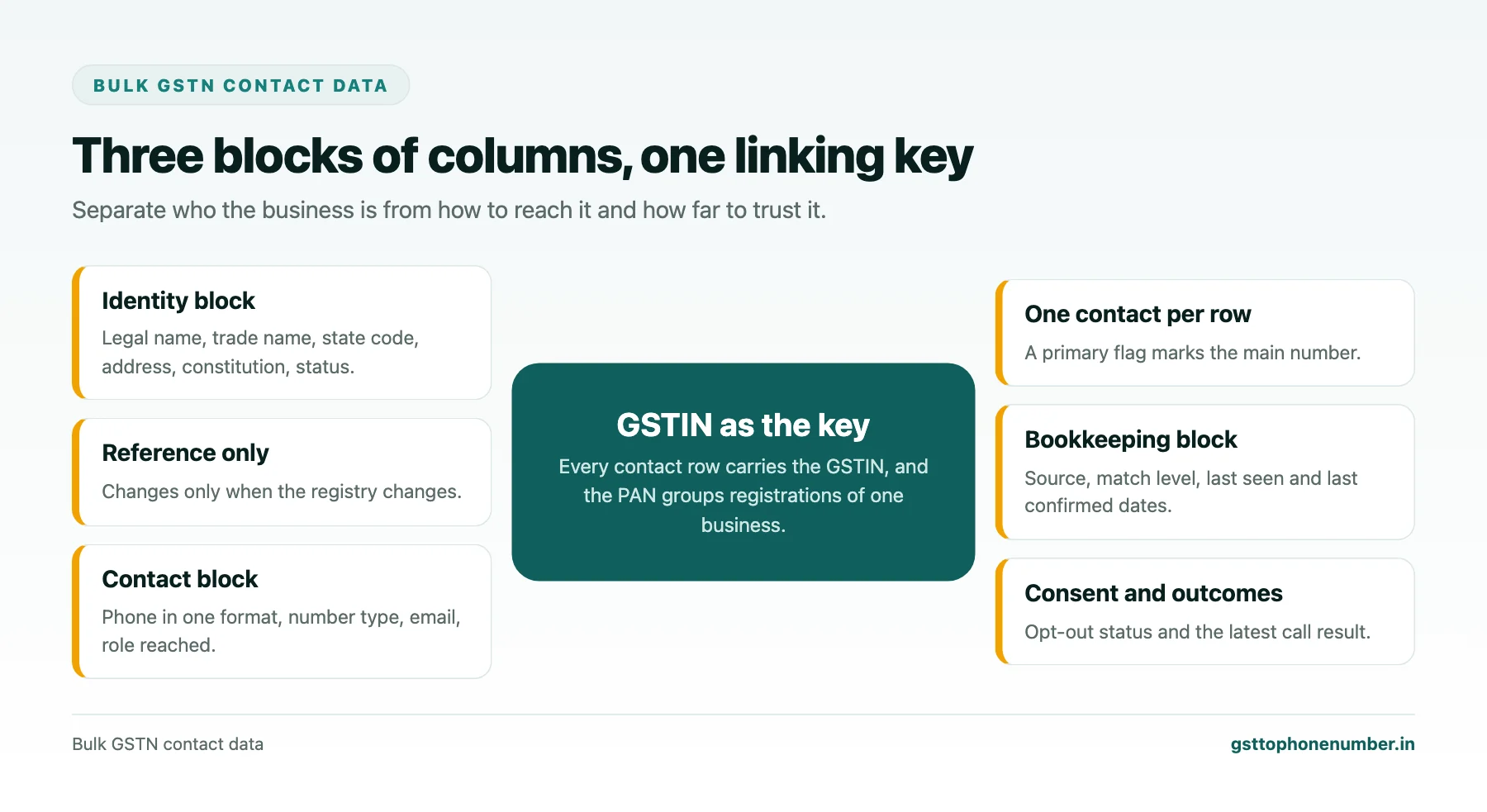
The first group of columns describes who the business is, as recorded in the GST registry. It includes the GSTIN, the PAN derived from characters three to twelve, the legal name, the trade name, the state code, the principal address with pincode, the constitution of business and the registration status with the date it was checked.
These columns should be treated as reference data. They come from the registry and should only change when the registry changes. Keep them in their own block so that a caller editing a phone number never accidentally edits a legal name.
The Contact Block
The second group holds the reachable details: phone number, number type, email address, the person or role the contact reaches, and any website. Each of these should be stored in a single consistent format so the file can be loaded into a dialler, a customer system or an email tool without another round of cleaning.
For phone numbers, choose one format and enforce it on every row. A common choice is the country code followed by the number without spaces, which works for both mobiles and landlines. Emails should be lower case with surrounding spaces removed. A separate column should state whether the number is a mobile, a landline or a board line, because the type decides which channels can be used.
Need the contact behind a GSTIN?Get the sample format with verified business contact fields.
One Row Per Contact, Not One Cell Per Business
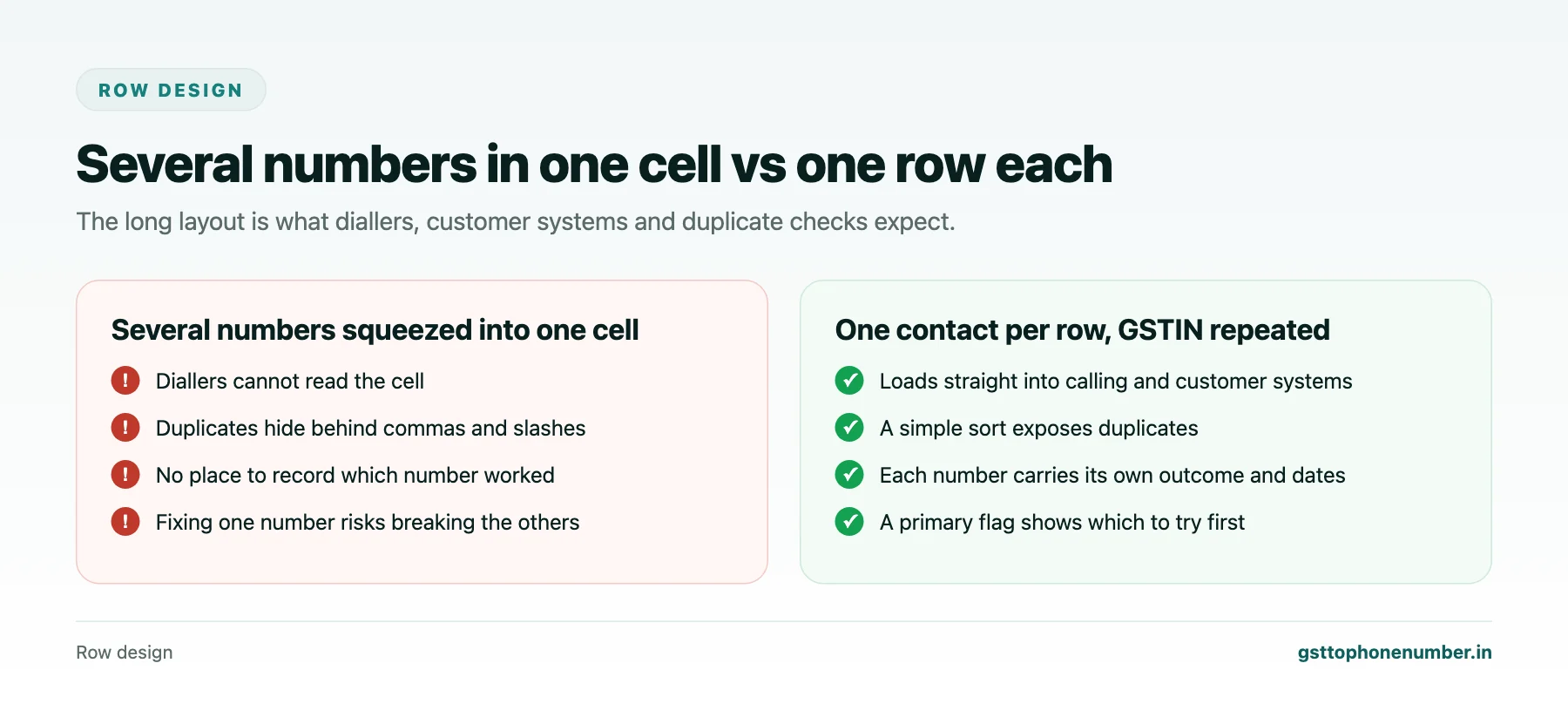
A common mistake is squeezing several numbers into one cell, separated by commas or slashes. It looks tidy but breaks everything downstream: diallers cannot read it, duplicates cannot be found, and there is nowhere to record which number worked.
The better structure is a long file, where each contact gets its own row carrying the GSTIN it belongs to. A business with a landline, an owner’s mobile and an accounts email therefore has three rows. A column marks which one is primary. When a caller confirms or rejects a number, the result is recorded on that exact row, and the other contacts for the same business are unaffected.
Handling One PAN With Many GSTINs
GST registrations are issued per state, and one business can hold several. A manufacturer with plants in three states will have three GSTINs that share the same PAN in characters three to twelve. In a contact file, those are not three separate prospects; they are one business with three locations.
Add a column for the PAN and another that marks the head office or primary registration where it is known. Teams can then choose whether to work the file by business, contacting only the head office, or by location, contacting each branch about local matters such as deliveries or state-specific invoices. Without the PAN column, the same company may receive three separate sales calls in one afternoon.
The Bookkeeping Columns
The columns that keep a file healthy are the ones most often left out. Every contact row should say where the contact came from, how strongly it was matched to the GSTIN, when it was last seen in a source and when it was last confirmed by a call or a reply. A column for consent or opt-out status is essential if the file is used for messaging.
These fields make the file self-explaining. A new team member can open it and immediately see which rows are reliable, which need checking and which must not be contacted.
Bookkeeping columns for every contact row
- Source of the contact
- Match level to the GSTIN
- Last seen date
- Last confirmed date
- Last outcome
- Consent or opt-out status
- Row owner or team
Want to see real match quality?See the sample format for your own GST numbers.
Naming, Versions and Change Logs
Bulk files tend to multiply: final, final-2, cleaned, cleaned-new. Agree on a single master file or table, and treat everything else as a dated extract taken from it. Record the date of each extract in its name and never edit an extract and send it back as if it were the master.
When contacts are corrected after calls, record the change with the date and the reason rather than simply overwriting the old value. This history explains why a number disappeared and stops it from being added back later by someone working from an older copy.
Storage, Access and Retention
A bulk contact file combines business identity with phone numbers and emails, and some of those belong to individuals. Store it where access can be controlled and reviewed, not in personal drives or chat groups. Give edit rights only to the people who maintain it, and read rights only to those who need to use it.
Decide how long contacts will be kept after they stop being useful, and delete them on schedule. A smaller file of current, relevant contacts is safer and more effective than an ever-growing archive nobody trusts.
Checking a File You Have Just Received
When a provider or a colleague hands you a bulk GSTN contact data file, check its structure before its content. Are identity and contact fields separate? Is every phone number in one format? Is there one contact per row? Are source, match level and dates present? A file that fails these checks will cost more time to fix than it saves, and it is worth sending back with clear instructions before anyone starts calling.
Have a list of GSTINs?Send a few and we will return matching contact fields.
Related guides
Frequently Asked Questions
What columns should bulk GSTN contact data include?
An identity block from the GST record, a contact block with phone, type, email and role, and bookkeeping columns for source, match level, last seen date, last confirmed date and consent status.
What is the best way to store phone numbers in a bulk file?
Use one format on every row, typically the country code followed by the number without spaces, plus a separate column for the number type.
Should several numbers for one business go in one cell?
No. Give each contact its own row carrying the GSTIN, and mark which one is primary. That keeps duplicates visible and outcomes traceable.
How do I handle a company with GSTINs in several states?
Add a PAN column, since characters three to twelve of each GSTIN are the PAN, and mark the head office so you can work by business or by location.
Why do source and date columns matter?
They tell users which contacts are reliable and current, and they let stale rows be filtered out or rechecked.
How long should bulk contact data be kept?
Only as long as it serves the purpose it was obtained for. Set a retention rule and delete contacts that are no longer needed.
 GST To Phone Number
We help sales, procurement and compliance teams turn a GST registration number into a verified, reachable business contact.
Company
Get Sample Format
Send us a few GSTINs and we will return the matching contact fields so you can judge the data before you buy.
© 2026 GST To Phone Number. All rights reserved.
Disclaimer: GST To Phone Number is an independent data service. We are not affiliated with, endorsed by or connected to the Goods and Services Tax Network, the Central Board of Indirect Taxes and Customs, or any government department. GSTIN verification should always be confirmed against the official GST portal. Contact data is provided for legitimate business use and must be used in line with applicable telecom, privacy and data-protection rules.