Home/Bulk GST Contact Data Guides/Bulk GSTIN Contact Lookup: What You Are Really Paying For
Bulk GSTIN Contact Lookup: What You Are Really Paying For
Bulk GSTIN contact lookup costs explained: per-row vs per-match pricing, cost per usable contact, hidden rework and the contract terms worth asking about.
GST Identification Number
27ABCDE1234F1Z0
- Legal nameSample Traders Pvt Ltd
- StateMaharashtra (27)
- RegistrationActive
- Phone+91 98XXX XXXXX
- Emailc****@example.com
Illustrative result. Get sample format for live records.
Reading time 8 min
Last reviewed October 2026
Bulk GSTIN contact lookup is often bought the way stationery is bought: someone collects two or three quotes, compares the price per row and picks the lowest. That approach almost always costs more in the end, because the price per row says nothing about how many rows will produce a contact your team can actually use. The real unit of value is the usable contact, meaning a phone number or email that reaches the right business and can be acted on lawfully.
This guide explains the common pricing models, shows how to work out the cost per usable contact from a quote, lists the hidden costs that never appear on an invoice, and suggests the questions and contract terms that protect a buyer. It is meant for anyone signing off on a contact lookup budget, whether for a sales campaign, a vendor clean-up or a collections drive.
Quick answer
- Price per submitted row and price per usable contact are very different numbers.
- Per-match pricing shifts some risk to the provider, but only if “match” is defined tightly.
- Rework, wrong-party calls and re-cleaning are real costs even though nobody invoices them.
- A paid pilot on your own data is the cheapest way to compare providers.
- Write match definitions, delivery format and replacement terms into the agreement.
The Three Common Pricing Models
Providers of business contact data generally charge in one of three ways. Each one places the risk of a poor result in a different place, and that matters more than the headline rate.
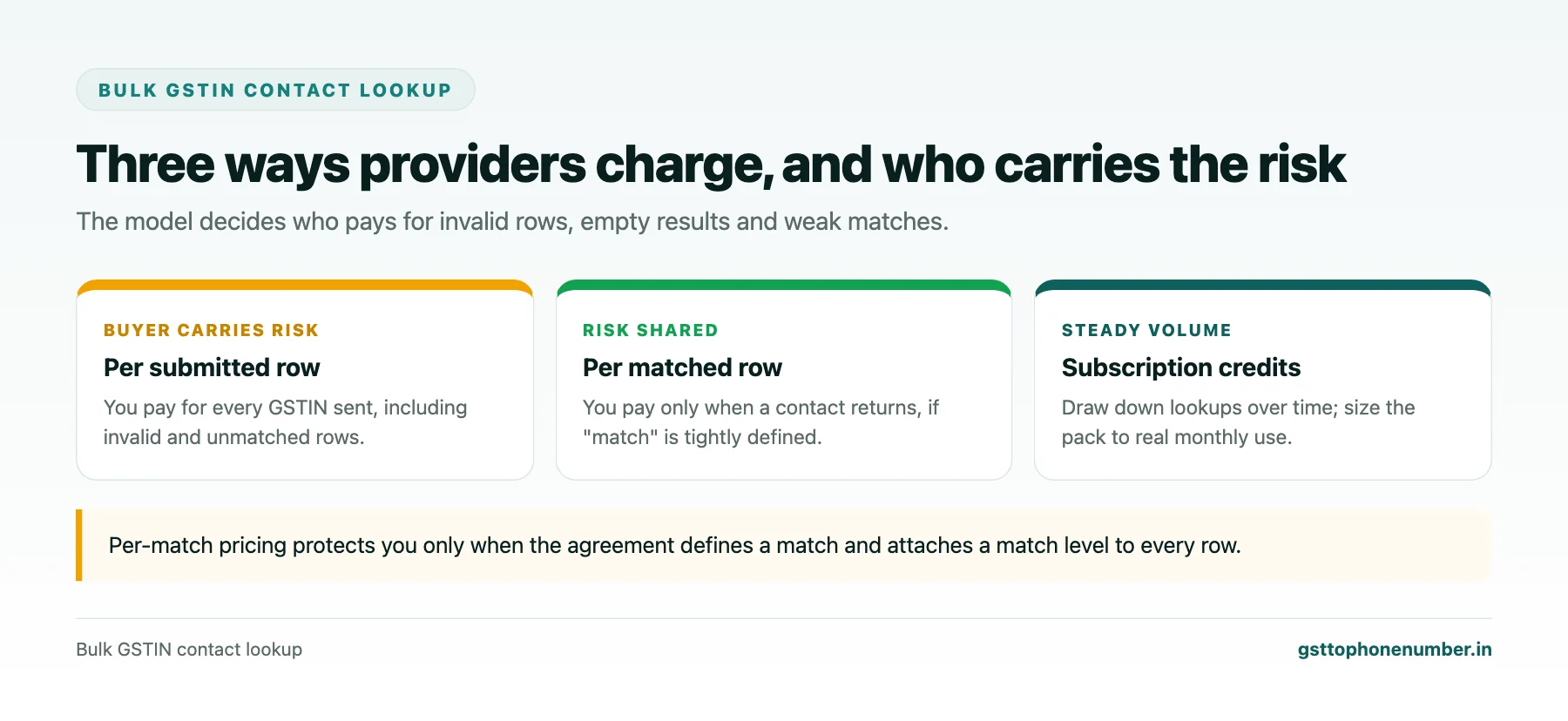
Per submitted row means you pay for every GSTIN you send, whether or not a contact comes back. It is simple to budget, but the provider has little reason to care about your match rate, and you carry the cost of every invalid or unmatched row.
Per matched row means you pay only for rows where a contact is returned. This sounds safer, and it can be, but everything depends on how a match is defined. If any number at all counts as a match, including weak ones found through a trade name in another city, you can end up paying for rows that would never survive a phone call.
Subscription or credit packs let you draw down lookups over a period. They suit teams that look up GSTINs steadily rather than in one big batch, such as an accounts team checking new vendors every week. The trap is unused credits that expire, so match the pack size to your real monthly volume.
Working Out the Cost Per Usable Contact
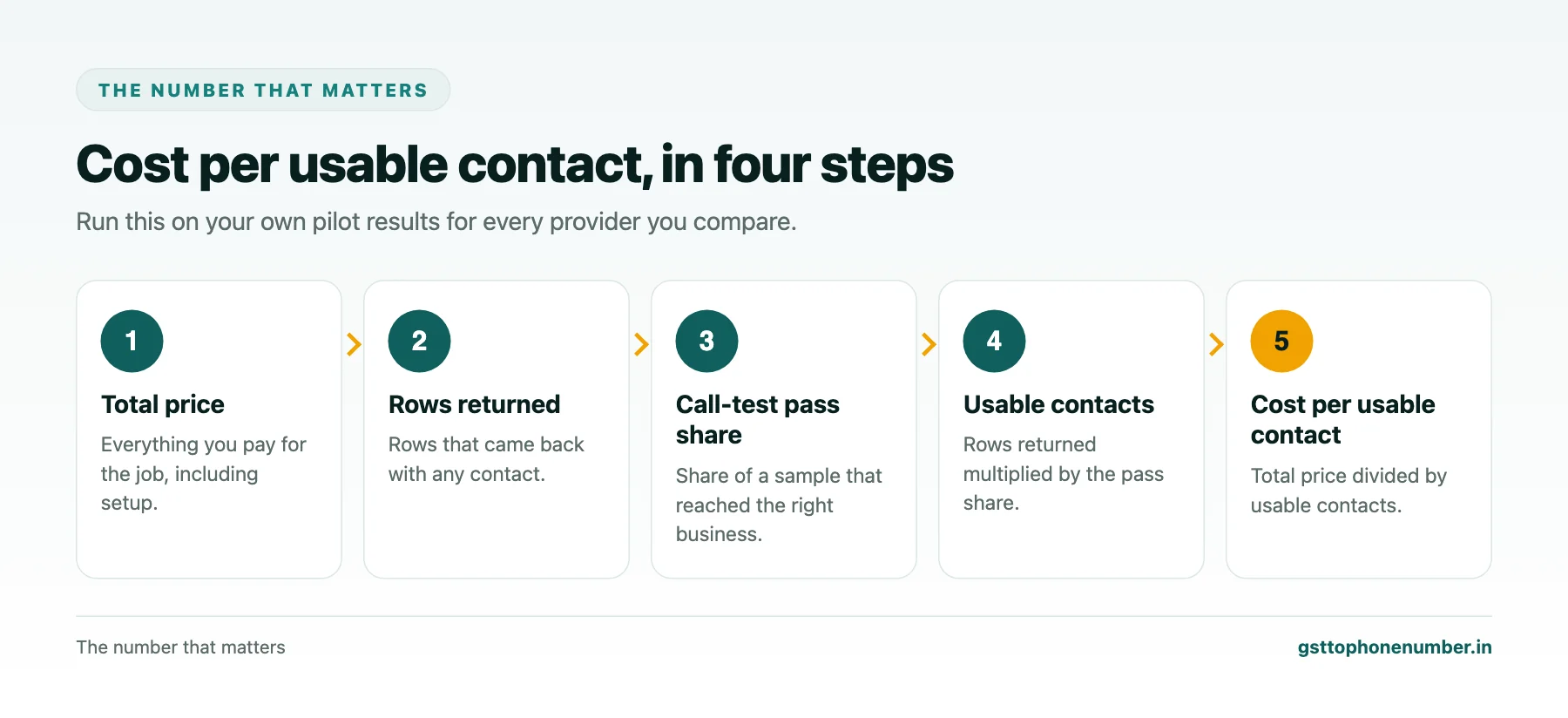
The number that matters is what you pay for each contact your team can actually use. You can estimate it before buying, and you should measure it after.
Start with the total price of the job. Divide it by the number of rows that come back with a contact. Then reduce that count by the share that fail a call test, because a number that reaches the wrong business is not a usable contact. The result is your cost per usable contact.
Here is a simple illustration with round numbers. Suppose two quotes are on the table for the same list. Quote A charges less per row but returns contacts for a smaller share of the list, and a call test shows that a noticeable share of its numbers reach the wrong business. Quote B charges more per row, returns contacts for a larger share, and almost all of them reach the right business. Once you divide each total price by the confirmed contacts it produces, Quote B frequently works out cheaper per usable contact, even though its headline rate is higher. The exact result depends on your list, which is why the comparison has to be run on your own data.
The Costs That Never Appear on the Invoice
The invoice shows what you paid the provider. It does not show what the result cost your organisation. Several of these hidden costs are larger than the lookup itself.
Caller time is the biggest. Every wrong-party number costs a caller several minutes: the dial, the confused conversation, the note and the move to the next row. Across a large campaign, a few percentage points of wrong numbers add up to days of salaried time.
Re-cleaning is the second. If the output arrives in a messy format, with numbers in different shapes or several numbers crammed into one cell, someone on your side spends hours fixing it before it can be loaded into a dialler or customer system.
Reputation is the third and hardest to measure. A proprietor who receives repeated calls meant for someone else, or calls after asking not to be contacted, remembers the name of the company that called. That memory can cost a deal later.
Need the contact behind a GSTIN?Get the sample format with verified business contact fields.
Questions to Ask Every Provider
Before you compare prices, make sure you are comparing the same thing. These questions bring out the differences that quotes tend to hide.
Ask how a match is defined and whether each returned contact carries a match level. Ask how old the contact data is and whether a last-seen date comes with every number. Ask what happens to invalid or cancelled GSTINs in your list, and whether you pay for them. Ask what format the output will arrive in and whether your original columns are preserved. Ask whether there is a replacement or credit arrangement for numbers that turn out to be wrong. And ask how the data was collected and on what basis it can be used for your purpose.
Questions for a bulk GSTIN contact lookup provider
- How is a match defined?
- Does every contact carry a match level?
- How old is the data, and is a date supplied?
- Do invalid GSTINs cost anything?
- What is the output format?
- Are wrong numbers replaced or credited?
- How was the data collected?
Why a Paid Pilot Beats a Sample Promise
Many providers will show you a polished sample. A sample chosen by the seller tells you very little, because it was chosen to look good. A small paid pilot on a random slice of your own list tells you almost everything: match share, match quality, output format, turnaround and how the provider handles questions.
Choose the pilot rows at random from the full list rather than picking easy ones, and run the same slice through every provider you are considering. Then call a sample of the results from each and record confirmed, wrong business and not reachable. The comparison that comes out of this exercise is far more reliable than any brochure.
Contract Terms That Protect the Buyer
Once you have chosen a provider, put the important points in writing. The agreement should state how a match is defined, which fields will be delivered and in what format, the expected turnaround, and what happens if a measured share of numbers turn out to be wrong. It should also cover how the data may be used, how long you may keep it, and whether you may share it with partners such as a calling agency.
If you plan to repeat the lookup every few months, agree in advance how previously delivered contacts will be refreshed and whether refreshed rows are charged again. Repeat buyers can often negotiate better terms on refreshes than on first-time lookups.
Want to see real match quality?See the sample format for your own GST numbers.
Budgeting for the Whole Year, Not One Batch
Contact data decays as businesses move, change staff and switch numbers. A budget that pays for one large lookup and nothing else will leave the team with a stale list within months. Plan a smaller recurring amount for refreshing the rows you actually use, and for looking up new GSTINs as they enter your systems.
Spreading spend this way usually costs less than repeating a full bulk lookup every year, and the list stays useful the whole time instead of slowly going out of date.
When Not to Buy a Bulk Lookup at All
Sometimes the right answer is to spend nothing. If your list is short, if the businesses are existing customers whose contacts sit in old invoices and emails, or if the purpose is a one-off verification, an internal search may be faster and cheaper. Bulk lookups earn their cost when lists are long, contacts are genuinely missing, and the outcome of each call has real value to the business.
Have a list of GSTINs?Send a few and we will return matching contact fields.
- The Three Common Pricing Models
- Working Out the Cost Per Usable Contact
- The Costs That Never Appear on the Invoice
- Questions to Ask Every Provider
- Why a Paid Pilot Beats a Sample Promise
- Contract Terms That Protect the Buyer
- Budgeting for the Whole Year, Not One Batch
- When Not to Buy a Bulk Lookup at All
Related guides
Enrich GSTIN With Mobile Number, Then Prove It Worked: a related guide.
Frequently Asked Questions
How is a bulk GSTIN contact lookup usually priced?
Most providers charge per submitted row, per matched row, or through subscription credits. Each model puts the risk of poor results in a different place.
What is cost per usable contact?
It is the total price divided by the number of returned contacts that actually reach the right business, measured with a call test on a sample.
Is per-match pricing always better?
Only when a match is clearly defined and each contact carries a match level. Loose definitions let weak numbers count as matches.
Should I pay for invalid GSTINs in my list?
Ask the provider before you send the file. Cleaning and validating the list yourself first avoids paying for rows that can never match.
How big should a pilot be?
Large enough that a call test on its results gives a fair picture, drawn at random from your full list, and identical for every provider being compared.
What contract terms matter most?
The definition of a match, the delivery format, turnaround, replacement for wrong numbers, permitted use and how long the data may be kept.
 GST To Phone Number
We help sales, procurement and compliance teams turn a GST registration number into a verified, reachable business contact.
Company
Get Sample Format
Send us a few GSTINs and we will return the matching contact fields so you can judge the data before you buy.
© 2026 GST To Phone Number. All rights reserved.
Disclaimer: GST To Phone Number is an independent data service. We are not affiliated with, endorsed by or connected to the Goods and Services Tax Network, the Central Board of Indirect Taxes and Customs, or any government department. GSTIN verification should always be confirmed against the official GST portal. Contact data is provided for legitimate business use and must be used in line with applicable telecom, privacy and data-protection rules.