Home/GST Phone Lookup Guides/Enrich GST Number With Phone Number: Inside the Matching Logic
Enrich GST Number With Phone Number: Inside the Matching Logic
Enrich GST number with phone number, explained: how names are cleaned, addresses compared and evidence scored so each match carries an honest confidence level.
GST Identification Number
27ABCDE1234F1Z0
- Legal nameSample Traders Pvt Ltd
- StateMaharashtra (27)
- RegistrationActive
- Phone+91 98XXX XXXXX
- Emailc****@example.com
Illustrative result. Request a sample format for live records.
Reading time 5 min
Last reviewed October 2026
Enrich GST number with phone number services all promise matches, but very few explain how a match is decided. Underneath, the process is a comparison between two kinds of record: the GST registration, which describes who a business is and where it is registered, and a contact record, which describes how some business can be reached. The art lies in deciding when those two records describe the same business. Done carelessly, enrichment attaches confident-looking numbers to the wrong businesses. Done well, it attaches numbers only where the evidence supports it and says honestly how strong that evidence is.
This guide opens up the matching logic. It explains the identity keys used, how names and addresses are cleaned before comparison, how evidence is combined into a confidence score, which false matches are most common, and how you can use this understanding to judge any enrichment you buy or build.
Quick answer
- Matching compares GST identity fields with fields in contact records.
- Names must be cleaned of titles, legal suffixes and punctuation before comparison.
- Addresses compare best on pincode and locality, not full street text.
- Evidence is scored, and the score decides whether a match is accepted.
- Common trade names and shared addresses cause most false matches.
The Two Records Being Compared
The GST side provides the GSTIN, the PAN inside it, the legal name, the trade name, the constitution, the principal and additional places of business with pincodes and the declared activities. The contact side, compiled from business sources, provides a business name as published, an address, perhaps a website, and one or more phone numbers.
Some contact records also carry a GSTIN or PAN, because businesses often print them on websites and listings. When they do, matching is straightforward. Most of the time they do not, and the match has to be built from names and addresses.
Cleaning Names Before Comparison
Raw names rarely match exactly. The same business may appear as “M/s Shree Ganesh Traders”, “Shri Ganesh Trading Co.” and “SHREE GANESH TRADERS (PROP. R. SHAH)”. Cleaning removes the noise: titles such as M/s, legal suffixes such as Private Limited, Pvt Ltd, LLP and Co., proprietor notes in brackets, punctuation and extra spaces. It also standardises common spelling variants, such as Shree and Shri, and expands or contracts frequent abbreviations consistently.
After cleaning, names are compared token by token. “shree ganesh traders” and “shri ganesh trading” share two strong tokens and one near-match, which is evidence of similarity but not proof, because many unrelated businesses share such common names.
Comparing Addresses
Full address text is messy, with building names, landmarks and spelling variations. Matching works better on structured parts: the pincode, the locality or market name, and the city. Two records with the same pincode and the same locality are far more likely to describe the same business than two with similar street text in different pincodes.
Additional places of business in the GST record matter here. A contact record at a branch address can still be a correct match for the GSTIN if that branch is registered. Ignoring additional places loses good matches; treating any address in the same city as a match creates bad ones.
Need the contact behind a GSTIN?Get the sample format with verified business contact fields.
Scoring the Evidence
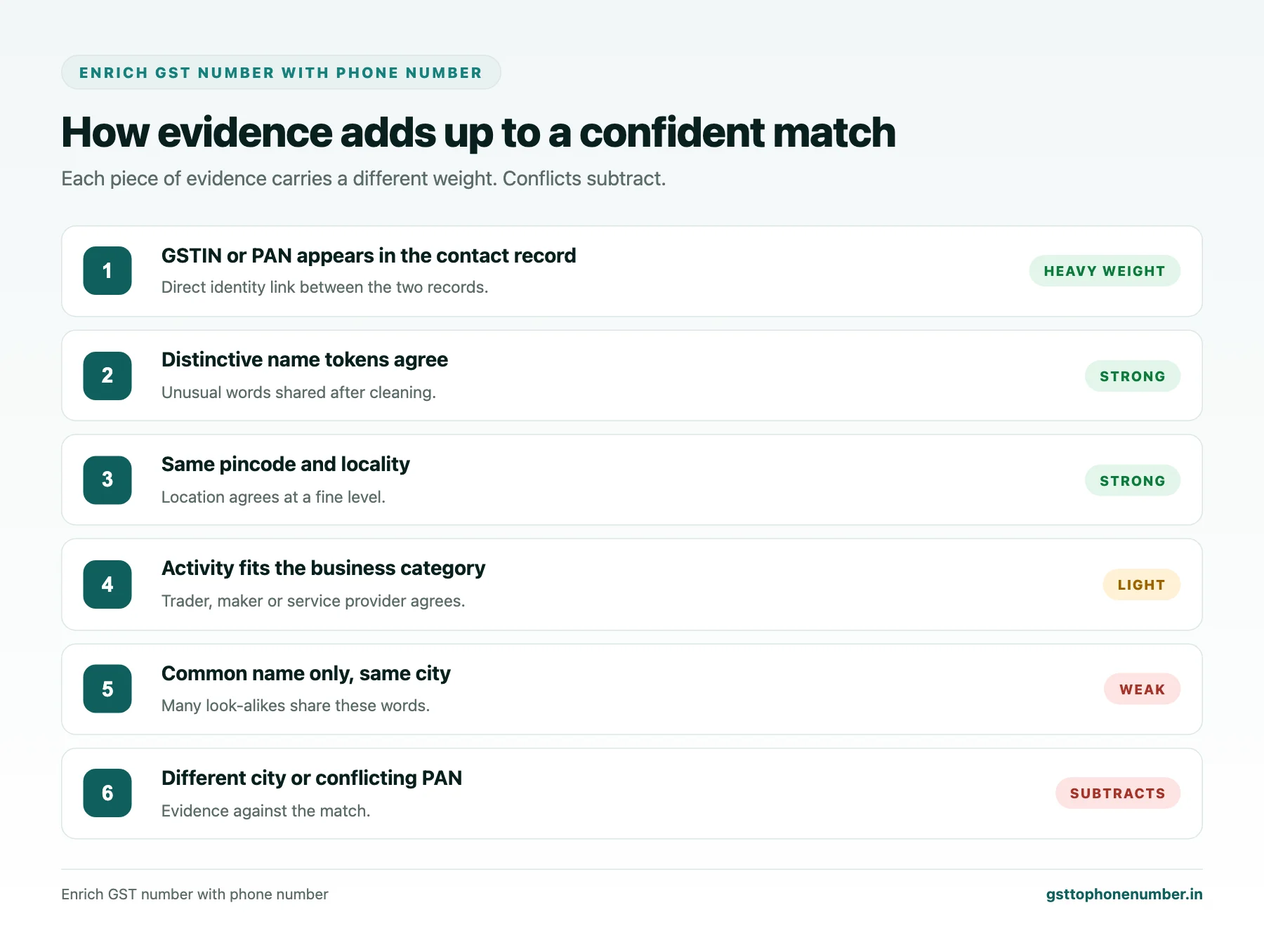
Good matching combines evidence into a score rather than applying a single rule. A GSTIN or PAN present in the contact record counts heavily. A distinctive name match counts strongly; a common name match counts weakly. Same pincode adds weight, same locality adds more. Agreement between the declared activity and the contact record’s business category adds a little. Conflicting evidence, such as a different city, subtracts.
The total decides the outcome. High scores are accepted automatically, middle scores go to human review, and low scores are rejected. The thresholds are set by testing on rows where the right answer is already known, so that the error rate at each level is measured rather than guessed.
The False Matches to Watch For
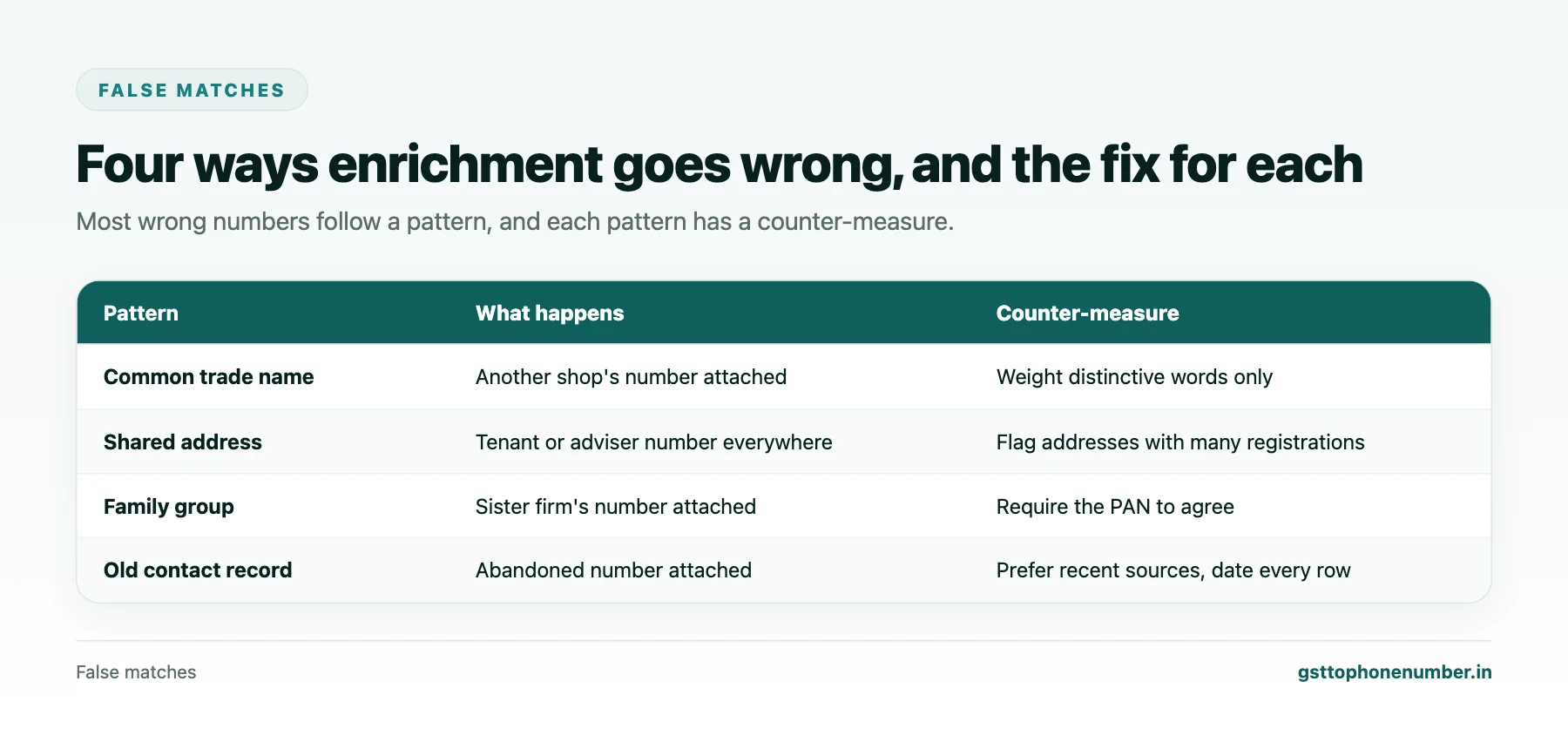
Most wrong enrichments fall into a few patterns. Common trade names in the same city attach one business’s number to another. Shared addresses, such as business centres or a professional’s office, attach the number of a tenant or of the professional to every business registered there. Related businesses in a family group, with similar names and the same building, get each other’s numbers. And outdated contact records attach a number that the business gave up years ago.
Each pattern has a counter. Distinctive-token weighting handles common names. Flagging addresses with many registrations handles shared offices. Checking PAN differences separates related businesses. Recency rules handle old records.
Why Confidence Levels Matter to You
The output of good matching is not just a phone number but a number with a confidence level. That level is the most useful thing an enrichment can give you, because it lets you decide how to use each row. High-confidence numbers can go straight into calling queues. Medium ones can be used with a confirming question at the start of the call. Low ones should be held back or reviewed.
If an enrichment service cannot tell you how confident each match is, you have no way to separate its good rows from its guesses, and you will discover the difference only through wrong calls.
Want to see real match quality?See the sample format for your own GST numbers.
Judging an Enrichment You Receive
Ask how matches were decided and whether each row has a confidence level. Look at a sample of high- and low-confidence rows yourself: do the names and addresses really correspond? Call a few of each. If high-confidence rows are reliably right and low-confidence rows are noticeably weaker, the scoring is working. If there is no difference, the confidence levels are decoration.
Building Your Own Matching
Teams with their own contact sources can apply the same logic in a spreadsheet or a small script: clean names, extract pincodes, score evidence and review the middle band by hand. Start with your own customers, where the right answer is known, to set thresholds. Even a simple version of this process is far better than matching on names alone.
Have a list of GSTINs?Send a few and we will return matching contact fields.
Related guides
Frequently Asked Questions
How does a service enrich GST number with phone number data?
It compares GST identity fields such as names, PAN and address with business contact records, scores the evidence and accepts matches above a tested threshold.
Why must names be cleaned before matching?
Titles, legal suffixes, brackets and spelling variants make the same business look different. Cleaning lets the real name tokens be compared.
Why compare pincodes rather than full addresses?
Full address text varies widely in spelling and format. Pincode and locality are structured and far more reliable for comparison.
What causes most wrong enrichments?
Common trade names, shared office addresses, related family businesses and outdated contact records.
What is a confidence level?
A measure of how strong the evidence for each match is, which lets you decide whether to use, confirm or hold back each number.
How can I test an enrichment's confidence levels?
Call samples from high and low levels. High-confidence rows should be reliably right and clearly better than low-confidence ones.
 GST To Phone Number
We help sales, procurement and compliance teams turn a GST registration number into a verified, reachable business contact.
Company
Get Sample Format
Send us a few GSTINs and we will return the matching contact fields so you can judge the data before you buy.
© 2026 GST To Phone Number. All rights reserved.
Disclaimer: GST To Phone Number is an independent data service. We are not affiliated with, endorsed by or connected to the Goods and Services Tax Network, the Central Board of Indirect Taxes and Customs, or any government department. GSTIN verification should always be confirmed against the official GST portal. Contact data is provided for legitimate business use and must be used in line with applicable telecom, privacy and data-protection rules.